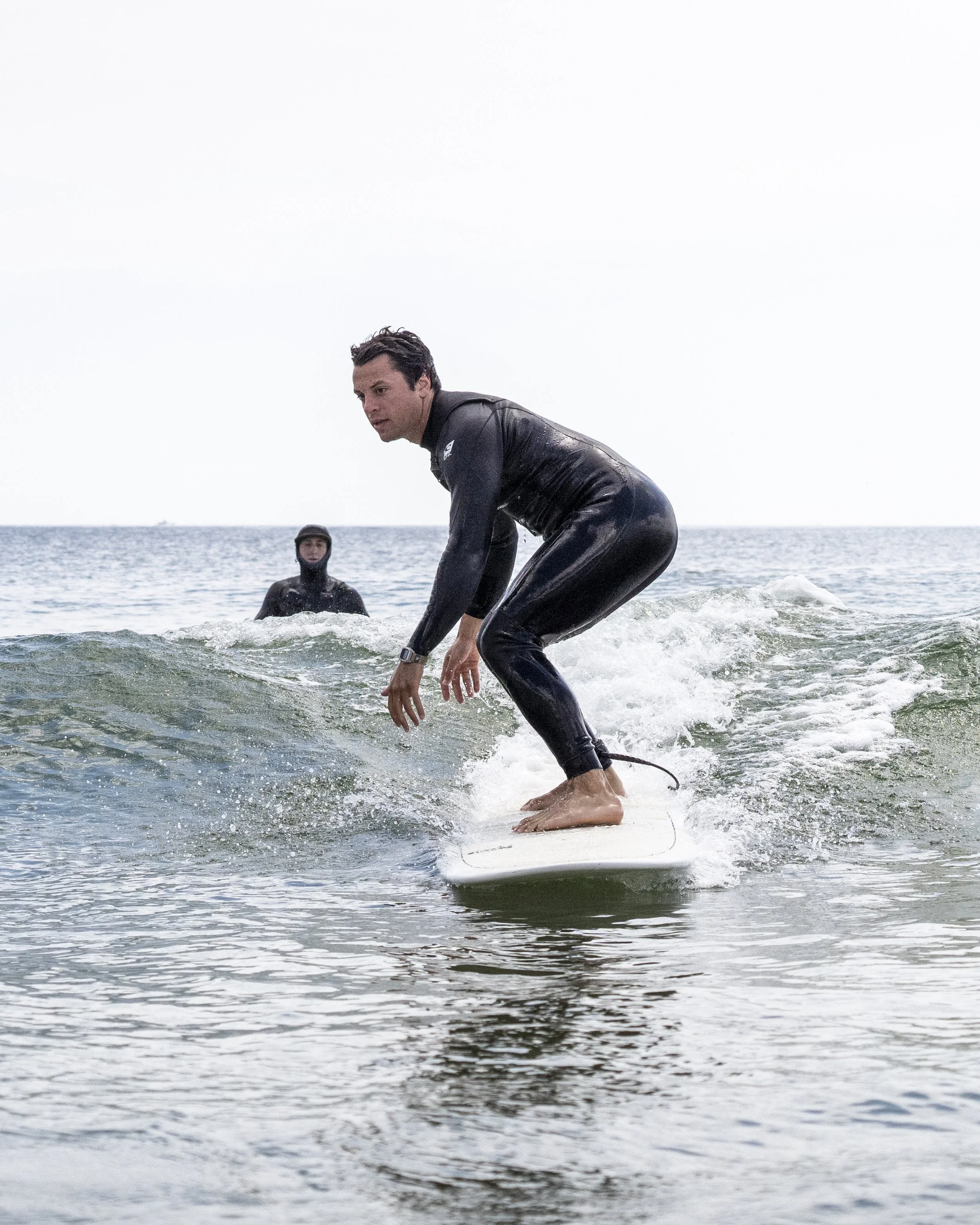
How fit you actually need to be to learn to surf
Boston Surf Adventures gets asked daily whether you need to be in peak physical condition to learn to surf, and the short answer is no, though you must be a competent, confident swimmer. While you do not need to change your body shape or spend six months in a gym to catch waves, having basic paddling endurance and trunk stability helps you catch more swells and avoid exhaustion during a 90-minute session at Nahant Beach. Surfing relies far more on balance, wave timing, and correct board volume than raw athletic power. Here is what the ocean demands from your body, how to test your baseline readiness, and why the right instruction bypasses the need for intense physical conditioning.
After coaching tens of thousands of hours of lessons over the past decade, our team has watched people of all ages, sizes, and athletic backgrounds learn to ride waves. We build our instruction on a ten-level progression system, working with hundreds of students who have proven that standing up on a board is a matter of technique rather than gym performance. Knowing which physical baselines matter saves you from wasting energy on the wrong workouts.
The non-negotiable baseline: swimming ability
Surfing happens in an open, constantly shifting ocean environment. For that reason, swimming competence is the single requirement that cannot be bypassed or substituted with better equipment. If you lose your board in the surf zone, your swimming ability keeps you safe and composed while you return to shore.
Panic burns through stamina faster than physical exertion. When you are comfortable treading water, floating on your back, and ducking under small waves, you preserve your energy for surfing instead of fighting survival anxiety. For an in-depth breakdown of water safety requirements, read the honest truth about swimming and surfing.
Our surf school created the Swim to Surf program because swimming endurance directly dictates how long you can stay in the water without fatiguing. A beginner who can swim continuous laps in a pool will catch three times as many waves as someone who runs out of breath after fifty yards of paddling. You do not need to swim at competitive speeds, but you should be able to tread water for several minutes and swim comfortably in deep water without touching the bottom.

What surf lessons demand of your body
From the sand, riding a wave looks effortless. In reality, catching waves requires short periods of work mixed with active recovery:
- Paddling endurance: Turning your arms continuously against water resistance to position yourself and match wave speed.
- Trunk stability: Holding your chest up off the deck without collapsing your lower back or shifting your weight off-center.
- Burst energy: Generating a quick, explosive push to bring your feet under your hips in a split second.
- Dynamic balance: Adjusting your center of gravity across an unstable surface that moves in three dimensions.
Paddling takes up most of your time
Paddling accounts for more than half of your total minutes in the water during an average session. A Josh L. Secomb review of the physical and physiological demands of surfing points out that surfboard paddling involves intermittent bouts of aerobic and anaerobic work. You paddle out through broken whitewater, reposition constantly to stay in the takeoff zone, and then sprint for five to ten strokes to catch an incoming swell.
This repetitive motion targets the lats, rear deltoids, triceps, and upper back. If you spend your workdays seated at a desk with rounded shoulders, holding your chest lifted while arching through your thoracic spine will feel unfamiliar. That posture requires isometric endurance in your spinal erectors. When beginners tire out in their first thirty minutes, it is almost always shoulder fatigue from paddling rather than leg tiredness from riding.
The mechanics of the pop-up
The pop-up is an explosive floor-to-feet motion, but it is not a standard gym push-up. A push-up requires a rigid plank where your chest and hips lift at the exact same rate. In a surf pop-up, you arch your back, pin your hips lightly to the board deck, push your upper body up, and snap your knees forward beneath your chest.
You do not need to press your entire body weight like a bench press. Instead, you create a momentary pocket of space beneath your torso so your lead foot can plant between your hands. Hip mobility and abdominal engagement matter far more than pressing power. If your hip flexors are tight, your feet land too far back on the tail, causing the board to stall and sink into the wave face.

Preparing for your first session without overtraining
You do not need a complicated gym routine or heavy barbell training before booking your first session at Boston Surf Adventures. Functional mobility and basic bodyweight circuits will give you the stamina you need.
A helpful guide on Surf Fitness for Beginners: Where to Start Before Your Next Session prioritizes mobility, basic strength, balance, and conditioning over heavy lifting. Two or three twenty-minute sessions each week will prepare your joints and muscles for the surf zone.
| Training focus | Target movement | Practical benefit on the board |
|---|---|---|
| Shoulder and back mobility | Prone cobra and thoracic extensions | Keeps your chest lifted while paddling without straining your neck |
| Hip mobility | Deep bodyweight squats and lizard lunges | Allows your feet to tuck cleanly under your chest during the pop-up |
| Core control | Bird-dogs, dead bugs, and forearm planks | Keeps the board flat and stable while paddling through choppy water |
| Pushing power | Incline push-ups or standard floor push-ups | Builds the initial burst needed to pop up from the board deck |
| Cardiovascular base | Pool laps or brisk interval walking | Speeds up recovery between wave sets so you can paddle back outside |
Pool swimming is the best cross-training you can do before your first lesson. Swimming freestyle directly mimics the alternating arm strokes and breathing cadence of paddling a surfboard. Aim for two pool sessions a week, mixing steady continuous laps with short twenty-five-yard sprint intervals.
Avoid the common mistake of practicing pop-ups fifty times a day on your living room floor while skipping cardio work entirely. A quick pop-up is useless if your shoulders are too burnt out to paddle into position. Focus on building clean movement and steady stamina first.
Why the right gear and coaching matter more than gym work
Many people delay taking lessons because they think they need to lose weight or build muscle first. That assumption is backward. In modern surf instruction, equipment selection and technique make up for physical shortcomings.
Every instructor in our water sessions is a certified lifeguard, and our dry-land coaching breaks down paddle technique, pop-up mechanics, and wave reading before you touch the ocean. If you struggle with balance or upper-body strength, using the correct board eliminates most of the struggle.
Foam boards for first-timers
First-time surfers should always start on wide, thick foam soft-top surfboards. Foam boards provide massive buoyancy, which lets the board plane across the water with very little paddling effort from the rider. A nine-foot foam board floats high on the surface, catching broken whitewater rolls easily even if your paddling cadence is slow.
Soft decks also provide extra traction and cushion when you fall. Because the rails are forgiving, the board stays steady while you transition from your belly to your feet. Beginners do not need to generate their own speed on these boards; the foam volume and wave energy carry you forward while you focus purely on your foot placement and stance.
Sizing up for stability
When beginners struggle to stand, the issue is almost never their physical fitness; it is an undersized board. Our No BS Gear Guide — Boston Surf Adventures outlines why matching board length and volume to body weight is essential:
- Surfers under 140 pounds need a minimum 9'0" board.
- Surfers between 140 and 160 pounds need a minimum 9'4" board.
- Surfers between 160 and 180 pounds need a minimum 9'8" board.
- Surfers between 180 and 200 pounds need a minimum 10'0" board.
- Surfers over 200 pounds require an ultra-wide, high-volume shape like the Walden Mega Magic.
A surfer weighing 220 pounds will struggle on a standard 8-foot rental foamie, not because of their fitness, but because the board sinks too low in the water. Step that same person onto a 10'0" high-volume shape, and the board floats cleanly, paddles fast, and provides a wide, rock-solid platform for standing up. The right gear does the heavy lifting for you.
Our weekend adult programs maintain a 3:1 student-to-coach ratio with 90-minute water sessions, ensuring you receive direct, immediate feedback on every paddle stroke. Learn more about our upcoming dates and equipment packages through our Surf Camps in Boston and New England — Boston Surf Adventures page.
Ready for your first wave at Nahant Beach
You do not need to be an elite athlete to become a real surfer. If you are comfortable swimming in open water, have normal joint mobility, and can push yourself up from the floor, you have all the physical capability needed to catch and ride ocean waves.
When you join a session with Boston Surf Adventures at Nahant Beach, we provide the fitted wetsuits and stable beginner boards so you can focus entirely on learning. Before you pack your bag, check where to park and meet for your Nahant surf lesson for arrival details, and visit the Boston Surf Adventures home page to claim your spot in the lineup. Bring a swimsuit, a towel, and basic swimming confidence; our certified coaches handle everything else.
Filed under