At Boston Surf Adventures, we have found that the fastest way to break through a surfing plateau isn't just spending more hours in the water—it's watching yourself on tape. To objectively improve your board control and wave count, you need to record your sessions and measure yourself against four specific performance milestones: pop-up speed, stance width, wave positioning, and bottom-turn compression. By establishing a video baseline and tracking these exact mechanics, you can isolate bad habits and fix them in days instead of years, using targeted setups at local beaches like Nahant Beach or during dedicated winter retreats in Rincon, Puerto Rico.
When filmmaker Brent Rose slowed footage of the world's best surfers down to 120 frames per second at Kelly Slater's Surf Ranch, he uncovered something unexpected: there is no single perfect pop-up. Instead, professional athletes adjust their movements based on wave profiles, but they all return to distinct mechanical baselines that dictate their speed and control. You can watch the slow-motion breakdown in How the World's Best Surfers Pop Up.
For the everyday surfer, this means copying a generic pop-up from a textbook is a recipe for a plateau. You must diagnose your own unique movement patterns. If you want to jump from catching five waves on a messy weekend to confidently catching 50 or 70 waves, you need an objective lens. This is where high-leverage technical coaching, such as our upcoming Progression Sessions, shifts your focus from guesswork to measurement.
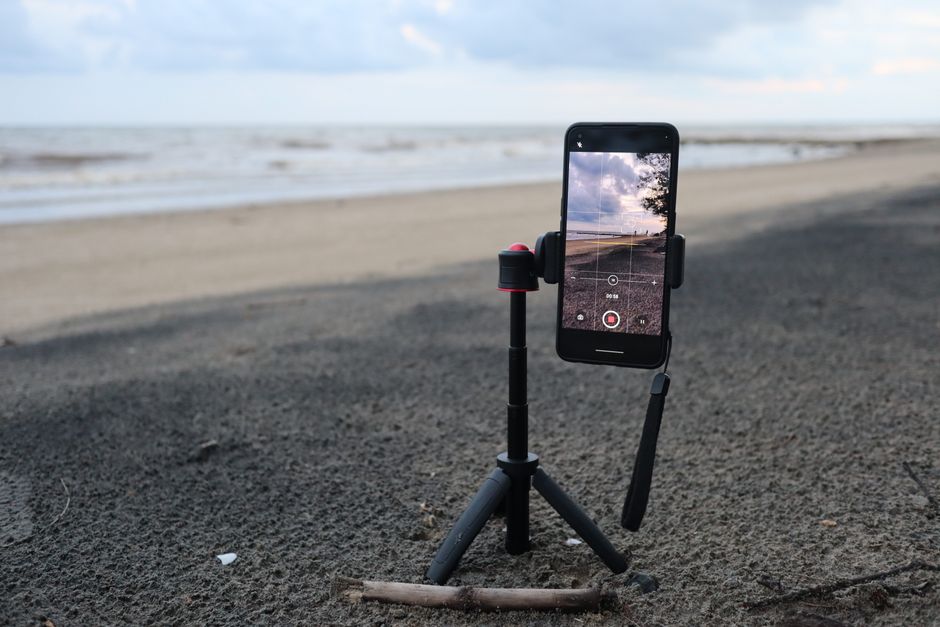
Setting up your camera to capture usable baseline footage at Boston Surf Adventures
To analyze your surf mechanics, you first need clear, high-quality video that captures the transitions from paddling to standing. Shaky, low-resolution footage shot from too far away hides the microscopic errors that cause your rails to dig or your nose to pearl. Keep the technical setup simple. A standard smartphone mounted to a tripod on the beach provides an ideal baseline. If you are surfing the gentle, consistent waves at Nahant Beach, MA, a simple tripod setup near the water's edge can capture your entire ride.
Angle and positioning
Position your tripod at a 45-degree angle to the shoreline, pointing toward the peak where waves are breaking. This angle provides a clear view of both your side-profile stance and your chest-on paddling position. Avoid shooting directly from behind or directly from the front, as these angles compress depth perception, making it difficult to evaluate your board-to-water entry angle. Ensure the camera is positioned high enough to avoid getting blocked by shorebreak or passing beachgoers.
Using tracking tools like Surfr
Manual recording works, but automated tools simplify the capture process. Software like Surfr acts as an AI surf coach, isolating individual waves from longer clips and tracking body positions frame by frame. Using these tools removes the chore of scrubbing through hours of empty water footage, letting you focus strictly on active riding time. This makes it easy to catalog your waves and track progress over multiple sessions.
Measuring pop-up speed and body mechanics with Boston Surf Adventures
A slow or clumsy pop-up is the primary reason surfers miss the critical green face of a wave. By slowing your footage down to 120 frames per second, you can audit your pop-up speed and isolate where your feet, hands, and hips are moving. A common misconception is that a pop-up must be a rapid, explosive jump. In reality, the best surfers focus on fluid, continuous movement. Slowing your footage down reveals if you are creating drag by dragging your knees or ankles along the deck of the surfboard.
The frame-by-frame breakdown
When analyzing your video, pause at the exact moment your hands plant flat on the board. Watch how your hips rise to clear the deck. Your hands should be placed flat under your chest, not grabbing the rails. Look for whether your feet land in one cohesive motion or if you are performing a two-step scramble. To understand how to evaluate coaching methods that use these recordings, explore our analysis of the surf video analysis audit: what actually improves your stance.
Eliminating hesitation
Hesitation drops your speed and makes you vulnerable to getting caught in the lip. Look at the transition between your last paddle stroke and your hand placement. If there is a delay of more than half a second where you are simply coasting, you are losing momentum. The momentum from your paddle must feed directly into the lift of your upper body. Video analysis helps you identify this pause so you can train your brain to initiate the pop-up the moment the tail of the board lifts.
Evaluating your stance against your anthropometric baseline with Boston Surf Adventures
Once your feet are on the wax, your stance determines your control over the board. There is no generic correct stance width because everyone has different limb lengths and heights. A peer-reviewed biomechanical study on the kinematics of the pop-up, published in MDPI's Sensors journal, found that pop-up kinetics are closely tied to a surfer's anthropometric characteristics. Your physical dimensions—such as height and leg length—dictate your optimal stance. Video analysis will reveal if you are forcing a stance that is too narrow or too wide for your body type.
Stance width adjustments
If your feet land too close together, your center of gravity rises, making you unstable. If your feet are too wide, you lock your hips, preventing you from compressing and turning. Use your video to measure your feet relative to your shoulders. For most surfers, your feet should land slightly wider than shoulder-width apart, with your back foot perpendicular to the stringer and your front foot angled at roughly 45 degrees. For a deeper dive into adjusting your feet on the wax, see our guide on how frame-by-frame video analysis fixes the stance errors stalling your progress.
Weight distribution on the board
Watch how your board reacts the moment you stand. If the nose rises dramatically, you are leaning too far back on your rear foot, stalling your speed. If the nose dips and catches water, your weight is too far forward. Your video will show if your knees are bent and your hips are centered over the stringer, allowing you to distribute your weight evenly. Pay attention to your front knee; it should be tucked slightly inward to help point your hips forward.
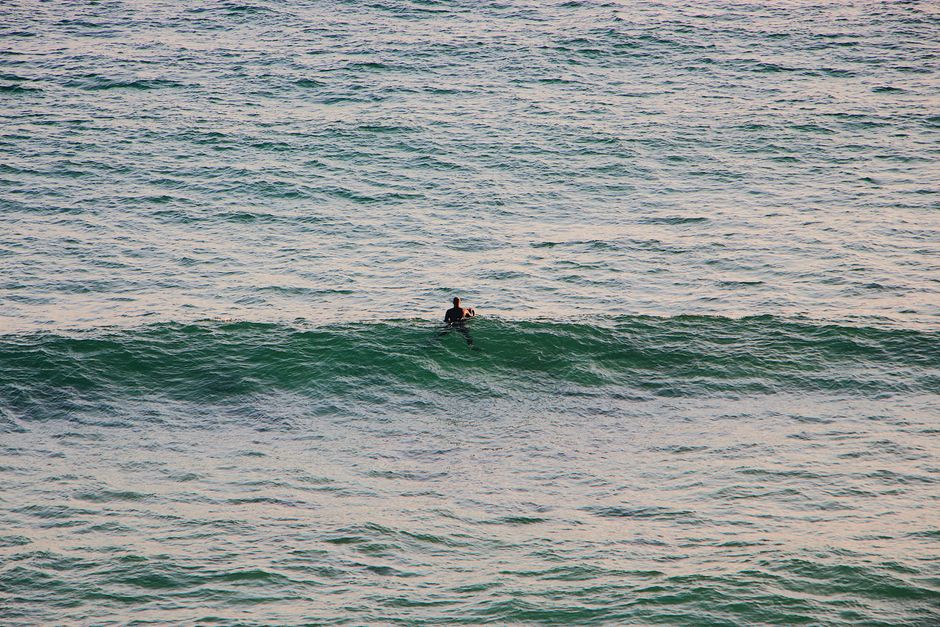
Tracking wave positioning and entry timing at Nahant Beach with Boston Surf Adventures
Catching a wave requires matching your speed with the wave's energy. Many intermediate surfers paddle too hard on waves they have already missed or take off too deep on the shoulder where there is no power. Within 45 minutes of Boston, there are over 20 surf breaks that feature small, clean waves and very low crowds. These empty lineups make local spots like Nahant Beach the perfect testing grounds for capturing clean baseline video.
Review your footage to check where you are when you begin paddling. Are you sitting right at the peak where the wave is steepest, or are you chasing waves from behind? Look at your board trim as you enter the wave. Your chest should be pressed down to keep the nose flat, allowing the board to glide down the face rather than getting pushed back by the wind. If the video shows the nose of your board pointing high in the air while you paddle, you are too far back on the board, creating massive aerodynamic and hydrodynamic drag.
Analyzing bottom turns and rail control on Boston Surf Adventures retreats
The bottom turn is the foundation of intermediate surfing. It is the maneuver that translates the vertical drop of a wave into lateral speed along the face. If you struggle to transition from a straight ride to a clean, carving turn, your video will show you exactly why. At our winter retreats in Rincon, Puerto Rico, where we enjoy offshore winds and reliable beginner to intermediate waves, we use a structured video coaching methodology.
We film every morning wave and review the footage before the afternoon session. To prevent cognitive overload, founder Grant Gary delivers only two high-leverage pieces of technical feedback per session. This prevents surfers from overthinking their movements when they get back in the water. This targeted approach is particularly useful for mastering the bottom turn, where small adjustments in body weight yield massive results.
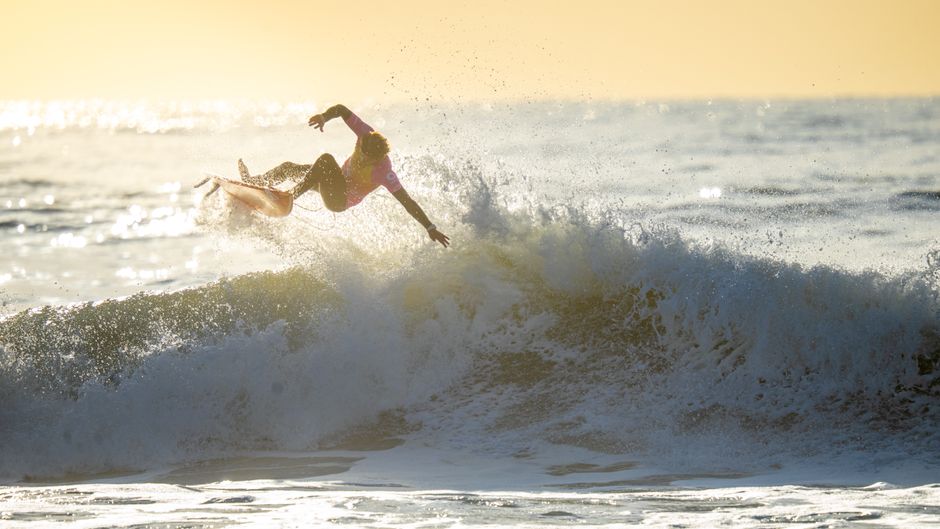
When looking at your bottom turn on video, check your compression. You should be compressed low, with your knees bent and your weight centered. As you reach the bottom of the wave, look at where you are pointing your head and shoulders. Your body follows your eyes; if you are looking down at your feet, your board will stay flat and fail to engage the rail. To carve effectively, your head must look up toward the shoulder of the wave, and your leading shoulder must rotate in the direction of the turn, prompting the board to lean onto its rail.
By systematically filming your sessions and evaluating these performance milestones, you remove the guesswork from your surf progression. You stop wondering why you fell and start seeing the exact frame where your stance drifted or your pop-up hesitated.
If you are ready to accelerate your surfing, join us for a winter getaway. Learn more about our coached trips and secure your spot on our Puerto Rico Retreat — Boston Surf Adventures page, where our team handles the filming and daily video analysis to guarantee your progress on the board.