One Thing to Watch Out For
When planning a group surf event, the number of people a surf school can host depends entirely on instructor ratios and local water safety standards rather than open beach space. At Boston Surf Adventures, structured adult surf camps cap at 12 people total and semi-private lessons maintain a strict 3:1 student-to-instructor ratio on Nahant Beach, keeping wave counts high and instruction direct. While broad regulatory baselines permit larger groups, booking a dedicated private group surf day for a corporate retreat, family reunion, or celebration requires matching your headcount to coach availability. To determine exact group capacity, deposit details, and custom scheduling options, contact the school directly to review dates and staffing for your session.
Getting a dozen friends or coworkers to agree on a weekend activity is difficult enough; getting them all to stand up on a surfboard requires actual strategy. Surf coaching is not like renting a lane at a bowling alley or booking a block of seats at Fenway Park. The ocean is dynamic, wave sets arrive on their own schedule, and an overcrowded lineup leads to tangled leashes and frustrated surfers. Understanding how surf schools structure group instruction helps you book an event where people spend their time catching waves instead of bobbing around waiting for attention.
The math of instructor ratios and wave counts
The biggest factor dictating group size in surf coaching is the coach-to-student ratio. In open water, safety and teaching quality drop the moment an instructor is spread across too many heads. According to the International Surfing Association (ISA) Safety Guidelines, the maximum allowable ratio for surf coaching in optimum conditions is eight students to one instructor (1:8). That 1:8 threshold serves as an international safety ceiling, not an educational ideal.
When one instructor works with eight beginners in the surf zone, basic logistics take over. An instructor can assist only one person on one wave at a time. If an incoming set offers three clean waves every five minutes, an eight-person group means each student might get pushed into a wave once every fifteen minutes. Over a standard sixty-minute session, an individual surfer might catch three or four waves. The rest of the hour is spent paddling against current, dodging stray boards, or treading water in the impact zone.
+-----------------------------------------------------------------------------+
| Ratio Comparison: 1:8 Industry Maximum vs. 3:1 Progression Model            |
+-----------------------------------------------------------------------------+
| Feature                     | 1:8 Industry Cap      | 3:1 Progression Ratio |
|-----------------------------+-----------------------+-----------------------|
| Waves caught per hour       | 3 to 5 waves          | 15 to 25+ waves       |
| Direct coach feedback       | Intermittent          | Every single wave     |
| Lineup positioning control  | Loose supervision     | Direct management     |
| Ocean hazard response time  | Divided focus         | Immediate assistance  |
| Instruction personalization | Generic group cues    | Tailored mechanics    |
+-----------------------------------------------------------------------------+
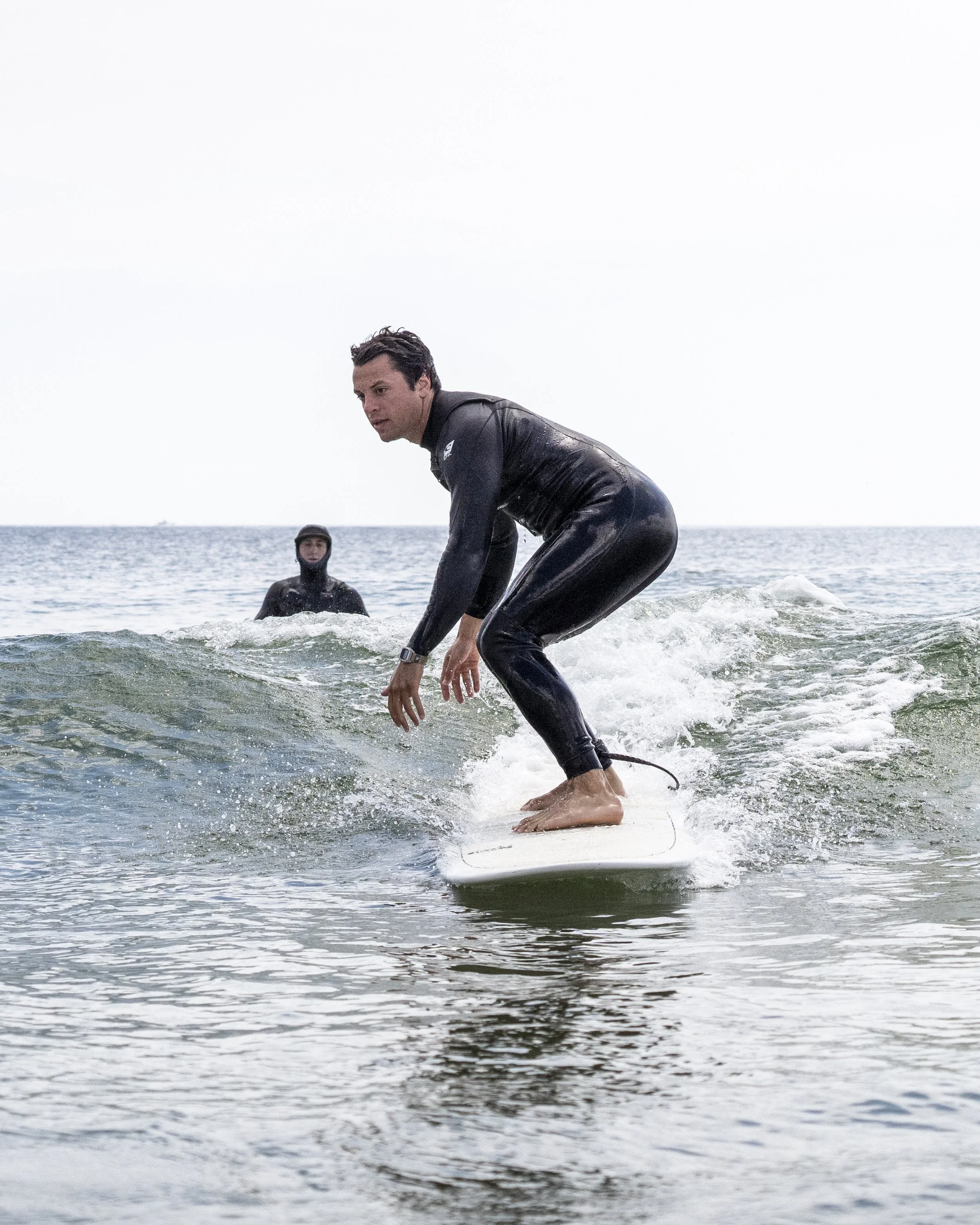
By contrast, tightening that ratio changes the entire learning curve. Boston Surf Adventures runs semi-private surf lessons built around a 3:1 student-to-instructor ratio. With only three surfers per coach, the instructor stays within arm's reach of the group throughout the session. Feedback happens immediately after kick-out: adjusting foot placement, fixing chest arch, or correcting paddle entry before bad habits set into muscle memory.
Higher reps create faster breakthroughs. In a three-to-one setup, individual surfers routinely catch 15 to 25 waves in an hour. When students get that many repetitions with direct coaching on each attempt, balance shifts from hesitant survival to genuine board control. For organizers planning an event, prioritizing a tight coaching ratio prevents the outing from becoming an exercise in standing around in cold water.
Managing a mixed-ability lineup with skill pods
Most organizers trying to organize a group outing discover their group is split. Half the crew has never touched a surfboard, two people took a vacation lesson in Costa Rica five years ago, and one person owns their own board and claims they can surf green waves. Trying to teach all of those people with a single, uniform lesson plan fails everyone involved.
Advanced surfers get bored waiting in knee-deep whitewater while absolute beginners learn how to attach an ankle leash. Conversely, dragging a beginner outside the break into head-high sets creates panic and serious physical danger. Professional operations solve this problem by organizing large groups into distinct ability pods run by separate coaches.
Boston Surf Adventures organizes instruction around a structured ten-level progression framework:
- Level 0 (Total Beginner): Learning to pop up, manage board trim, and ride broken whitewater rollers straight to the beach.
- Level 1 (Whitewater Rider): Standing up consistently and handling independent takeoffs without physical coach assistance.
- Level 2 (Small Wave Surfer): Angling takeoffs, paddling into unbroken green waves, and riding cleanly to the inside.
- Level 3 (Green Wave Beginner): Heading past the primary break to paddle into outside sets and manage basic positioning.
- Level 4 (Down the Line): Generating speed and trimming across open wave faces rather than riding straight to shore.
When organizing an event, sorting attendees into these brackets beforehand keeps the session moving smoothly. A Level 0 pod can spend the first twenty minutes on the sand covering board anatomy, pop-up mechanics, and water entry before hitting the inside reform waves. Simultaneously, a Level 2 or Level 3 pod can paddle straight out to the primary sandbar with their coach to work on reading wave peaks and timing takeoffs.
This division keeps the lineup organized and eliminates frustration. Total beginners build confidence in waist-deep water where they can easily touch bottom, while experienced surfers receive tactical coaching on wave selection and cutbacks out back. If you are planning an outing with friends or colleagues, like those covered in our guide on how to plan a surf bachelor party in Boston, grouping participants by real skill level rather than social ties makes the water time far more rewarding.
Gear and safety requirements for crowds
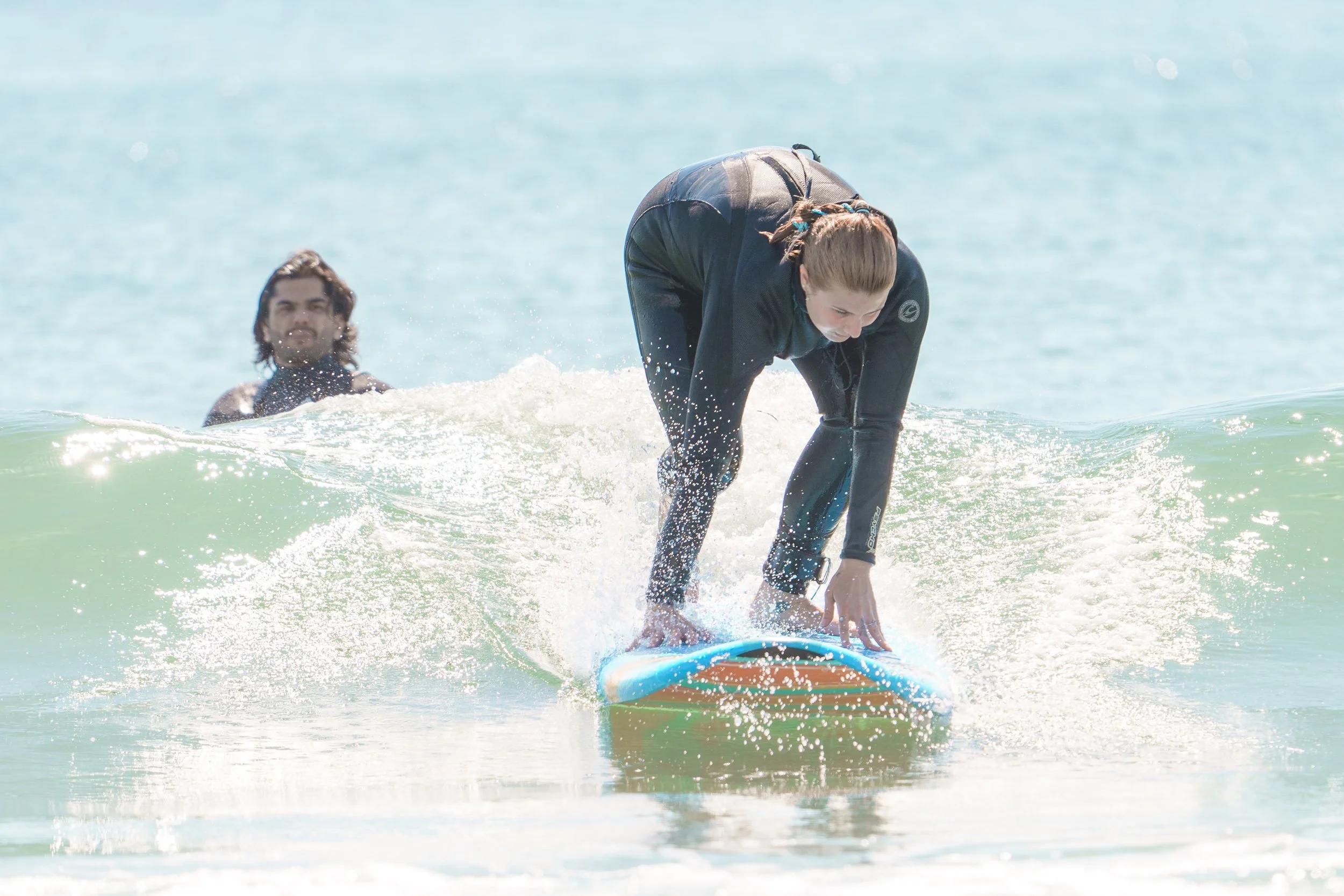
Managing multiple surfers in the Atlantic surf zone requires strict logistical control over equipment and ocean safety protocols. Surfboards are heavy, hard objects moving with the energy of breaking water; uncontrolled boards present the single biggest hazard to beginners in a group setting.
A professional surf school must provide specific safety gear and operational support for every group session:
- High-volume foam softboards matched precisely to each participant's individual height, weight, and athletic background.
- Properly fitted full wetsuits tailored to Atlantic water temperatures, supplemented by neoprene boots and gloves when conditions call for them.
- Bright, high-visibility colored rash guards worn over wetsuits to distinguish students instantly from general public beachgoers.
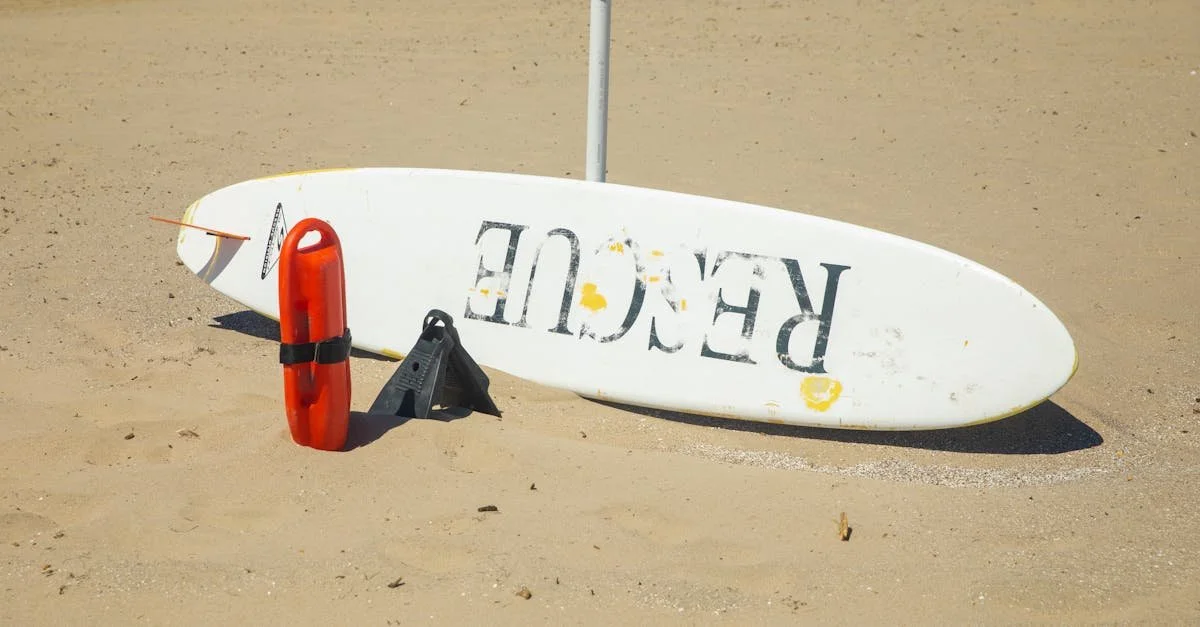
- A dedicated safety cache stationed on the beach, containing a first aid kit, emergency communications, and a specialized rescue board.
- Dual-credentialed water staff holding active surf instructor certifications along with lifeguard and CPR credentials.
Nahant Beach sits about 30 minutes from downtown Boston, offering an accessible location for group surf outings. Because it is a curved, protected barrier beach, Nahant frequently produces forgiving, rolling surf ideal for group instruction. However, every ocean beach carries real hazards that require active supervision.
According to data compiled by the United States Lifesaving Association, rip currents account for over 80 percent of all rescues performed by surf beach lifeguards. Rip currents form when water pushed ashore by breaking waves funnels into deeper channels running back out to sea. In inexperienced groups, panic is the primary hazard if someone drifts off a sandbar.
Before any group enters the water, instructors run a mandatory beach safety briefing. Coaches break down the day's wind conditions, explain the drift along the sandbar, and demonstrate the universal recall signal. Because every coach in the water with Boston Surf Adventures is a certified lifeguard trained in custom ocean rescue protocols, groups operate with a safety net that ordinary beach rentals cannot provide.
Booking the right setup for your headcount
Because surf schools face hard limits on equipment, permit allowances, and qualified coaching staff, matching your headcount to the right structural format is essential. You cannot simply show up with twenty people on a Saturday morning and expect a school to have twenty boards and five spare instructors standing by.
Small groups (2 to 4 people)
Small groups of two to four people are the easiest to arrange and offer the highest quality instruction. This size fits neatly into existing daily operational blocks. For three friends, booking a single semi-private session gives the group their own private coach and a full hour of focused water time.
If your group has four people, schools can split the party across two instructors or pair two semi-private bookings back-to-back. With small parties, scheduling flexibility is high, equipment selection is straightforward, and coaches can spend considerable time diagnosing individual biomechanics.
Mid-size groups (5 to 12 people)
Once a group reaches five to twelve participants, scheduling requires deliberate coordination. At Boston Surf Adventures, structured adult surf camp programs operate with a strict cap of 12 people total, deploying multiple coaches to keep the student-to-instructor ratio at 3:1 throughout the sessions.
For private groups of this size—such as tech startup team offsites, athletic clubs, or bridal parties—organizers generally look to book dedicated coaching blocks. Coordinating eight to twelve surfers requires reserving multiple coaches at the same tide window to ensure the whole party surfs together safely. Planning at least three to six weeks ahead is practical for mid-sized bookings, especially during peak summer months between July and September when local beach permits and instructors are heavily booked.
Large groups (13 or more people)
Groups larger than a dozen present distinct operational puzzles. Accommodating fifteen, twenty, or thirty people at once requires extensive equipment reserves, dedicated beach staging zones, and a substantial coaching roster.
For groups of this scale, surf schools often structure the event in rotational shifts:
+-----------------------------------------------------------------------------+
| Sample Staggered Schedule for a 16-Person Private Surf Event                |
+-----------------------------------------------------------------------------+
| Time Block    | Group Alpha (8 Surfers)       | Group Bravo (8 Surfers)     |
|---------------+-------------------------------+-----------------------------|
| 09:00 - 09:30 | Gear fitting & wetsuit prep   | Ocean safety & dry-land demo|
| 09:30 - 10:45 | In-water session (Pod 1 & 2)  | Beach games & rest station  |
| 10:45 - 11:15 | Hydration & technique review  | Gear changeover & stretch   |
| 11:15 - 12:30 | Beach support & photo review  | In-water session (Pod 3 & 4)|
| 12:30 - 01:00 | Group debrief on the beach    | Group debrief on the beach  |
+-----------------------------------------------------------------------------+
Staggering the water sessions lets a single organization bring a large crew to the beach while maintaining safe, low coach-to-student ratios in the impact zone. While half the group catches waves, the other half rests, watches technique from the sand, or eats lunch. This prevents the lineup from becoming dangerously overcrowded and avoids overwhelming instructors.
Because capacity depends directly on seasonal staffing and equipment availability, anyone organizing an outing for thirteen or more people must contact the surf school directly to discuss logistics. Exact pricing, deposit schedules, and customized multi-coach blocks cannot be resolved through an automated online checkout.
Avoid the high-ratio trap
The most common mistake group organizers make is shopping strictly on baseline per-person pricing. A budget surf school might quote a low rate by putting twelve or fifteen adults under the care of a single instructor.
On paper, that looks like a bargain. In the water, it falls apart fast. One coach standing in waist-deep surf cannot watch fifteen people spread across a hundred yards of beach break. The coach spends the entire lesson chasing runaway boards, untangling leashes, and rescuing exhausted swimmers who drifted into a rip. The participants spend forty-five minutes floating on oversized foam boards, catching zero waves, and wondering why they paid to get cold.
Surfing is an athletic discipline with real technical barriers. Standing up on a moving wave requires paddle timing, core stabilization, and precise foot placement. When you invest in a group event, you are paying for actual wave rides and shared breakthroughs, not just board storage and flotation. Choosing a school that protects low coaching ratios guarantees your group leaves the beach exhausted, grinning, and talking about the waves they actually rode.
Plan your group session on Nahant Beach
If you have a date, a rough headcount, and a group looking to get into the Atlantic, the best path forward is straightforward communication with the coaching team. Talk through the athletic backgrounds of your attendees, ask about current tide windows, and find a format that matches your goals.
To check available coaching slots or discuss custom options for your crew, reach out through the Boston Surf Adventures website or call (617) 517-6168. Getting the logistics dialed in advance lets your group focus on paddling into clean waves together.
Filed under