Boston Surf Adventures identifies the primary barrier to surfing progression as the intermediate plateau, where surfers fail to transition from the whitewater to open faces due to uncorrected mechanical habits. This article answers how to bridge that gap by outlining five specific physical shifts, ranging from eye-line discipline and independent wave selection at Nahant Beach to advanced rotational carving in Rincon, Puerto Rico. By utilizing the BSA Progression Pyramid developed by founder Grant Gary, students move beyond the five-wave-per-session limit of solo practice to catch up to 70 waves in a single coached weekend, installing the muscle memory required for consistent performance on green waves.
The repetition trap in New England surf
Most surfers in the Greater Boston area spend years stuck in a cycle of marginal improvement because they assume that more time in the water naturally equates to better technique. This is a fallacy. Surfing is a complex series of biomechanical triggers that must happen in a specific sequence. If you spend your weekends at Nahant Beach riding straight toward the shore in the whitewater, you are certainly building balance, but you are not necessarily building the skills required to ride a green wave. In fact, without professional correction, you are likely reinforcing bad habits that will become harder to erase the longer you practice them.
Boston Surf Adventures operates on the principle that volume without structure is wasted effort. Across the thousands of students we have taught, a clear pattern emerges: the difference between a beginner and an intermediate surfer is not "talent," but the number of corrected repetitions. If you go out on your own over a two-day period, you might successfully catch five waves. With a coach and a structured framework, you can easily catch 50 to 70 waves in one weekend. This volume of success is what allows the brain to map the transition from a survival-based pop-up to a performance-based turn.
The "whitewater trap" happens when a surfer becomes comfortable with the power of broken water pushing them. Because whitewater is turbulent and moves in a straight line, it allows for a flat-board stance that would fail immediately on the steep, clean face of a green wave. To break this cycle, you must stop viewing surfing as an "art" and start viewing it as an engineering problem. You are managing energy, friction, and torque.

Milestone 1: The explosive pop-up and eye-line discipline
The first mechanical shift occurs before your feet even touch the wax. Most beginners struggle with a slow, "climbing" pop-up where they use their knees to stabilize themselves. This delay is fatal on a green wave because it misses the moment of maximum momentum. At our weekend camps, we teach a refined 3-point pop-up that emphasizes speed and explosive hip clearance. The goal is to move from a prone paddling position to a stable stance in one fluid motion before the board begins its steepest descent.
Stance stability and foot placement
A common error is the "penguin stance," where feet are too narrow and the center of gravity is too high. Proper stance requires your feet to be shoulder-width apart, with your back foot perpendicular to the stringer and your front foot at a slight 45-degree angle. This orientation allows for "compression"—the ability to bend your knees and absorb the energy of the wave. Without this compression, the board becomes a rigid plank that is prone to being bucked by any surface chop.
The eyes-up balance rule
The most influential mechanical fix we implement is eye-line discipline. A 2024 surf progression study confirms that looking down at the feet or the nose of the board causes an immediate loss of balance and forward momentum. Humans are biologically wired to follow their gaze; if you look at the nose of your board, your weight shifts forward, causing the nose to dive (pearling). If you look at your feet, your posture collapses. We train students to pick a specific landmark on the shore or a spot on the wave’s shoulder and stare at it throughout the entire pop-up. This keeps the chest up and the weight centered over the board’s midpoint.
Milestone 2: Independent wave selection in sub-3-foot surf
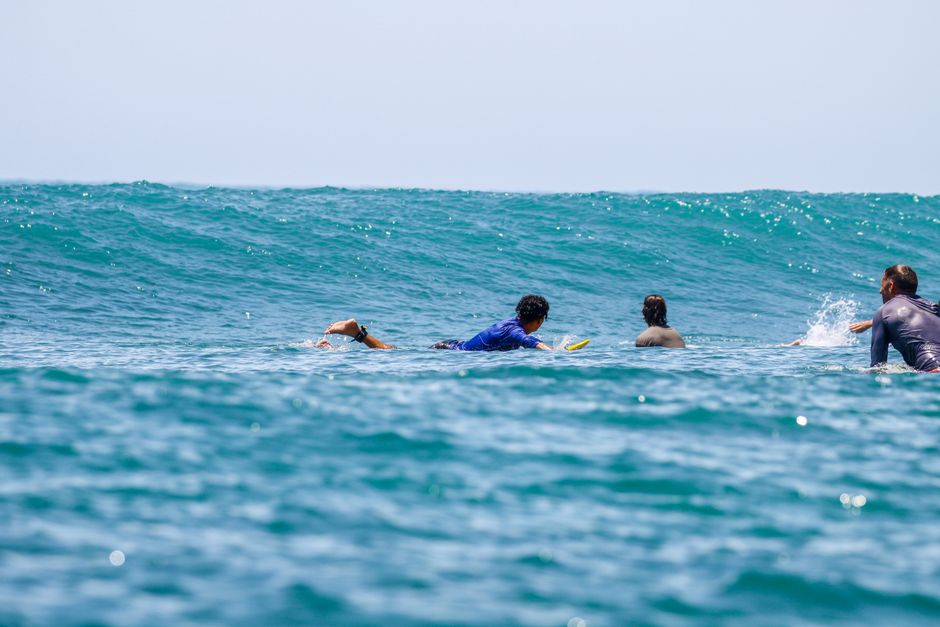
By the second day of our sessions at Nahant Beach, the focus shifts from the mechanics of the ride to the mechanics of the catch. Relying on an instructor to push you into a wave provides a false sense of timing. To become a self-sufficient surfer, you must master wave selection and unassisted paddling. This requires a deep understanding of "surf science"—how waves form, how they "peak," and where the energy is most concentrated.
During our Sunday sessions, we target waves that are 3 feet and under. This size is large enough to provide genuine momentum but small enough to allow for repeated failures without exhaustion. Independent selection involves:
- Identifying the "peak" or the highest point of the approaching swell.
- Positioning the board so the tail is lifted by the swell before the wave breaks.
- Matching the wave's velocity with 3–4 explosive paddles.
- Timing the pop-up for the exact moment the board starts to plane.
This transition is what separates recreational beach-goers from actual surfers. It requires you to stop being a passive participant and start being a predator. You are hunting for the right energy, not just waiting for the water to hit you. We detail this transition further in our guide on how an all-inclusive coaching framework yields 50 waves in a weekend.
Milestone 3: Trimming and generating down-the-line speed
Once you can catch a wave and stand up, the next shift is moving away from the "ride to shore" mentality. Riding straight is a dead end. To progress, you must learn to trim. Trimming is the act of angling the board to stay on the "green" or unbroken part of the wave. This is achieved by engaging the rail—the edge of the surfboard—into the water.
Speed is the absolute prerequisite for any maneuver. Without speed, the board sits deep in the water, creating drag. By shifting your weight slightly forward and toward the wave face, you engage the rail and allow the board to plane across the surface. This "down-the-line" speed is what provides the kinetic energy needed for turning. If you find yourself outrunning the wave and ending up in the flats, you are likely failing to trim effectively.
| Feature | Whitewater Riding | Green Wave Trimming |
|---|---|---|
| Direction | Perpendicular to the shore | Parallel to the wave face |
| Board Position | Flat on the water | Rail engaged in the face |
| Speed Source | Turbulent push (foam) | Gravity and planning (green) |
| Weight Dist. | Centered/Back | Forward/Lateral |
| Objective | Balance and survival | Speed generation and positioning |
Milestone 4: The foundational bottom turn
The bottom turn is the most important turn in surfing. It is the bridge between the drop-in and the rest of the wave face. After you pop up and drop down the face of the wave, you reach the "trough" or the flat area at the bottom. A successful bottom turn uses the speed gained from the drop to redirect the board back up toward the wave's power source (the pocket).
This maneuver requires significant physical compression. You must bend your knees deeply at the bottom of the wave, lean into the turn, and then "extend" or push off the board as you head back up the face. This compression-extension cycle is a core component of the BSA Progression Pyramid. Without a solid bottom turn, any attempt at a carve or a cutback will result in a "bogged rail" where the board loses all speed and sinks.
Milestone 5: The rotational open-face carve
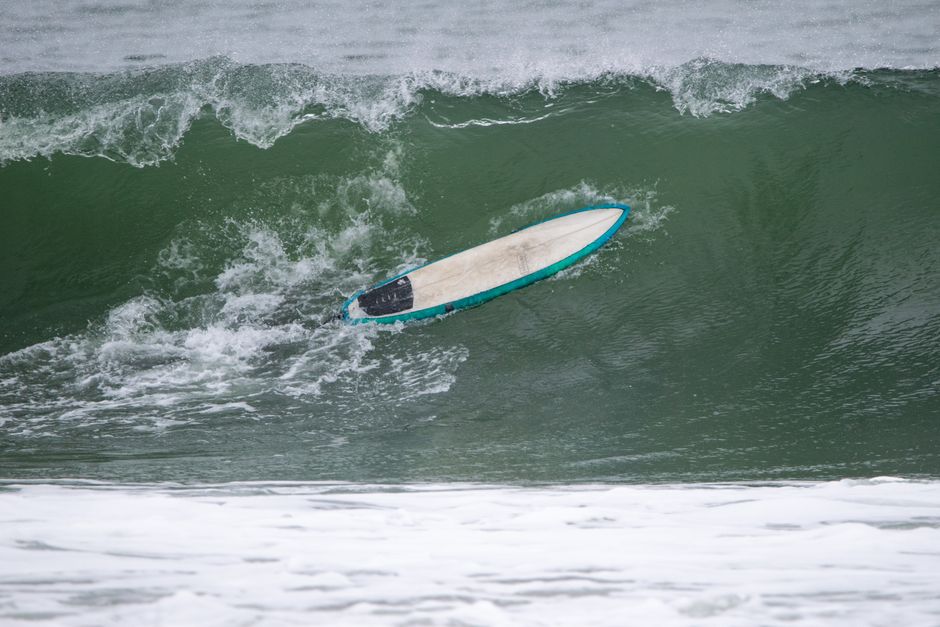
The final mechanical shift is the carve. Unlike a "snap," which is a quick, jerky change in direction, a carve is a long, smooth arc that maintains speed. This is where the biomechanics of the upper body become critical. A technical analysis of carving explains that the turn begins with the eyes, moves to the head, and then rotates the torso.
Torso rotation and rail engagement
To execute a carve, you must rotate your leading shoulder in the direction you want to go. This rotation creates torque that travels down through your hips and into your feet. If you try to turn using only your feet, the board will likely skid out or fail to change direction. The torque allows you to apply pressure to the "rail," digging it deep into the water to create the arc.
Using video analysis to correct timing
In our Puerto Rico retreats, we use daily video analysis to fine-tune this rotation. Because a carve happens in a matter of seconds, it is almost impossible for a student to "feel" what they are doing wrong in real-time. By filming every wave, founder Grant Gary can identify exactly where the rotation is breaking down. Often, a student thinks they are rotating their shoulders, but the video shows they are only moving their arms.
The conditions in Rincon are essential for this stage of learning. With offshore trade winds guaranteed until at least 10 AM, the waves provide a clean, consistent canvas. This allows for the high-volume repetition of carves on open faces that you simply cannot find in the unpredictable Atlantic chop without a focused plan.
Implementing the progression framework
Transitioning from a beginner to an intermediate surfer is a matter of technical milestones, not time. Each shift—from the pop-up to the carve—builds upon the last. If your pop-up is weak, you won't have the speed for a bottom turn. If you can't trim, you'll never reach the open face to practice a carve.
At Boston Surf Adventures, we treat these mechanics as a repeatable physical discipline. Whether you are joining us for a summer session near Swampscott and Marblehead or traveling with us to the Caribbean, the goal remains the same: short-circuiting bad habits and replacing them with sound, ISA-certified technique.
Review the upcoming dates for the Puerto Rico Retreat — Boston Surf Adventures to apply these mechanics in consistent, intermediate-friendly waves with daily video feedback and professional coaching.