Boston Surf Adventures teaches students to catch 50 to 70 waves in a single weekend at Nahant Beach, a volume that quickly exposes the limitations of one-size-fits-all surf school equipment. While heavy, high-volume foam boards are standard issue for beginner safety and buoyancy, relying on a uniform fleet for every student creates a hard ceiling on skill development. Analyzing International Surfing Association (ISA) equipment standards and recent board volume research, this audit breaks down how generic equipment masks poor technique and when an instructor should transition a student to a more responsive shape to teach turning, timing, and wave selection.
The inventory trap: why surf programs default to identical fleets
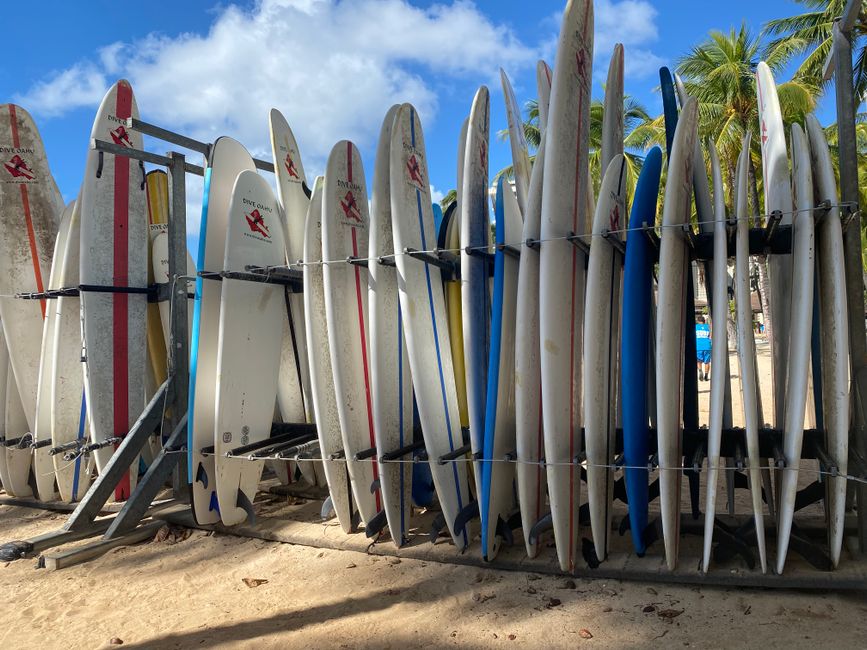
The majority of surf schools in New England operate on a model of logistical convenience rather than educational outcomes. When you walk onto a beach and see a rack of thirty identical 8-foot blue foam boards, you are looking at a business that has optimized for storage, durability, and uniform purchasing. These boards, often referred to as "tanks," are designed to withstand the abuse of being dragged across the sand and to float almost any body weight. However, this "one size fits most" approach ignores the fundamental physics of surfing. A 100-pound teenager and a 200-pound adult have vastly different buoyancy requirements. For the lighter student, an 8-foot high-volume foamie provides so much lift that the board sits on top of the water rather than in it, making it nearly impossible to engage a rail and start a turn.
At Boston Surf Adventures, the coaching philosophy is built around a proprietary curriculum developed by Grant Gary, a former school teacher with 15 years of professional education experience. We recognize that the equipment must match the student's center of gravity and power-to-weight ratio. Most seasonal schools avoid this level of differentiation because it complicates their setup. They would rather have a student struggle with a board that is too big than manage a diverse quiver of different lengths and volumes. This is the first red flag of a "tourist" surf school: an equipment rack that looks like a carbon copy of itself.
If a program doesn't offer a range of equipment that evolves with you, they are essentially planning for you to remain a beginner forever. This is why many people who take a single lesson feel they haven't "gotten it"—the board was doing all the work of staying stable, which prevented the student from feeling the subtle shifts in balance required to actually control the craft. When students participate in our DIY surf weekends vs. all-inclusive coaching, the difference in equipment sensitivity becomes the primary driver of their rapid progress.
The volume ceiling: mapping the mechanical limits of entry-level foam
A standard soft-top is an incredible tool for your first ten waves. It provides the stability needed to master the biomechanics of a pop-up and the buoyancy to catch small, rolling whitewater. But as a student moves into Day 2 of our program—where the focus shifts to wave selection, pop-up timing, and pulling off waves—the very traits that made the board "safe" start to act as a drag on progression. High-volume foam boards have thick, rounded rails. In the world of hydrodynamics, a round rail resists penetrating the water's surface. When you try to lean into a turn, the board wants to stay flat.
This creates a "volume ceiling." You might be doing everything right with your foot placement and shoulder rotation, but the board simply tracks straight. For many students, this is the point of peak frustration. They believe they lack the talent to turn, when in reality, they are fighting the mechanical limits of a board designed for the lowest common denominator. According to data from Degree 33 Surfboards, the jump from a foam board to a refined shape is the most critical transition in a surfer's journey.
| Board Type | Primary Benefit | Mechanical Trade-off | Ideal Use Case |
|---|---|---|---|
| 8'0" Soft-Top | Extreme stability / safety | Low maneuverability / slow rail response | First 1-5 sessions / whitewater |
| 9'0" Refined Longboard | Paddle power / glide | Requires more ocean awareness to handle | Learning to trim and cross-step |
| 7'6" Midlength (Hard) | Turning / speed generation | Less stable during the pop-up | Transitioning to "green" unbroken waves |
| Performance Fish | High responsiveness | Very difficult to paddle and time | Intermediate to advanced carving |
The false economy of sizing down too fast
A common mistake we see among surfers who try to go it alone is the "shortboard shock." They get comfortable standing up on a 9-foot foamie and immediately go out and buy a 6-foot shortboard because it looks like what the pros are riding. This is a recipe for quitting the sport. As noted by Surf Ontario, skipping the "ladder" of board progression results in a massive drop in wave count. If you move from a 70-liter foam board to a 35-liter shortboard, you have effectively halved your chances of catching a wave.
Sizing down is not just about length; it is about the strategic reduction of volume. At our Nahant Beach sessions, we emphasize that a "smaller" board is only better if you are still catching the same number of waves. If your wave count drops from ten per hour to two per hour, you aren't progressing; you're just sitting in the water getting cold. The goal is to find the smallest board that still allows you to paddle effectively for the waves you want to catch.
The midlength transition
The "sweet spot" for most progressing surfers in the Greater Boston area is the midlength surfboard, typically ranging from 7'0" to 8'0". These boards maintain enough volume to help you navigate the often-choppy conditions of the North Shore, but they feature "hard" rails (tapered edges) that actually bite into the wave face. This allows for the "angled take-off," a skill we prioritize once a student is comfortable in waves under 3 feet. By moving to a more refined shape, you can begin to experience "trimming"—the feeling of the board accelerating as it finds the power pocket of the wave.

The progression standard: how certified instruction matches board to skill
Boston Surf Adventures is the only ISA Certified Surf School in New England. This isn't just a badge on our website; it means we adhere to the global standards set by the International Surfing Association, the worldwide governing body for the sport. One of the core requirements for high-level instruction is the ability to differentiate equipment based on student skill. You cannot effectively teach intermediate mechanics if you only have one type of board in your trailer.
In our surf school intake audit, we look for specific markers of readiness before suggesting a board change. We don't just look at whether you can stand up; we look at your "look-back" (checking the wave's peak), your paddle cadence, and your ability to generate speed in the whitewater. If these fundamentals are sound, the foam board is officially holding you back.
ISA and ASI equipment requirements
The Academy of Surfing Instructors (ASI) mandates that for intermediate-level coaching, students must have access to both soft-cored boards with soft fins and fiberglass (hard) boards. The reason is simple: you cannot learn how a board's fins actually interact with water tension on a floppy rubber fin. Professional-grade coaching requires professional-grade tools.
When you join one of our weekend surf camps, we provide all the gear, but more importantly, we provide the right gear for your specific stage of the BSA Progression Pyramid. This ensures that on Day 2, when we are working on pop-up timing and wave selection, your equipment is helping you succeed rather than masking your errors. Generic schools that ignore these standards are essentially providing a "rental with a babysitter" rather than a true educational experience.
Diagnosing readiness for a responsive board
One of the unique aspects of our programs, especially our Puerto Rico Surf Retreats in Rincon, is the use of video analysis. Every morning session is filmed, and during the lunch break, Grant Gary and the coaching staff sit down with you to review the footage. This objective feedback is where the "equipment stall" becomes visible. You can see the exact moment where your board's thick rail refuses to engage with the wave, causing you to slide out or lose speed.
We look for three specific indicators that a student is ready to move off a generic foamie:
- Consistent "green wave" take-offs (catching the wave before it breaks).
- The ability to angle the board during the paddle-in rather than just pointing straight at the shore.
- Correct foot placement that is far enough back on the tail to allow for pivot-point turning.
Once these markers are met, we transition the student to a more responsive shape. This transition is why our students report catching 50 to 70 waves in a weekend—they aren't fighting their equipment; they are using it.

Building a lasting foundation in New England surf culture
Surfing in the North Shore area, including spots like Swampscott and Marblehead, requires a specific kind of resilience and knowledge. The waves here can be fickle, and the crowds at the best breaks can be intimidating for someone who doesn't feel in control of their board. Our mission at Boston Surf Adventures is to move you past the "tourist" stage as quickly as possible. We want to see you out there as a self-sufficient surfer who understands how to read a buoy report and which board to pull out of the car for the day's conditions.
The community we build is centered around the rule that "no one eats alone," a philosophy that extends from our post-surf brewery hangouts to our international retreats. We believe that better surfers make for a better community. When you understand your equipment, you are safer in the water, more respectful of etiquette, and more likely to continue the journey long after the summer ends.
If you have been stuck in a cycle of "beginner" lessons where you feel like you are just repeating the same three steps in the whitewater, it is time for an audit. Look at the equipment you are being given. Is it a tool for progression, or is it a flotation device designed for liability management?
To experience a program that actually differentiates instruction and equipment, book a spot in one of our upcoming Surf Camps in Boston and New England. Whether you are a parent looking for a structured, lifeguard-certified environment for your child or an adult ready to break through an intermediate plateau, our ISA-certified team is ready to get you on the right board. Visit the Boston Surf Adventures website to view our 2025-2026 schedule and join the community at Nahant Beach.