Most surf lessons start with handing you a wetsuit and pointing at the ocean, skipping the one critical step that determines whether you will actually stand up on the board: a baseline mobility check. Boston Surf Adventures requires a clear understanding of your physical baseline before you hit the water to guarantee your safety and progress. This guide outlines how to audit a surf school's physical screening process, from evaluating shoulder range of motion to documenting pre-existing joint injuries. The most critical benchmark for any legitimate surf program, whether operating at Nahant Beach or running a winter retreat in Rincon, Puerto Rico, is whether they adapt their instruction to your specific musculoskeletal constraints rather than forcing a rigid, one-size-fits-all pop-up technique.
How Boston Surf Adventures evaluates pre-participation medical and injury history
A professional surf school does not treat physical safety as a simple liability waiver. Adventure watersports demand structured screening because the ocean environment introduces unpredictable forces that test the limits of human joint mechanics. A formal Pre-Participation Medical Evaluation for Adventure and Wilderness Watersports establishes that evaluating medical conditions before high-exertion marine activities is a primary requirement for risk mitigation.
Many schools operate on a "sign and swim" model. They collect your digital signature on a liability waiver and immediately push you into the breaking zone. This lazy industry practice ignores chronic joint issues, recent surgeries, and spinal conditions that can be severely aggravated by the physical impact of waves.
Pre-booking questionnaires
Your screening must begin long before you arrive at the beach. A thorough intake process includes specific questions about your musculoskeletal history. The school needs to know if you have a history of lumbar disc herniations, shoulder subluxations, or knee ligament reconstructions.
This information allows instructors to prepare modifications before the lesson begins. If a school fails to document these details, they cannot safely manage emergencies or adapt their coaching style to your body. To understand how physical limits intersect with trauma management, you can read our guide on how to vet a surf school's spinal injury and extraction protocols.
On-beach verbal confirmations
Even with a digital intake form, a live safety verbal check is required on the sand. Conditions change, and old injuries can flare up on the day of your lesson. A qualified instructor will pull you aside before you put on your wetsuit to verbally confirm your physical status.
During this conversation, the coach should ask about your current comfort level in open water and any joint stiffness you are experiencing that day. This double-check ensures that the digital data matches your immediate physical reality. It also establishes a direct line of communication between you and your coach regarding what your body can and cannot do.

Upper-quarter mobility and shoulder assessment at our ISA certified surf school
Surfing places extreme demands on the upper body. Paddling accounts for the vast majority of your time in the water, requiring repetitive overhead reaching and continuous spinal extension. According to the peer-reviewed clinical guide PHYSICAL ASSESSMENT IN SURFERS: GUIDELINES FOR HEALTH PROFESSIONALS - PART 1 UPPER QUARTER, the repetitive nature of paddling heavily taxes the cervical spine, lumbar spine, and shoulder girdle. This makes upper-quarter assessment a major requirement for preventing chronic strain.
As the only International Surfing Association (ISA) certified surf school in New England, Boston Surf Adventures uses structured testing to evaluate these exact patterns. We look at how your upper body moves on dry land before asking you to perform those movements against water resistance.
Paddling mechanics
Effective paddling is not about raw upper-body strength. It is about your ability to maintain a comfortable prone arch on the surfboard. This position requires thoracic spine extension, scapular retraction, and glenohumeral joint mobility.
If your thoracic spine is stiff from sitting at a desk, your body will compensate by over-extending your neck. This compensation lead directly to severe cervical strain and shoulder impingement. A brief land assessment reveals whether you have the physical clearance to paddle without placing your spine in a high-stress position.
Identifying chronic restrictions
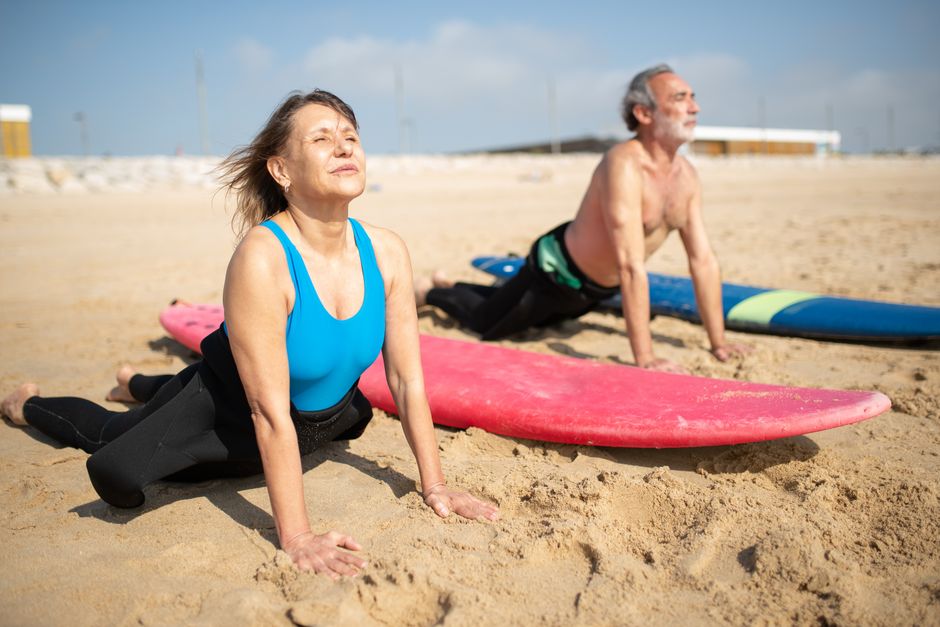
An instructor should observe your shoulder active range of motion (AROM) on the sand. They should check your ability to fully elevate your arms overhead without arching your lower back. If you display a restricted range, the coach must adjust your paddle technique.
A simple modification is to have you position your body slightly further back on the board to lower the angle of prone extension. This small adjustment reduces the load on your rotator cuff. It also prevents you from tiring out within the first fifteen minutes of your session.
Adapting the pop-up for joint constraints at Boston Surf Adventures
The transition from lying flat to standing on a moving board is the most physically complex part of surfing. It requires rapid hip flexion, knee flexion, and ankle dorsiflexion. A clinical review in PHYSICAL ASSESSMENT IN SURFERS: GUIDELINES FOR HEALTH PROFESSIONALS - PART 2 LOWER QUARTER shows that lower-quarter joint restrictions are the leading cause of failed pop-ups and acute joint strains in beginner surfers.
At Boston Surf Adventures, our weekend Surf Camps in Boston and New England — Boston Surf Adventures are designed to help you catch 50 to 70 waves in a weekend. Doing this requires massive physical repetition, which is why we offer our Ride a Surf Board in Boston & New England in your First Surf Lesson or Surf Camp — Boston Surf Adventures with custom-tailored movement coaching. If your coach does not offer pop-up variations based on your joint mobility, you are highly likely to struggle or injure yourself.
| Joint Constraint | Standard Mechanical Failure | Coaching Adaptation | Expected Outcome |
|---|---|---|---|
| Limited Hip Flexion | Hips lift too early, feet land short of the sweet spot | Cobra-to-step variation or wide-stance catch | Clean foot placement without spinal rounding |
| Knee Stiffness / Injury | Inability to deep-squat during pop-up | Modified side-slip pop-up or knee-to-foot transition | Stable stance with reduced joint shear stress |
| Ankle Dorsiflexion Restriction | Heel lifts, pushing weight too far forward | Angled rear-foot placement on the stringer | Balanced center of gravity over the board's midpoint |
If you have stiff hips, your feet will land too far back on the board, causing the nose of the surfboard to dive under the water. Instead of trying to force a standard pop-up that your joints cannot physically perform, we teach a modified step-through technique. This adaptation bypasses the need for extreme hip flexion, allowing you to stand up smoothly and maintain your balance.

Demystifying surf fitness with the Boston Surf Adventures methodology
Many aspiring surfers believe they need to complete a grueling strength-training program before they can take their first lesson. They spend weeks on treadmills and weight machines, trying to build general fitness. This approach misses the target because surfing requires highly specific joint mobility and movement coordination, not just cardiovascular endurance.
Our founder, Grant Gary, is a former school teacher with 15+ years of professional teaching experience. He approaches surf instruction as physical education. This means we break down complex athletic movements into digestible, accessible progressions that match your natural biomechanics.
Assuming all pop-ups look identical
The belief that every surfer must pop up in a single, explosive jump is a myth. Professional surfers with decades of tissue conditioning can perform these movements effortlessly, but forcing a beginner to replicate them is a recipe for joint strain.
An experienced educator looks at your physical structure and finds the path of least resistance. We teach different variations of the pop-up depending on your age, flexibility, and strength. This approach takes the frustration out of the learning process and ensures that you do not build bad habits.
Confusing cardiovascular fitness with joint mobility
You can have excellent cardiovascular endurance and still struggle to stand on a surfboard if your ankles and hips are locked. Research on the musculoskeletal and physiological profile of surfers highlights that specific joint flexibility is a much stronger predictor of surfing success than general aerobic capacity.
If your ankles cannot bend deeply, you will not be able to sink your weight into your knees to absorb the motion of the wave. A structured pre-surf screening identifies these restrictions before you enter the water, allowing us to prepare you with specific mobility drills on the sand.
To experience an instruction model built around your specific physical needs, visit the Boston Surf Adventures homepage to find a program that fits your physical baseline.