Anyone can push a beginner into a crumbling whitewater wave and yell "stand up," but that sequence alone will never make you an independent surfer. To avoid this common plateau, Boston Surf Adventures uses a structured, education-first approach to teach the oceanography and swell-reading mechanics required for true self-sufficiency. For adult learners and parents vetting surf school programs, the clearest benchmark of a quality coach is a stated curriculum that covers oceanography concepts like wave period, wind direction, and swell generation—not just board balance. By auditing a coach's technical communication and ensuring they teach out-of-water surf science, you can transition from catching five accidental waves on your own to successfully identifying and riding dozens of clean swells independently.
The out-of-water curriculum requirement at our Boston surf school
When you look for a surf school in the Greater Boston area, the standard experience often starts directly on the sand. You get a quick five-minute demonstration on how to pop up, a brief warning about rip currents, and then you are immediately sent into the water. This rapid transition skips the entire foundation of wave literacy. A legitimate surf education company, like Boston Surf Adventures, treats land-based instruction as a formal classroom setting rather than a brief hurdle before wetsuits get wet.
Before booking any program, you should ask if they have a dedicated, out-of-water portion of their syllabus. In our analysis of regional programs, the presence of a structured, pre-surf briefing is the single best predictor of whether you will learn to surf independently or remain dependent on an instructor. This is why we developed our Friday night Surfology 101 online program, which delivers the entire conceptual framework needed to understand New England waters before you ever touch Nahant Beach.
Understanding the science of the ocean is not an academic exercise. It is a safety and performance requirement. If you do not understand how waves are formed, where they get their energy, and how they react to the local coastline, you will spend your sessions paddling aimlessly. You can learn more about how to vet these educational standards in the surf instructor audit: How to verify your coach can actually teach.

Reading wind and weather charts
To become a self-sufficient surfer, you must learn to read surface weather maps and interpret offshore data. This begins with understanding how atmospheric pressure gradients generate the winds that ultimately create surf. When you look at a weather map, you are looking at lines of equal atmospheric pressure, known as isobars. Tightly packed isobars mean strong pressure gradients, which produce high-velocity winds over vast distances of open ocean.
A qualified coach should teach you how to analyze these wind fields. You need to know the difference between a distant groundswell, generated by low-pressure systems thousands of miles away, and a local windswell, created by nearby atmospheric disturbances. This distinction dictates the quality and shape of the waves you will encounter. Groundswells carry more energy and tend to produce clean, organized lines, whereas windswells are often chaotic, short-period, and difficult to read. You can explore the mechanics of atmospheric pressure and wave generation further through the resources provided by the Hawaii Waves and Surf Forecasting guide.
Understanding local tide swings
The New England coastline is defined by dramatic tide changes that completely alter how waves break over shallow sandbars. At Nahant Beach, MA, a spot that works beautifully at mid-tide can become completely flat at high tide, or a dangerous shore-break at low tide. A surf school must teach you how bathymetry—the underwater topography of the ocean floor—interacts with these shifting water depths.
When tide levels change, they alter the depth of the water over the sandbar. If the water is too deep, the wave energy passes over the bar without breaking, leaving you with nothing to ride. If the water is too shallow, the waves close out all at once, creating a wall of water that slams shut and offers no rideable face. A professional coach does not just tell you when to show up; they explain the specific tide windows that make your local break function safely and predictably.
Evaluating the in-water wave selection protocol in New England
Once you enter the ocean, the coaching style must change from passive observation to active skill-building. The worst way to learn to surf is through the "assisted push" method. In this setup, the instructor stands in waist-deep water, spots an oncoming wave, grabs your board, and shoves you forward. While this gets you standing up quickly, it completely bypasses the mental processing required to read and catch a wave.
To help you contrast these approaches, we have broken down the two main styles of in-water instruction below:
| Coaching style | What it is best for | Progression speed | Key tradeoff |
|---|---|---|---|
| The Push-In Method | First-time recreational tourists seeking a quick photo | Extremely slow after the first day | Teaches zero independent skills; builds immediate coach dependency |
| Independent Swell Reading | Serious students wanting to surf without supervision | Rapid long-term progression | Requires more physical effort and mental focus on day one |
At Boston Surf Adventures, our Sunday curriculum at Nahant Beach is explicitly designed around independent swell reading. We focus on teaching you how to paddle for your own waves, time your pop-up, and select the right wave face in conditions three feet and under. This is how you transition from a passive passenger to an active pilot.
The 50-wave repetition threshold
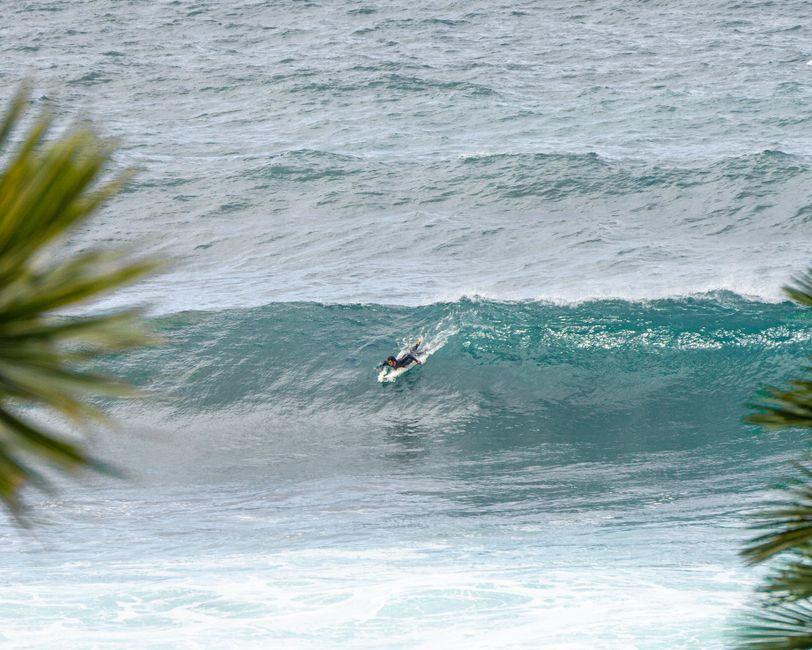
The primary benefit of having a professional coach in the water is the sheer volume of quality repetitions you can achieve. If you try to learn on your own over two days, you might successfully catch five waves. The rest of your time will be spent paddling in the wrong spot, getting caught inside by sets, or wiping out on close-outs. You end up exhausting your muscles without building any positive muscle memory.
With an experienced coach guiding your positioning, you can catch 50 to 70 waves in a single weekend. This massive increase in wave count allows you to focus purely on the mechanics of the pop-up and the feel of the wave face. Instead of fighting the ocean, you are getting clean, repeatable practice. This high-volume approach builds the neural pathways required for automatic movement, saving you months of frustration.
Transitioning from coach-assisted to independent paddling
The ultimate goal of any legitimate surf program is to make the coach obsolete. This transition must be planned and systematic. On day one, a coach might assist with your positioning to help you feel the speed of the wave. By day two, however, you should be paddling under your own power, reading the swell line as it approaches, and making your own decisions.
This shift requires you to master paddle acceleration. You cannot paddle at a single, static speed; you must match the velocity of the water as it begins to lift the tail of your board. A qualified coach will teach you the exact moment to apply three extra, powerful strokes to lock your board into the wave's energy. They will also teach you how to pull off a wave safely if it begins to close out, protecting both you and other surfers in the lineup.
What most people get wrong about surf progression
Many adult beginners arrive at our Greater Boston surf school with a clear idea of why they are struggling. Almost always, their self-diagnosis is completely wrong. They believe their failures are physical—that they lack the balance, the core strength, or the speed to stand up on the board. In reality, their issues are almost entirely cognitive.
Confusing board balance with wave literacy
Balance is rarely the limiting factor for adult learners. Modern beginner surfboards are highly stable, high-volume platforms designed to float easily. The real problem is wave literacy. If you paddle for a wave that is already closing out, or one that lacks the necessary slope to push your board, no amount of balance will save you. You will either sink or get tossed over the falls.
When you learn to read the ocean, you begin to see that waves have different zones. You are looking for the "peak"—the highest point of the swell where the wave will begin to break first. Catching a wave at the peak gives you a smooth, sloping entry. Attempting to catch a wave in the flat shoulder, or in the white water after it has already collapsed, is a recipe for failure. A great coach focuses your attention on the horizon, teaching you to spot these shapes before they reach you.
Ignoring wind direction entirely
Another massive mistake is ignoring the wind. Beginners often look at a basic swell forecast, see that the waves are three feet high, and head to the beach. They are disappointed to find a messy, choppy ocean that is impossible to paddle through. They have ignored the wind direction, which is just as important as swell height.
Onshore winds blow from the ocean toward the land. They destroy the shape of the waves, causing them to crumble prematurely and creating a bumpy ride. Conversely, offshore winds blow from the land out to sea. These winds groom the wave faces, holding them open longer and creating clean, smooth surfaces. This is why our international retreats in Rincon, Puerto Rico, prioritize morning sessions, where offshore winds are guaranteed until at least 10 AM. We want our students to experience how clean wind conditions make wave selection and riding significantly easier.
Verifying the use of objective feedback loops in surf instruction
If you want to ensure your money is well spent, you must ask a surf school how they deliver feedback. A coach who simply yells "good job" or "paddle harder" is not providing instruction; they are cheerleading. To break through plateaus, you need precise, technical corrections based on objective data.
This is where international standards become critical. Boston Surf Adventures is the only ISA Certified surf school in New England. This means our coaching methodologies are backed by the International Surfing Association, the worldwide governing body for the sport. Our coaches do not rely on ad-hoc advice. We use structured progression frameworks to analyze your movement and identify the exact root cause of your mistakes.

Correcting mechanics with video analysis
The absolute gold standard for surf coaching is video analysis. Surfing happens incredibly fast, and what you think you are doing on the board is often very different from what is actually happening. You might feel like you are standing low and looking forward, while the camera reveals you are standing completely straight and staring down at your feet.
During our international surf retreats, we film every single wave caught during the morning session. Between sessions, our founder, Grant Gary, who brings over 15 years of professional teaching experience, runs dedicated video review sessions. We do not overwhelm you with a dozen different corrections. We identify just two simple, actionable changes for your afternoon session. By pairing visual proof with professional educational design, we help you make immediate, lasting adjustments to your stance, timing, and wave entry.
According to oceanography coaching frameworks featured by Sportsconnect360, integrating real-time environmental data with video feedback is the most effective way to build genuine wave literacy. It allows you to connect the visual shape of the swell on screen with the physical sensation you felt in the water. This feedback loop is what turns a casual beach activity into a lifelong, independent skill.
Vetting your next move in the water
Before you sign up for your next lesson, run through this simple audit with your prospective surf school:
- Ask if they have a structured, out-of-water curriculum that covers swell forecasting, tides, and wind patterns.
- Inquire if their instructors are certified by the International Surfing Association (ISA) or if they rely purely on local experience.
- Confirm that their day-two program focuses on paddling for your own waves and independent wave selection, rather than continuous instructor pushes.
- Check if they offer advanced feedback tools, such as video analysis, to correct subtle mechanical errors.
If a program cannot answer these questions clearly, you are paying for a rental board and a high-priced pusher, not an education. To build a foundation that will serve you on any coastline in the world, review the BSA Progression Pyramid and book a weekend surf camp at Boston Surf Adventures.