Boston Surf Adventures provides a specific framework for auditing New England surf retreats based on objective metrics like water time and coach-to-student ratios. To avoid wasting a weekend, prospective surfers should look for programs that guarantee specific in-water coaching hours and maintain a 3:1 adult ratio. This guide highlights how to verify these factors, along with International Surfing Association (ISA) certifications, to ensure rapid skill progression at spots like Nahant Beach or Rincon during the 2026 season.
Find the actual in-water coaching hours
Booking a summer surf weekend sounds idyllic until you realize you spent four hours on the sand playing icebreakers and caught exactly one wave. Many generic programs pad their schedules with long on-land orientations and "surf theory" that could have been delivered via email. When you look at an itinerary, calculate the time between "gear on" and "gear off." If a four-hour block includes a one-hour lunch and 45 minutes of beach games, your actual coaching window is halved.
At Boston Surf Adventures, we structure our Weekend Surf Camp around the reality that muscle memory requires repetition. Our Nahant Beach weekend camps feature two distinct surf sessions on Saturday focused specifically on popping up and paddling. By Sunday, the focus shifts to wave selection and pulling off waves. This density of activity is why we can claim that a student with a coach can catch 50 to 70 waves in one weekend, whereas someone surfing solo might struggle to catch five.
You should specifically look for itineraries that offer "split sessions." High-intensity coaching for two hours, followed by a mandatory rest and hydration break, and then another two-hour session is significantly more effective than one marathon six-hour day. The human body, especially for those not accustomed to the specific paddle muscles of the upper back and shoulders, typically hits a wall after 90 minutes of active water time. A professional itinerary respects this physiological limit while maximizing the windows when the tide and wind are optimal.
When comparing options, consider the difference between a "guided beach day" and an "accelerated coaching program." A guided day is about the experience; an accelerated program is about the result. If you are choosing between a DIY surf weekend vs. all-inclusive coaching, the primary value of the latter is the elimination of "dead time." Professional programs handle the gear logistics and tide monitoring so that every minute you are at the beach is spent either in the water or receiving direct feedback.

Audit the student-to-coach math
Progression stalls when you have to wait 20 minutes for a coach to watch your form. The most common failure point in New England surf schools is the "herd" model, where one or two coaches attempt to manage a group of 15 students. In this scenario, the coach becomes a lifeguard rather than an instructor. You are paying for eyes on your pop-up, not just a person to tell you when a wave is coming.
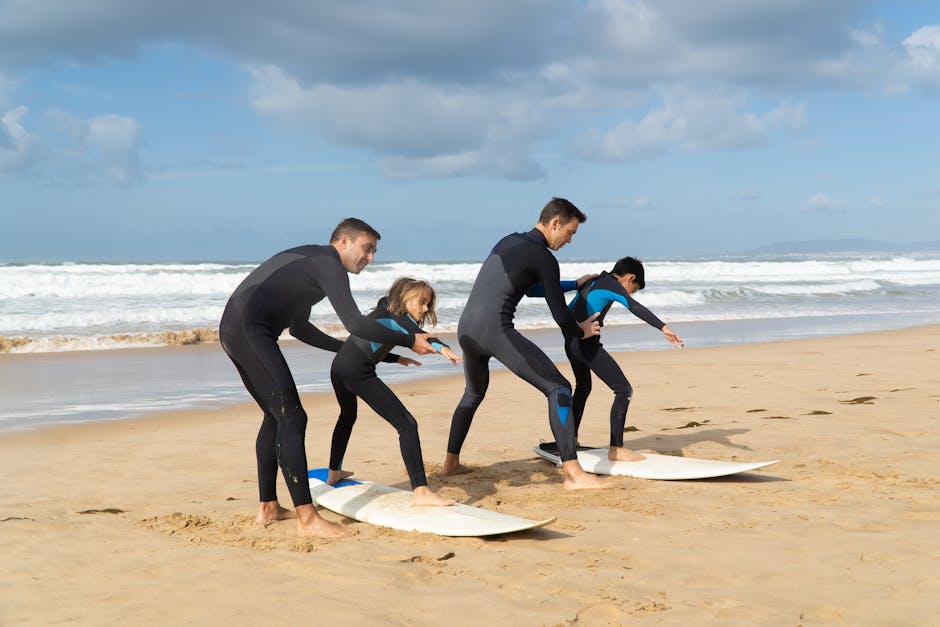
A professional surf retreat will cap adult groups at a 3:1 student-to-coach ratio. This is the gold standard because it allows the coach to see every single wave you attempt and provide immediate, actionable feedback before you paddle back out. For kids' camps, the ratio should never exceed 5:1. Smaller ratios are not just a luxury; they are a safety and education requirement. When the ratio is right, the coach can differentiate the instruction to meet the individual needs of every client, whether they are a total beginner or an intermediate surfer working on turns.
Our founder, Grant Gary, is a former school teacher with over 15 years of professional teaching experience. He built the Boston Surf Adventures curriculum on the principle that feedback must be immediate to be effective. If you catch a wave and don't receive a correction until three waves later, you have already reinforced a bad habit three times. We emphasize "differentiated instruction," a term from the professional education world that means the coach adjusts their teaching style and goals for each student in the 3-person pod.
Before booking, ask the school: "What is the hard cap on your coaching groups?" If they give you a range like "usually six to eight," that is a red flag. A firm commitment to a 3:1 or 4:1 ratio indicates the school prioritizes student success over profit margins. This level of attention is what allows a student to catch 10 times more waves than they would on their own. You can find more about how we structure these groups in our surf school safety audit.
| Feature | Professional Surf Retreat | Generic Beach Camp |
|---|---|---|
| Adult Student-to-Coach Ratio | 3:1 or lower | 6:1 to 10:1 |
| In-Water Coaching Time | 4+ hours per day | 90 minutes to 2 hours |
| Feedback Style | Individualized/Corrective | General/Encouraging |
| Safety Certification | ISA Certified | Local Permit Only |
| Progression Tools | Video Analysis & Journals | None |
Look for integrated video analysis
You cannot fix what you cannot see. In our experience coaching thousands of students, there is a massive gap between what a surfer thinks they are doing and what they are actually doing. You might feel like you are standing up straight, but the video shows you are "pooping the chair" or looking down at your feet instead of the beach. Advanced itineraries include dedicated filming sessions followed by beach-side breakdowns.
We use video analysis to identify "warp zone" skills—the one or two mechanical changes that will yield the biggest jump in performance. In our Progression Sessions, we film for 20 minutes and then spend 40 minutes on the beach analyzing the footage. This isn't about making a highlight reel for social media; it's a diagnostic tool. We use the BSA Progression Pyramid to show you exactly where your mechanics are breaking down.
When vetting an international retreat, such as those in Rincon, Puerto Rico, video analysis is even more critical. In those environments, the waves are more consistent, which means you have more opportunities to repeat mistakes. A retreat that films every wave in the morning and reviews them before the afternoon session ensures that the second half of your day is spent fixing the errors identified in the first half. This feedback loop is the fastest way to stop "outrunning the wave" or failing to make the drop.
If a school mentions "photos included," clarify if those are "action shots" for purchase or "coaching videos" for analysis. A professional school uses the video as a textbook. Without a visual record of your sessions, you are relying entirely on the coach's verbal description, which is often lost the moment you paddle back into the impact zone.
Verify the safety and governing body credentials
Do not assume all local camps meet international safety standards. New England has specific permit regulations for various beaches, but a town permit is often just a business license—it does not guarantee coaching quality or water safety protocols. To truly vet a program, you must look for external validation from global governing bodies.
ISA Certification
The International Surfing Association (ISA) is the worldwide governing body for surfing, recognized by the International Olympic Committee. Boston Surf Adventures is the only ISA Certified Surf School in New England. This means our curriculum, our safety standards, and our coaching methods have been audited to meet a global benchmark. An ISA certification tells you that the instructors aren't just "good surfers" who decided to teach; they are trained educators who understand oceanography, rescue techniques, and the physics of the sport.
Lifeguard and CPR requirements
Safety in the North Atlantic is a serious matter. Whether you are at Nahant Beach or further north in Maine, the conditions can change in minutes. A professional itinerary should explicitly state that all in-water coaches are certified lifeguards and all on-land staff is CPR certified. We go a step further, with coaches trained in custom rescue techniques developed by Grant Gary specifically for our local breaks.
When you are looking at a school, ask about their emergency action plan. A school that can't tell you where their first aid kit is located or who the designated safety lead is for the day is not a school you should trust with your family. This is especially important for Boston Summer Surf Camps where children are involved. Our kids' camps maintain a strict 5:1 ratio and use a game-based approach to teach ocean literacy alongside surfing skills, ensuring that every student leaves more confident than they arrived.
Evaluate the total value beyond the price tag
A $100 lesson might seem cheaper than a $300 weekend camp until you realize the $100 lesson provides zero gear, no follow-up, and a 10:1 ratio. When you audit an itinerary, look for the "total value" of the package. A high-quality program should include everything you need to succeed so you don't have to make additional investments before you're ready.
For example, our weekend camps are valued at $1,180 but sold for a fraction of that. This includes:
- Wetsuit and board rentals ($100 value)
- Four targeted surf lessons ($280 value)
- Surfology 101 online program ($100 value)
- Bonus Swim to Surf fitness program ($200 value)
- The "No BS Surf Gear Guide" to save you from buying the wrong equipment later
By including a "Swim to Surf" program and the Surfology 101 course, we ensure that students don't spend their expensive water time learning things that could have been handled on land. If an itinerary is thin on these "pre-work" or "bonus" elements, you will likely spend your first hour in the water learning how to put on a wetsuit or which way the fins go. A professional program respects your time and your investment by handling the basics before you ever hit the sand.
The goal of a professional surf retreat is to make you a self-sufficient surfer. According to Yeeew!, New England surfing requires grit and determination. You shouldn't have to waste that grit on a poorly planned schedule. Choose a program that treats surfing as a discipline to be mastered, not just a hobby to be sampled.
Review the exact itinerary for our upcoming Nahant Beach weekend surf camps to see how an accelerated coaching schedule is structured for the 2026 season. If you are looking for more intensive, skill-specific training, check out our Progression Sessions to see how we use video to skip the months of frustration common to self-taught surfers.