Boston Surf Adventures uses a performance compression framework to solve the persistent beginner plateau by replacing unstructured sessions with high-volume repetition and video analysis. By targeting 50 to 70 waves in a single weekend at Nahant Beach, students bypass years of trial and error through a methodology designed by former educator Grant Gary. This approach relies on ISA Certified standards to ensure that technical habits like pop-up timing and wave selection are ingrained correctly before bad habits become permanent.
The mechanics of the beginner plateau
The most significant barrier to surf progression for the average adult learner is not a lack of athletic ability, but a lack of density in the learning experience. Surfing is unique among sports because the playing field is in constant motion, providing a low-frequency environment for repetition. A self-taught surfer visiting Nahant Beach independently may spend three hours in the water and successfully engage with only five waves. This low wave count is insufficient for the human brain to move a new movement sequence from conscious effort to subconscious muscle memory.
When the intervals between successful repetitions are too long, the brain struggles to identify which physical adjustments led to success and which led to a wipeout. This creates a "reactive" state where the surfer is simply surviving the wave rather than practicing a skill. Without a coach to provide external feedback, these surfers often reinforce "survival mechanics"—such as grabbing the rails during a pop-up or looking down at the board—which eventually become deeply ingrained bad habits. These habits can take months or years of intentional practice to erase once they are cemented.
At Boston Surf Adventures, we diagnose this plateau as a feedback loop failure. In most Boston-area surf schools, students are given a board and basic instructions but lack the volume of waves necessary to actually test those instructions. To break the plateau, the learning environment must be modified to increase the frequency of successful trials. By moving the student from five waves to over fifty in a single weekend, we provide the cognitive density required for the nervous system to actually learn.
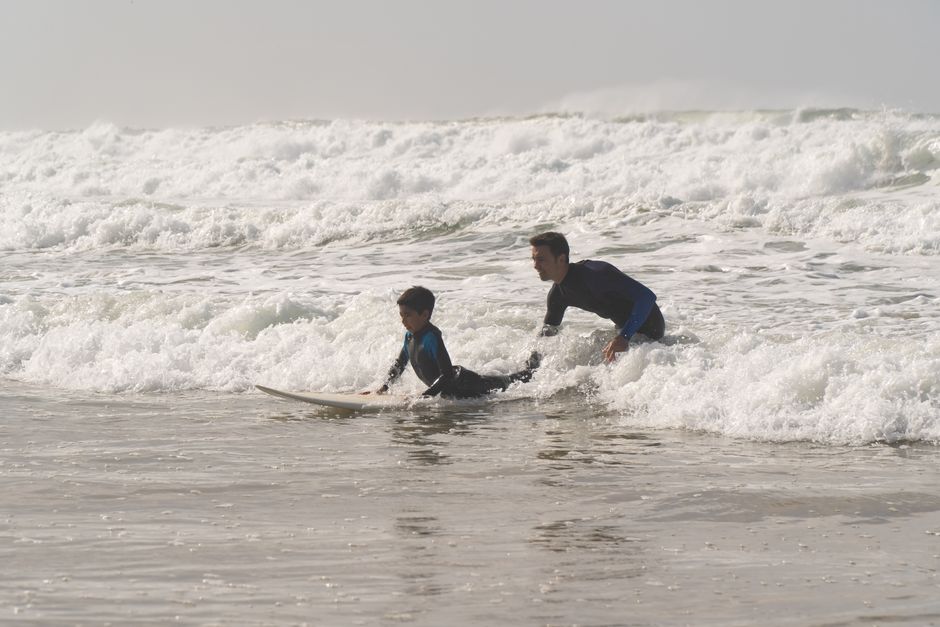
The neuroscience of surf mechanics and muscle memory
Surfing requires the coordination of complex motor patterns under high-pressure, time-sensitive conditions. To master a pop-up, the brain must execute a specific sequence of muscle contractions while simultaneously processing visual data about wave shape and speed. This is a high cognitive load task. According to principles of motor learning used in high-performance programs like NOMB Surf, the key to mastering such tasks is to bypass the conscious mind through repetition.
Overriding bad habits
When a surfer has spent months or years surfing incorrectly, they have built "incorrectly accustomed movement sequences." The nervous system has paved a highway for the wrong movement. To override this, the Boston Surf Adventures methodology uses a "closed-loop" feedback system. We start with land-based technical framing to establish the correct movement pattern in a zero-stress environment. When the student enters the water at the North Shore, the coach provides immediate, real-time corrections. This prevents the brain from logging a "bad" repetition as a success.
The role of video feedback in motor learning
One of the greatest challenges in surf progression is the disconnect between what a surfer feels they are doing and what they are actually doing. A student may feel they are looking down the line, while their head is actually buried in their chest. We solve this through targeted video analysis. By filming every wave, we allow the student to see the mechanical flaw objectively.
The BSA Progression Pyramid dictates that we only provide two specific technical changes per day. This is a deliberate pedagogical choice to prevent cognitive overload. If a coach provides ten corrections, the student's brain freezes. If we provide two, the student can focus 100% of their mental energy on those specific shifts, leading to accelerated surf progression.
The 48-hour performance compression framework
The core of our Boston-based instruction is the weekend intensive, a 48-hour period designed to compress six months of casual surfing into two days. This framework is not about physical endurance; it is about maximized technical engagement. While a typical day at the beach for a hobbyist involves a lot of sitting and waiting, a session with a Boston Surf Adventures coach is a structured technical drill.
Land-based technical framing (Surfology 101)
The framework begins before the student even touches the water at Nahant Beach. Through our Surfology 101 program, we establish the "mental model" of the surf session. This includes ocean literacy—understanding how waves form, how to read a New England surf forecast, and the physics of wave energy. By removing the "mystery" of the ocean on land, we free up the student's mental bandwidth to focus entirely on physical mechanics once they are in the water. This transition from theory to practice is a cornerstone of how we learn 10x faster.
High-volume wave count targets
The primary metric of success for our weekend camps is the wave count. In a standard lesson at most schools, a student might catch 10 waves. In the BSA framework, we target 50 to 70 waves over two days. We achieve this through:
- Small group ratios (maximum 3:1 in many sessions)
- Strategic positioning by ISA Certified instructors
- Assisted paddling and wave selection to ensure the student spends their energy on the pop-up and ride, not just fighting the current
Progression pathways compared
The difference between self-guided practice and the BSA methodology is stark when viewed through the lens of time-to-mastery. For a professional in Greater Boston, time is the most limited resource. Spending every Saturday for three years to reach a mediocre level is an inefficient use of that resource.
The following table compares the typical outcomes of a self-taught path versus the Boston Surf Adventures intensive weekend model.
| Feature | Self-Taught Practice | BSA Weekend Intensive |
|---|---|---|
| Wave count per weekend | 3–8 waves | 50–70 waves |
| Feedback loop | Internal/Subjective | External/Video Analysis |
| Technical focus | Survival & Balance | BSA Progression Pyramid (2 targets) |
| Ocean Literacy | Trial and error | Surfology 101 (Guided) |
| Key Tradeoff | Low cost / Years of frustration | Upfront investment / 10x faster progress |
This comparison highlights why we focus on "performance compression." By increasing the frequency of successful repetitions, we enable the student to move past the "white water" phase and into the green wave phase in a fraction of the time. This is particularly vital for those interested in Progression Sessions, where the goal shifts from standing up to performing advanced turns and maneuvers.
What most people get wrong about early progression
The surf industry often markets the sport as a zen-like, intuitive journey. While that may be true for advanced surfers, it is a detrimental mindset for beginners. Surfing, at its start, is a highly technical discipline akin to gymnastics or martial arts.
The illusion of independent practice in small waves
Many beginners believe that small waves (under 3 feet) are just for "playing around" and that "real" learning happens in bigger surf. This is a fundamental error. Small, consistent waves—the kind we frequently see at Nahant Beach—are the clinical environment for technical mastery. In small waves, the penalty for a mistake is low, allowing the student to experiment with pop-up timing and foot placement without the fear of a heavy wipeout.
If you cannot perfectly execute a pop-up and a bottom turn in 2-foot surf, you have no business being in 5-foot surf. Using small waves as a laboratory to lock in mechanics is the secret to bypassing the beginner plateau. This is why we emphasize identifying real progression programs that respect the value of small-wave technical work.
Treating surfing as an endurance sport instead of a technical skill
The "hustle" culture of surfing suggests that you should paddle until your arms fall off. However, exhausted muscles lead to poor form. When a student is tired, they start "cheating" their pop-up, using their knees or dragging their toes. These repetitions are not just useless; they are harmful because they reinforce bad muscle memory.
The Boston Surf Adventures methodology emphasizes short, high-intensity technical bursts followed by structured recovery. We want every wave caught to be a high-quality repetition. If a student is too tired to pop up correctly, we stop the session or shift to a different drill. Quality of repetition will always trump quantity of time in the water when it comes to neuroplasticity and skill acquisition.
Professional pedagogy in a beach environment
The success of our methodology is largely due to the background of our founder, Grant Gary. As a former school teacher with over 15 years of professional education experience, Gary understands how humans actually learn. Most surf coaches are simply "good surfers" who try to describe what they do. Gary, however, has built a curriculum based on pedagogical standards.
This includes:
- Scaffolding: Breaking a complex skill (surfing) into smaller, achievable parts.
- Differentiated Instruction: Adjusting coaching cues based on the student's individual biomechanics or fears.
- Immediate Feedback: Correcting a mistake within seconds of it occurring to ensure the brain associates the correction with the action.
As the only ISA Certified surf school in New England, we adhere to global standards that ensure your coach isn't just a surfer, but a trained educator. Whether you are at our home base in Nahant or joining us for one of our Puerto Rico Surf Retreats in Rincon, the methodology remains consistent. We focus on the "why" behind every movement, ensuring that when you leave our program, you have the "ocean literacy" to continue your journey as an independent, capable surfer.
Review the upcoming availability for our Nahant Beach weekend surf camps to apply this performance compression framework to your own progression and finally move beyond the beginner plateau.