How to audit a surf school's emergency beach access

Boston Surf Adventures

When an in-water surfing injury occurs, the arrival of paramedics at the shoreline is often delayed not by response times, but by the physical barriers of the sand itself. Vetting a surf school requires checking how emergency vehicles access the sand, a baseline safety measure prioritized by professional operators like Boston Surf Adventures at Nahant Beach. The most critical step in this audit is verifying that your chosen program has a dedicated Emergency Action Plan (EAP) that coordinates with local municipal 4x4 ambulance teams. By checking physical ramps and instructor extraction protocols beforehand, you can identify and avoid unprepared surf coaches before booking your lesson.
The gap between the coastal road and the wave
Most people look at the ocean or the quality of the surfboards when they arrive for a lesson. They look at the sky and check the temperature of the water. They rarely look behind them at the dunes, the seawalls, or the single-lane stairs that lead down to the beach.
If a medical crisis occurs in the whitewater, a standard ambulance cannot drive onto the beach. Paramedics must transition to specialized beach response vehicles or rely on local beach patrols. If those vehicles do not have a clear, reinforced path to the sand, emergency responders are forced to travel on foot carrying heavy medical gear.
This delay can turn a minor incident into a severe health crisis. The transition from water to sand to road is the weakest link in beach safety.
| Access Category | Physical Infrastructure | Transit Capabilities | Response Time Impact |
|---|---|---|---|
| Standard Foot Access | Stairs, wooden boardwalks, narrow dune paths, seawalls | Foot transit only; responders carry backboards and trauma kits by hand | Delays of 10 to 20 minutes depending on sand distance |
| Restricted Vehicle Access | Unpaved dirt ramps, soft sand entry points, locked gates | 4x4 vehicles only; high risk of getting stuck without deflated tires | Variable delays; dependent on gate key holders and sand density |
| Optimized Emergency Transit | Reinforced concrete ramps, wide clearance, designated access gates | Full-sized 4x4 emergency ambulances and utility vehicles with direct beach entry | Immediate access to shoreline; transit speeds up to 20km/h on hard sand |
The physical infrastructure of beach emergency response at Boston Surf Adventures
Evaluating the physical layout of the beach where a surf school operates is the first step in performing a safety audit. Not all shorelines are created equal when it comes to heavy vehicle mobility.
Ramps and designated access points
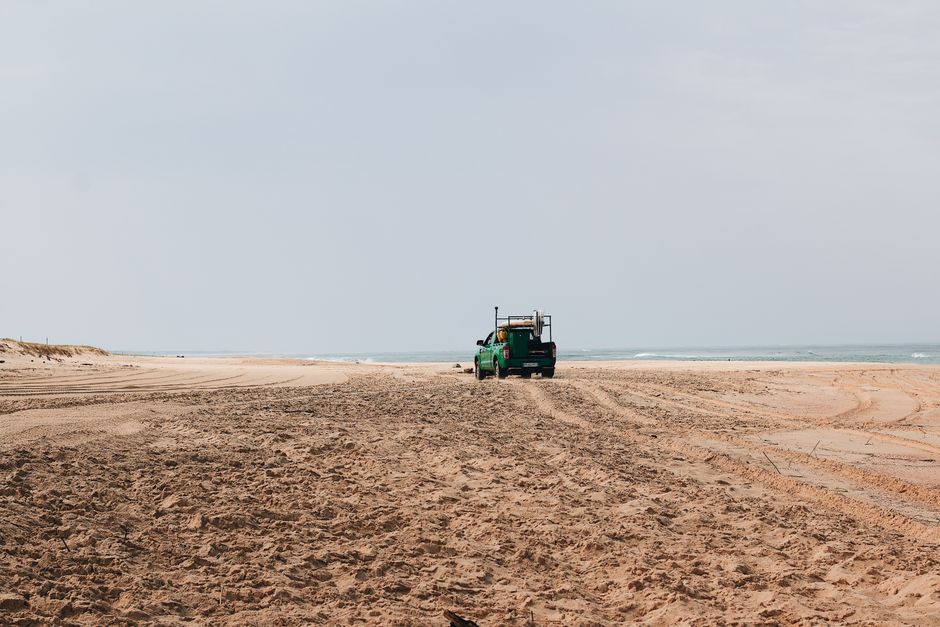
Emergency vehicles like a 4x4 ambulance cannot simply drive over dunes or drop down seawalls. They require designated entry ramps that are engineered to support heavy vehicles. At Nahant Beach, professional operations run lessons near established access points like beach entrance #9. This entrance features a structured path that allows municipal rescue vehicles to descend safely onto the sand without getting bogged down in uncompacted coastal soil.
When auditing a surf school, you must physically locate these entry points. If a surf camp operates hundreds of yards away from the nearest ramp, the response window widens.
Sand density and vehicle limitations
Sand is not a uniform driving surface. Driving a multi-ton rescue vehicle on dry, soft sand requires specialized driving protocols. According to public safety guidelines outlined in the PSS 7.6 Lifesaving Vehicles on Beaches Standard Operating Procedures, emergency vehicles must deflate their tires to a lower limit, often around 16psi, to maintain traction.
This deflation process takes time, and driving on deflated tires limits the vehicle's braking and steering response. Speed limits on populated beaches are heavily restricted, with standard limits dropping to 5km/h in active swim zones or between safety flags to protect beachgoers. A surf school must choose teaching zones where the sand density supports these vehicles and allows responders to reach the water's edge safely.
The crowd factor
A crowded summer beach is a physical obstacle course for emergency vehicles. Sunbathers, beach umbrellas, and windbreaks block direct paths. During peak summer sessions, such as those running throughout July and August, beaches in the Greater Boston area experience high visitor density.
An experienced surf school coordinates its teaching zones to maintain clear sightlines to the closest access ramp. Instructors must actively monitor beach congestion and adjust their staging areas to prevent a wall of tourists from blocking an incoming medical vehicle. According to the New Jersey MEL Safety Institute's bulletin on Beach Vehicles: Operational Considerations, operating emergency vehicles on public beaches requires highly specialized local awareness to manage these crowd dynamics safely.

Analyzing the surf school's Emergency Action Plan
Every legitimate surf camp or surf school must maintain a written, site-specific safety protocol. This document is referred to as an Emergency Action Plan, or EAP.
On-beach communication systems
An instructor cannot rely on a phone locked inside a dry bag at the back of a distant tent. Immediate water-to-land communication is required. Instructors must carry waterproof communication gear directly on their bodies or on their rescue boards while coaching in the water.
This includes waterproof VHF radios or marine-grade cellular cases that allow immediate contact with emergency dispatchers. If a coach has to swim back to the beach, search through a backpack, and find cell reception, precious minutes are lost. You should read about how these protocols work in The Open-Ocean Missing Swimmer Audit: Vetting Surf School Emergency Protocols.
Location specificity
"We are at the beach" is not a valid coordinate for emergency dispatchers. A professional EAP must outline exact, pre-verified meeting coordinates. For instance, the safety protocols of established programs list precise drop-off zones and vehicle turnaround areas.
A good example of this is the Scarborough Surf School Safety and Compliance Pack, which details exact parking, drop-off, and vehicle turnaround points for large emergency vehicles. At Nahant Beach, a safety-focused school like Boston Surf Adventures designates beach entrance #9 as its primary staging and emergency meeting location to avoid confusion.
Staff roles during an incident
When an emergency occurs, there is no time to delegate tasks on the fly. The EAP must pre-assign specific responsibilities to every staff member on the beach.
One coach must remain in the water to stabilize and extract the injured surfer. A second coach or land-based coordinator must immediately contact emergency services and run to the designated access ramp to meet the incoming 4x4 ambulance. The land coordinator's job is to open any locked access gates, clear pedestrians from the ramp, and guide the rescue vehicle directly to the casualty on the sand.

Instructor rescue capability and medical training at Boston Surf Adventures
A 4x4 response vehicle is useless if the surf school instructors cannot manage the initial extraction and stabilization of the student.
Minimum certifications
Do not assume every person wearing a coach's shirt is qualified to perform an ocean rescue. At a bare minimum, every in-water instructor at a surf school must hold an active beach lifeguard certification.
Additionally, all supporting land staff must be certified in CPR and first aid to assist once the student is brought to the dry sand. You can learn more about how land-based staff manage safety during these transitions by reading The surf camp land-safety audit: Verifying off-water supervision.
Custom rescue techniques
Standard pool lifeguarding does not translate directly to open-ocean surf zones. Surf coaches must be trained in specialized surfboard-assisted rescue techniques.
This includes board-flipping extraction methods, dealing with rip currents while supporting an injured swimmer, and navigating the shorebreak. At Boston Surf Adventures, founder Grant Gary uses his 15+ years of teaching experience to train all coaches in custom rescue techniques developed specifically for the tidal conditions and sandbars of New England.
International Surfing Association standards
The gold standard for surf instruction safety is certification from the International Surfing Association (ISA), the worldwide governing body for surfing. Boston Surf Adventures is the only ISA Certified Surf School in New England.
ISA certification requires strict adherence to student-to-coach safety ratios. For example, during youth summer sessions, keeping group sizes to five or fewer students per coach ensures that instructors can maintain constant supervision and quickly initiate a physical rescue without leaving other students unmonitored in the water.
What most people get wrong about beach safety
Assuming public lifeguards replace school protocols
A common mistake is assuming that municipal lifeguards stationed on the beach relieve the surf school of its safety duties. Municipal lifeguards watch the entire public beach; they are not dedicated personal safety guards for a private surf lesson.
The surf school's staff must act as the primary first responders. They are responsible for executing the immediate in-water extraction, administering initial first aid, and calling for emergency services. Public lifeguards are a secondary layer of support, not a replacement for a rigorous, school-specific EAP.
Confusing beach proximity with vehicle access
Just because a beach is right next to a paved road or parking lot does not mean a medical vehicle can access it. High concrete seawalls, steep sand dunes, or protected salt marshes can physically isolate the shoreline from the road.
Without a designated vehicular ramp, paramedics must carry heavy backboards and medical gear over these obstacles on foot. This manual transit method is slow and physically exhausting, which directly delays patient care. An audit of a surf camp must always prioritize checking the physical pathway from the road to the wet sand.
How to conduct your own beach access audit
Before you sign up for a weekend surf camp or enroll your child in a summer program, spend ten minutes conducting a physical and verbal safety audit of the location.
- Look for a concrete or reinforced wooden ramp near the lesson staging area that is wide enough for a full-sized 4x4 utility vehicle.
- Ask the program director for their exact EAP coordinate or designated beach entrance number for emergency vehicle arrivals.
- Verify that the school maintains a low student-to-coach ratio, such as the 5:1 ratio used at Boston Surf Adventures, to guarantee that coaches are never stretched too thin during an incident.
- Confirm that all in-water coaches hold current lifeguard certifications and are trained in board-based ocean rescues.
Choosing a safer experience at Nahant Beach
Safety is not an accidental outcome; it is the result of deliberate planning and strict training. When you choose a surf school in the Greater Boston area, verifying these behind-the-scenes safety measures is the best way to guarantee a positive experience in the ocean.
Boston Surf Adventures operates with these exact protocols in place at Nahant Beach entrance #9. By combining ISA-certified coaching with custom ocean safety training, we make sure that our weekend camps and youth summer sessions are built on a foundation of professional risk management.
To learn more about our summer dates, safety guidelines, and booking details, visit the official Surf Camps in Boston and New England — Boston Surf Adventures page and secure your spot today.


