Paddling accounts for up to 60 percent of the energy you expend during a surf session, while actual wave riding takes up just 5 to 10 percent. To avoid burning out on day one of a heavy-water surf trip to Costa Rica or Hawaii, you need a targeted physical preparation strategy before you pack your board bag. Boston Surf Adventures recommends a 6-week conditioning plan that combines pool-based hypoxic swim intervals with land-based posterior chain endurance exercises. By isolating the lats, triceps, and lower back using specific high-rep, moderate-resistance drills, this regimen ensures you spend your vacation catching waves instead of staring at closeouts with dead arms.
Understanding the physical load of ocean paddling
Surfers spending long hours on the water face a stark physical reality. Paddling is not a casual warm-up; it is the dominant movement pattern of the entire sport. A study conducted by the Auckland University of Technology found that 54 percent of professional surfing is spent in low-intensity paddling. This low-intensity work keeps a surfer active at roughly 60 to 70 percent of their maximum heart rate, demanding a high level of aerobic endurance.
When you prepare for a trip, your primary training focus must be on building a massive aerobic base. Boston Surf Adventures structured surf education courses teach that a surfer's back and shoulders take the brunt of the work. Paddling is a pull-dominant movement relying heavily on the latissimus dorsi, rear deltoids, rhomboids, and lower back. Efficient paddling requires muscular endurance—the ability to sustain low-level tension over hours—rather than absolute peak strength.
Research on surf biomechanics consistently shows that paddling uses 50 to 60 percent of a surfer's energy, while wave riding takes only 5 to 10 percent. If your upper body lacks the conditioning to sustain this workload, your form breaks down. Your chest drops, your head sags, and your strokes become shallow and ineffective. Instead of gliding over the water, your board plows through it, creating drag and ensuring you miss the very waves you traveled to ride.

Pool training protocols for sustained paddle endurance
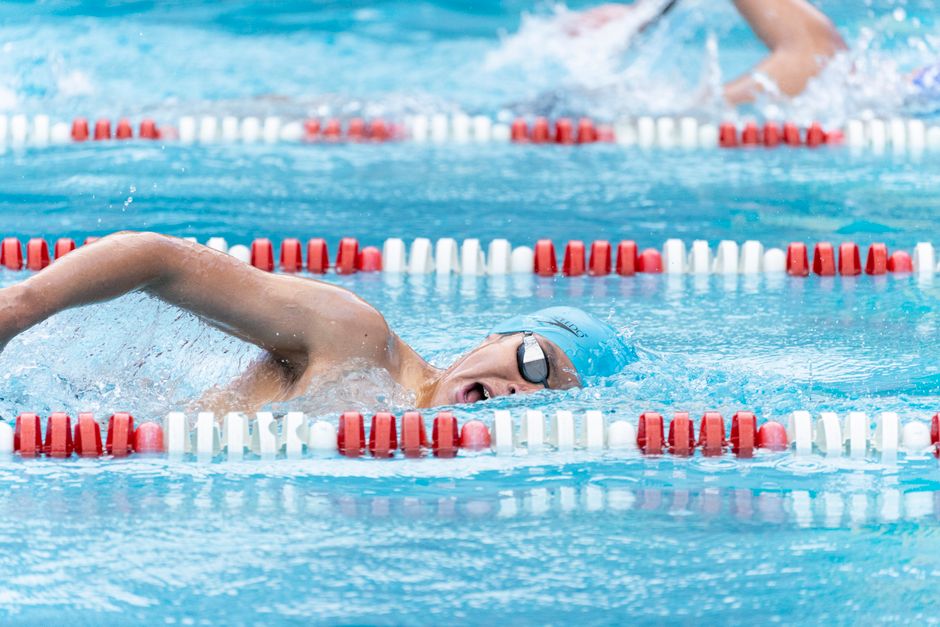
To build a body capable of handling multi-hour sessions, you must simulate the constant energy demands of the ocean. Swimming is the closest accessible simulation to paddling, but standard lap swimming is not enough. You need targeted adjustments that force the upper body to adapt to the specific postural and oxygen-deprivation challenges of a surf zone. The coaches at Boston Surf Adventures recommend hitting the pool two to three times a week for a dedicated 30-to-45-minute surf-specific swimming session.
Freestyle intervals and hypoxic training
Hypoxic training is the practice of limiting your breathing frequency during swim intervals. This method teaches your body to operate efficiently with high levels of carbon dioxide, mimicking the feeling of paddling hard through a heavy set where you cannot take a breath at will. A standard routine involves swimming 50-meter freestyle intervals while restricting your breath to every fifth or seventh stroke.
Start with a baseline of breathing every three strokes, then progress to five, and finally seven as your lung capacity increases. Maintain a flat, steady pace rather than sprinting. This systematic reduction in oxygen availability forces your heart and lungs to work harder, building the cardiovascular base needed to survive long paddle-outs.
Pull buoy isolation
In standard freestyle swimming, your legs provide a significant portion of your propulsion and keep your lower body buoyant. Surfers do not use their legs to paddle; their lower body is dead weight resting on the fiberglass deck. To replicate this biomechanical reality, place a pull buoy between your thighs during your pool sessions.
Isolating your legs forces your arms, shoulders, and core to do 100 percent of the work. This drill targets the triceps and lats, building the specific endurance required to pull water under your board. Incorporate pull buoy sets of 200 to 400 meters into your weekly routine to build the muscular stamina that prevents your arms from turning to stone on a long paddle-back.
| Training Phase | Session Frequency | Target Volume (Minutes) | Primary Drill Focus | Hypoxic Breathing Pattern |
|---|---|---|---|---|
| Weeks 1-2 | 2x per week | 30 | Base aerobic building with freestyle laps | Breathe every 3 strokes |
| Weeks 3-4 | 3x per week | 40 | Upper body isolation using a pull buoy | Breathe every 5 strokes |
| Weeks 5-6 | 3x per week | 45 | High-intensity swim sprints and hypoxic pyramids | Breathe every 5 to 7 strokes |
Land-based drills for posterior chain durability
While water-based training is ideal, land-based exercises are excellent for building the postural endurance needed to keep your chest high off your surfboard. Maintaining an arched back for hours requires immense endurance in the erector spinae, glutes, and upper back. At Boston Surf Adventures, we focus on training these muscles through high-repetition, moderate-resistance movements that mimic the sustained mechanical effort of real paddling.
For local surfers looking to refine these advanced physical mechanics, incorporating land-based conditioning is a prerequisite before booking structured coaching sessions. To accelerate your progress further, you can combine this home-based training with personalized coaching through the Boston Surf Adventures Progression Sessions to audit your form before leaving New England.
Prone paddle simulations
One of the most effective ways to train your back posture on land is through prone paddle simulations. Lie face down on a flat gym bench or a stability ball, lifting your chest and legs off the surface to engage your entire posterior chain. Hold this arched posture while performing continuous, alternating arm-pulling motions for 60-second intervals.
To increase the challenge, hold light dumbbells or use low-resistance swim bands anchored to a wall. Focus on a high elbow recovery and a deep, deliberate pull that engages your lats. Performing three to five sets of these 60-second simulations will build the specific endurance needed to keep your neck and lower back from cramping after ten minutes in the lineup.

Pop-up endurance under fatigue
Catching a wave requires a sudden, explosive burst of power after minutes of fatiguing paddling. To prepare your body for this transition, your land training must include pop-ups to a deep squat position performed at the very end of your endurance sets. This sequence teaches your nervous system to fire explosively even when your muscles are screaming for rest.
After completing a 60-second prone paddle simulation, immediately transition into six to ten rapid, technically perfect pop-ups. Focus on landing softly in a low, compressed stance with your feet centered. This drill bridges the gap between aerobic endurance and anaerobic power, ensuring that when the set wave of the day finally arrives, your arms will not buckle during the critical drop.
Protecting shoulder health and thoracic mobility
Building muscle on top of restricted, stiff joints is a direct path to shoulder impingement and rotator cuff tears. The repetitive, open-chain pulling movements of paddling will quickly expose any hidden tightness in your chest or upper back. If you work a 9-to-5 desk job in the Greater Boston area, you likely suffer from a stiff thoracic spine and rounded shoulders.
Before adding heavy strength or endurance work, you must address this restricted range of motion. Professional surf coach Cris Mills warns that adding strength to limited joint mobility will tear joints apart. To prevent injury, your 6-week preparation plan must pair every conditioning session with a dedicated mobility routine focused on thoracic extension and shoulder rotation.
Desk posture (rounded back) -> Thoracic stiffness -> Shoulder impingement -> Rapid fatigue
To break this cycle, incorporate sphinx pose reaches, thoracic spine foam rolling, and open-chest stretches into your daily routine. Focus on strengthening the rotator cuff using external rotations and prone Y/T/W raises with light resistance bands. This balanced approach creates a stable, mobile shoulder joint that can handle the massive volume of paddle strokes you will face on your trip.
Many surfers traveling from cold-water regions face a massive physical shock when transitioning to warm-water tropical waves. To better understand how to prepare your body and choose the right equipment for this transition, read our guide on how to choose a local surf camp that prepares you for tropical waves.
This conditioning focus is why Grant Gary, the founder of Boston Surf Adventures and a former professional school teacher with over 15 years of teaching experience, integrates a specialized Swim to Surf Fitness Program into the core curriculum at our Surf Camps in Nahant, MA. Having taught thousands of students, Grant knows that poor paddle endurance and thoracic stiffness are the number one barriers preventing surfers from catching waves on their own.
Your weekly 6-week conditioning schedule
Boston Surf Adventures recommends structuring your weekly routine with a balanced mix of endurance, strength, and active recovery. Your 6-week timeline should slowly increase in intensity, peaking during weeks three and four, before tapering down in week six to allow your muscles to fully recover and rebuild before your flight.
- Monday: Prone paddle simulations, high-rep dumbbell rows, and pop-up drills (30 minutes)
- Tuesday: Pool session: 30-45 minutes of freestyle swimming with pull buoy isolation and hypoxic intervals
- Wednesday: Active recovery: Thoracic spine mobility, deep stretching, and shoulder rotator cuff band work
- Thursday: Prone paddle simulations, light lat pulldowns, and core stability work (planks and supermans)
- Friday: Pool session: 30-45 minutes of high-intensity swim sprints and hypoxic pyramids
- Saturday: Outdoor paddle session (if local water access is available) or a 45-minute aerobic endurance run
- Sunday: Full rest and intensive mobility work
Following this structured path ensures that your body adapts progressively to the mechanical strains of surfing. You will arrive at your destination with looser shoulders, a stronger lower back, and a paddling gas tank that allows you to surf through every tide cycle.
If you are planning a tropical surf vacation to escape the cold, you must also prepare for the sudden mechanical differences of reef breaks compared to New England beach breaks. You can read more about this transition in our deep-dive article on fixing the tropical trip shock: training for reef breaks at home.
Start this 6-week conditioning protocol today to build the physical foundation you need. Once your paddle stamina is ready, put your new arms to the test by booking a spot at our upcoming Puerto Rico Retreat in Rincon, Puerto Rico. With consistent winter swells running from December through April and morning offshore winds guaranteed until 10 AM, you will have plenty of opportunities to put your training to use on some of the most reliable waves on the planet.