How to vet a New England surf school's cold-water safety standards

Boston Surf Adventures

When booking a cold-water surf lesson in New England, students face severe physiological risks if they rely on schools with sub-standard thermal gear or untrained personnel. Boston Surf Adventures developed this auditing framework to help surfers verify that their school provides proper cold-water equipment and qualified supervision before entering the ocean. To guarantee safety at North Shore breaks like Nahant Beach, a professional operation must provide seasonally appropriate wetsuits—ranging from 4/3mm to 6/5mm neoprene—with Glued and Blind Stitched (GBS) seams, while utilizing coaches who hold active ISA Level 1 Surf Instructor and open-water lifeguard certifications to actively manage thermal exposure. By combining physical thermal protection with rigorous supervision, students can safely focus on measuring real technical progression instead of merely surviving the elements.
When the Atlantic Ocean dips below 50°F, a basic summer rental wetsuit isn't just uncomfortable—it is an active liability that severely limits your time in the water. In New England, cold-water surfing is a reality for the majority of the year. The North Atlantic demands respect, and choosing the wrong surf school can lead to rapid heat loss, exhaustion, and dangerous physical panic.
Surfing in cold water requires a highly technical approach to insulation and safety management. Before you pay for a lesson, you must look past shiny marketing and perform a safety audit. This guide breaks down the concrete standards every reputable surf academy must meet to keep you warm, functional, and safe.
The New England temperature and thickness mandate
A professional surf school operating in New England must maintain a complete inventory of cold-water wetsuits. This inventory cannot rely on one-size-fits-all summer suits. The seasonal requirements are absolute:
- Late Fall/Early Spring: 4/3 mm full suit to block chilly water transitions.
- Late Fall/Early Winter: 5/4 mm hooded full suit for freezing mornings.
- Deep Winter: 6/5 mm or 6/5/4 mm hooded full suit with maximum rubber density.
These specifications ensure that a student's core temperature remains stable throughout a multi-hour session.
| Water Temperature Range | Required Neoprene Thickness | Essential Accessories | Primary Physiological Risk |
|---|---|---|---|
| 50°F to 58°F | 4/3 mm Fullsuit | Boots (3mm or 5mm optional) | Mild hypothermia, rapid loss of core warmth |
| 40°F to 50°F | 5/4 mm Hooded Fullsuit | 5mm Boots, 3mm Gloves | Cold-water shock, rapid loss of manual dexterity |
| 35°F to 40°F | 6/5 mm or 6/5/4 mm Hooded Fullsuit | 7mm Boots, 5mm Gloves | Extreme thermal loss, systemic hypothermia within 30 minutes |
As documented in the E Street Surf School guide, these temperature benchmarks represent the bare minimum for safe ocean exposure. A 4/3mm suit is standard when water temperatures hover in the 50–58°F range, typically found in early summer and late autumn. When temperatures drop below 50°F, a 5/4mm hooded wetsuit is mandatory.
The integrated hood is a non-negotiable safety component. Significant body heat is lost through the head, and sudden immersion in cold water without a hood causes rapid vasoconstriction. This leads to immediate "ice-cream headaches," disorientation, and an accelerated heart rate.
Boston Surf Adventures addresses this barrier by providing professional-grade wetsuits as part of its standard gear package, which is valued at $100 within their weekend surf camp enrollment. This ensures that every student who arrives at Nahant Beach is equipped with the correct thermal protection rather than trying to get by with inadequate personal gear.
Fit protocols and seam construction
A thick wetsuit is entirely useless if cold water constantly flushes through the neck, wrists, and seams. Neoprene works by trapping a thin layer of water between the rubber and your skin, which your body heat then warms. If this trapped water is constantly replaced by fresh, icy ocean water, your core temperature will plummet.
The construction of the seams determines how well a wetsuit prevents this flushing effect. You must look for Glued and Blind Stitched construction rather than cheap flatlock stitching.
- GBS Seams: The neoprene panels are glued together and then stitched only halfway through the material, leaving the outer face of the rubber completely puncture-free and waterproof.
- Flatlock Seams: The stitching runs directly through the neoprene, creating thousands of tiny pinholes that constantly spray cold water onto your skin.
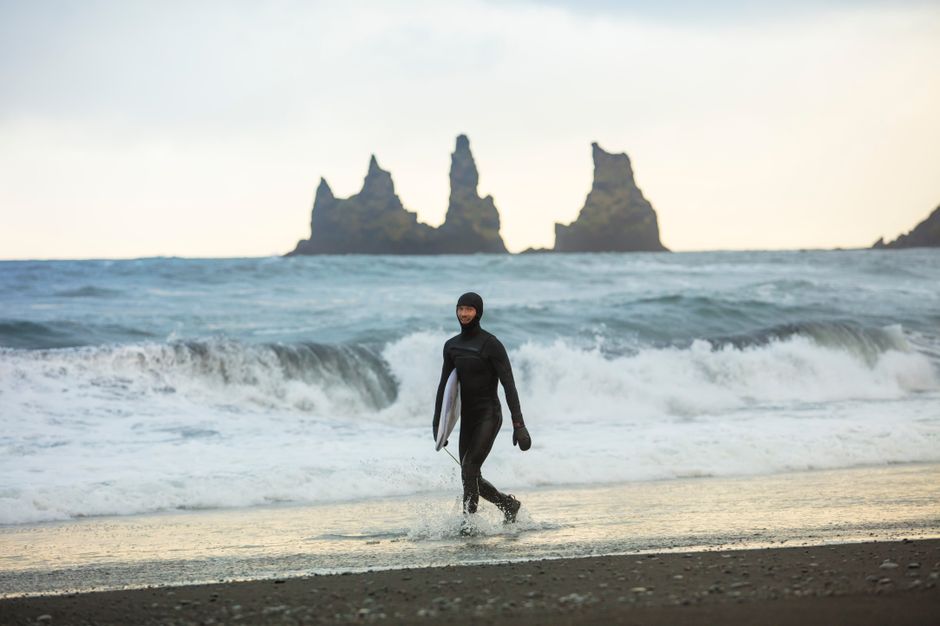
Fit is just as critical as construction. A proper cold-water suit must fit tightly against your skin without restricting your breathing or paddling motion. If there are loose pockets of neoprene under your arms, in your crotch, or along your lower back, water will pool there and steal your body heat.
A professional surf school must carry an extensive size inventory, including tall and short variations of standard sizes. If an instructor attempts to squeeze you into a suit that is too small, the neoprene will overstretch, thinning the insulation and pulling open the seams. If they place you in a suit that is too large, you will experience immediate flushing, cutting your lesson short due to shivering.
Extremity protection requirements
Protecting your hands and feet is paramount for safety and endurance. When your body is exposed to cold water, it initiates vasoconstriction, pulling warm blood away from your extremities to protect your vital organs. This physiological response quickly numbs your fingers and toes, destroying your balance and your ability to pop up on the board.
To maintain function and safety, a surf school must provide high-quality boots and gloves for any session where the water temperature is below 55°F.
For New England waters, you need 5mm or 7mm wetsuit boots. You should prioritize a split-toe design over a round-toe design. The split-toe isolates your big toe, which prevents the boot from sliding around on your foot, offering far superior traction and board feel.
Gloves must be either 3mm or 5mm thick. While five-finger gloves offer the best dexterity for paddling, three-finger mittens or claws provide much greater warmth by keeping your fingers grouped together.
When auditing a surf school, observe how their staff instructs students to put on this gear. The boots must be worn under the wetsuit ankle cuffs, and the gloves must tuck under the wrist sleeves. If you put the suit on first and slide the boots and gloves over the outside, the openings will act as scoops, filling your hands and feet with freezing water on your first paddle out.

Coach certification and exposure management
Thermal safety is not just about the rubber on your back; it is about the professional systems managed by your instructors. Most surf lessons along the New England coast operate with basic municipal permits, but do not undergo physical audits of their safety infrastructure. Discerning students must verify that their school holds school-level accreditation from the International Surfing Association (ISA), the globally recognized governing body for surfing.
Verifying ISA and lifeguard credentials
Boston Surf Adventures is documented as the only ISA Certified Surf School in New England. This accreditation means the entire organization operates under strict safety protocols, rather than relying on the ad-hoc decisions of seasonal instructors. Every instructor must hold an active ISA Level 1 Surf Instructor certification, which requires formal training in risk management, oceanography, and teaching mechanics.
Furthermore, you must distinguish between standard pool lifeguarding and open-ocean rescue credentials. As detailed in the audit of surf school rescue credentials, pool guards are trained for static, transparent water. Ocean safety requires active scanning, knowledge of rip currents, and specialized rescue swimming. Every coach at Boston Surf Adventures is a certified lifeguard, and all on-land staff is CPR certified, ensuring a professional safety net.
Evaluating student-to-coach ratios in cold conditions
When water temperatures drop, the margin for error disappears. In warm tropical waters, a single coach can manage eight to ten students. In the North Atlantic, a high student-to-coach ratio is an extreme safety hazard. If multiple students wipe out simultaneously in cold water, an isolated coach cannot monitor them all.
For youth camps, look for strict compliance with state health regulations and low supervision limits. As discussed in the youth surf camp safety audit, a safe operation must limit groups. Boston Surf Adventures maintains a strict 5:1 student-to-coach ratio for its summer camps, which run from June 22 through August 28.
This small ratio ensures that instructors can closely monitor each student for early signs of cold stress, such as slow reaction times, shivering, or difficulty popping up. This tight safety net allows the school to focus on getting students to catch dozens of waves in a single weekend safely.

Legal and administrative compliance
Safety standards must also be visible on paper. In Massachusetts, commercial entities cannot simply set up shop on a public beach. A legitimate school must hold active municipal permits and satisfy State Board of Health regulations, specifically under 105 CMR 430.000 for youth programs.
Before booking, ask if the school performs CORI and SORI background checks on all staff. Furthermore, verify that the school carries specialized open-ocean liability insurance rather than standard general liability. General business insurance often excludes water sports and active in-water coaching.
A professional school will gladly present these documents. As highlighted in the guide on verifying surf school permits and liability insurance, operating without proper permits risks municipal shutdown mid-lesson, leaving students stranded. Ensure your chosen provider is fully permitted to operate at Nahant Beach to guarantee a secure, uninterrupted experience.
Finding the right cold-water entry point
If you want to transition from a casual beachgoer to a self-sufficient surfer, you must train with an organization that treats ocean safety as a science. Vetting your instruction provider ensures you do not waste time shivering in poorly fitted gear or risking your safety with uncertified guides.
Boston Surf Adventures runs structured programs designed to maximize your safety and wave count:
- Weekend Surf Camps: Limited to 6 spots per weekend at Nahant Beach, offering a high-density coaching format that includes a full wetsuit and board package.
- Progression Sessions: Targeted coaching packages designed to help intermediate surfers break through technical plateaus.
- Summer Surf Camps: Weekly summer programs for kids and teens with a strict 5:1 student-to-coach ratio led by certified lifeguards.
You can book your next session directly by visiting Surf Camps in Boston and New England — Boston Surf Adventures to secure one of the limited spots for the upcoming weekend.


