The most common cause of injury for a new surfer is not the ocean floor or the wave itself, but the impact of a sharp board nose or rigid fin immediately following a wipeout. Boston Surf Adventures developed this equipment audit to help you verify the safety standards of any lesson provider before you get in the water. This guide covers the exact hardware requirements for legitimate beginner instruction, including flexible safety fins, thermoformed EVA decks, and high-density nose bumpers. Whether you are signing up for your first lesson at Nahant Beach or booking an international winter retreat, you will learn exactly what to look for and what questions to ask your outfitter.
The hardware baseline: soft tops with high-density bumpers
When you walk down to the beach for your first lesson, the equipment waiting for you on the sand tells you everything you need to know about the school's operational standards. A professional New England surf school should never hand a first-time student a traditional fiberglass board.
To ensure safety, every beginner board must meet these minimum hardware specifications:
- Full foam construction with a soft outer deck skin to absorb impacts.
- A minimum volume of 60 to 80+ liters to guarantee stable flotation.
- High-density thermoformed EVA bumpers integrated directly into the nose and tail.
- A wide, rounded nose template that resists nose-diving and stabilizes your stance.
The physical design of a quality beginner board prioritizes stability over extreme maneuverability. High volume translates directly to buoyancy, which makes paddling efficient and allows you to catch waves with minimal physical exhaustion. When you paddle a high-volume board, the extra float keeps the deck high above the water line, reducing drag and giving you more time to establish your stance.
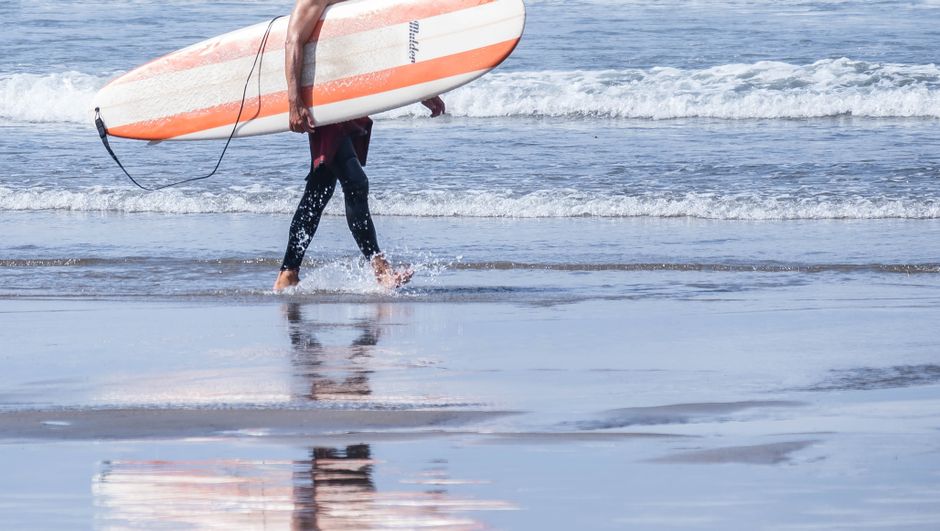
Soft-top rails also protect you during the inevitable tumble. When a wave rolls you off your board, the equipment often spins in the washing machine of white water. A soft foam rail significantly reduces the force of any impact against your ribs, legs, or face.
For example, purpose-built school boards like the NSP Surf Wide P2 Basic feature full EVA covers and protective nose bumpers designed specifically to withstand daily school use while keeping students safe. At Boston Surf Adventures, we use these high-volume, safety-first boards at our Nahant Beach camps to give students a secure platform to learn.
Flexible safety fins vs. standard fins
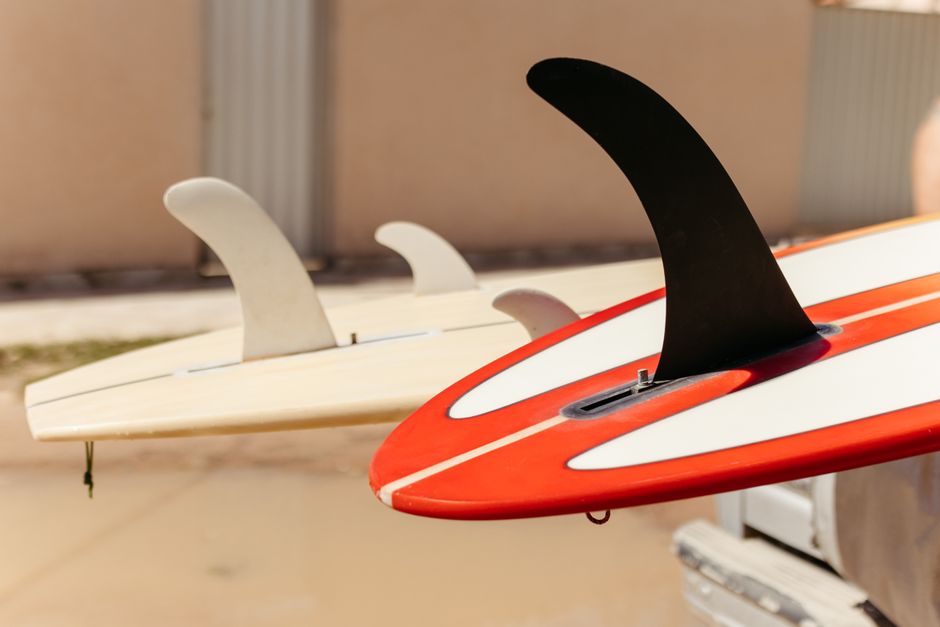
Standard surfboards use rigid fiberglass or hard plastic fins designed to slice through water and hold a line at high speeds. In a beginner environment, those same rigid fins act like knives. If a loose board washes over a swimmer or strikes a student in the shallow water, rigid fins can cause severe deep-tissue lacerations.
The table below breaks down the primary fin categories you will encounter at rental shops and surf schools:
| Fin Type | Injury Risk | Best For | Price Tier |
|---|---|---|---|
| Rigid Fiberglass | Extreme (Lacerations) | Advanced surfers seeking speed | Premium |
| Hard Plastic (FCS/Futures) | High (Contusions/Cuts) | Intermediate surfers progressing | Budget to Mid |
| Flexible Rubber (Screw-in) | Negligible (Bends on impact) | Surf schools and beginners | Mid |
To eliminate this hazard, legitimate surf schools use flexible rubber safety fins. These safety-focused designs, such as Pro Teck Fins, feature a soft, flexible core and flexible edges that bend completely flat when they strike a solid object.
If a flexible fin hits your leg during a wipeout, it flexes on impact instead of cutting through your skin. This simple hardware difference changes the entire psychological experience of learning to surf.
When you know the board underneath you is incapable of slicing you open, your anxiety drops. You can focus entirely on your pop-up timing and wave selection rather than worrying about the location of your board's underside.
Always look under the board before you carry it to the water. Press your thumb against the edge of the fins. If the fin does not bend easily under moderate thumb pressure, you are riding on rigid plastic or fiberglass.
Nose guards and the physics of a wipeout
The nose of a modern surfboard is styled like a spearhead, coming to a sharp, tapered point. During a standard fall, a beginner often slides forward off the deck while the board remains stationary or gets pushed backward by the wave. As you submerge, the board can rebound on its leash, pulling the sharp nose directly back toward your face.
Data from the designers of the GUARD G.NOSE show that impact with the pointy nose of a surfboard following a fall is the most frequent mechanism of acute injury in the sport. These facial lacerations and eye-area impacts are entirely preventable.
A safety-conscious surf school will mitigate this danger by using boards with rounded nose profiles or by retrofitting sharp noses with rubber guards. High-density EVA nose bumpers absorb the energy of a direct collision, dispersing the impact force across a wider surface area.
This protective hardware is especially critical during beach practice and close-contact group lessons. When multiple students are riding in the same white-water zone, runaway boards are a constant variable.
At Boston Surf Adventures, founder Grant Gary uses his 15+ years of teaching experience to structure every session around physical safety. We believe that incorporating safety-first coaching and utilizing boards with built-in protective bumpers is the only way to build real confidence in the water.
What most people get wrong
Many aspiring surfers assume that any board with a soft deck is automatically safe and appropriate for learning. This misconception leads to frustrating sessions, wasted money, and avoidable injuries.
Confusing board size with board volume
A common mistake is selecting a board based purely on its length while ignoring its volume and width. An eight-foot gun designed for riding large, steep waves is narrow, thin, and has very little volume. It will sink under the weight of an adult beginner.
A proper soft-top surfboard designed for learning must have both length and thickness to achieve the necessary 60 to 80+ liters of volume recommended by experts at Good Wave. Volume provides the actual upward displacement that keeps you stable.
Without sufficient volume, your board will wobble laterally every time you shift your weight, making it nearly impossible to find your balance.
Assuming all "foamies" have safe fins
Many cheap foam boards sold at big-box department stores come equipped with rigid, sharp plastic fins. Parents often purchase these generic boards assuming the soft foam deck makes the entire setup safe for their children.
In reality, those hard plastic fins can cause severe injuries in shallow water. When evaluating a summer program, you must verify that the school does not cut corners with cheap retail gear.
High-quality instruction programs prioritize youth development and safety by investing in commercial-grade school boards built with soft rails and flexible, bolt-through safety fins. If a school cannot verify that their entire fleet uses flexible rubber fins, they are missing the most fundamental safety standard in the industry.
Review the equipment provided in our weekend camps. If you are learning with us in Nahant, you are guaranteed high-volume, safety-first equipment included in your session. Book your next step in the water with our semi-private and private instruction programs.