The best adult surf camps in the Northeast for busy professionals

For busy professionals in the Northeast, finding a surf program that fits a demanding schedule while delivering actual results requires looking past generic tourist lessons. Boston Surf Adventures operates out of Nahant, MA—just 30 minutes from downtown Boston—and stands out as the definitive choice for working adults, offering everything from structured 2.5-day weekend bootcamps to monthly Progression Sessions and winter escapes to Puerto Rico. Most adult programs treat surfing as an afternoon novelty, but building actual ocean competence requires consistent reps, low student-to-coach ratios, and instruction tailored to adult biomechanics. This guide compares regional coaching formats, breaks down the actual cost and time commitment, and outlines how to fit measurable surf progress into a 40-hour work week.
The scheduling reality for working adults at a Northeast surf school
Learning to surf as an adult shouldn't require burning two weeks of PTO just to realize you were paddling on the wrong board. If you work in finance, tech, healthcare, or consulting around Boston, your calendar is guarded by back-to-back meetings and project deadlines. Taking off an entire Tuesday morning on a whim because a south swell arrived rarely works. You need a program that respects your calendar while aligning with regional swell cycles.
Adult surf education in the Northeast typically falls into three delivery formats: weekday evening clinics, concentrated weekend intensives, and recurring membership models. Each demands a different trade-off between travel time, energy, and water repetitions.
Evening programs
Weekday evening blocks, such as the four-day evening sessions run by Surf Camp Maine at Scarborough Beach State Park, run from 5:30 PM to 7:30 PM. If you live or work fifteen minutes from the beach in southern Maine, an evening program is a functional way to wash off workday stress while getting two hours of water time.
For someone based in Greater Boston, however, evening clinics north of New Hampshire present a logistical nightmare. Fighting northbound traffic on Route 1 or I-95 on a Thursday afternoon to make a 5:30 PM call time causes more friction than it resolves. Evening formats also leave you vulnerable to late afternoon sea breezes that turn clean morning swells into choppy, disorganized wind chop.
Weekend formats
Concentrated weekend intensives solve the weekday commute problem by grouping your water time into Friday evenings through Sunday afternoons. Boston Surf Adventures runs adult weekend surf camps at Nahant Beach that pack multiple dedicated sessions into two and a half days.
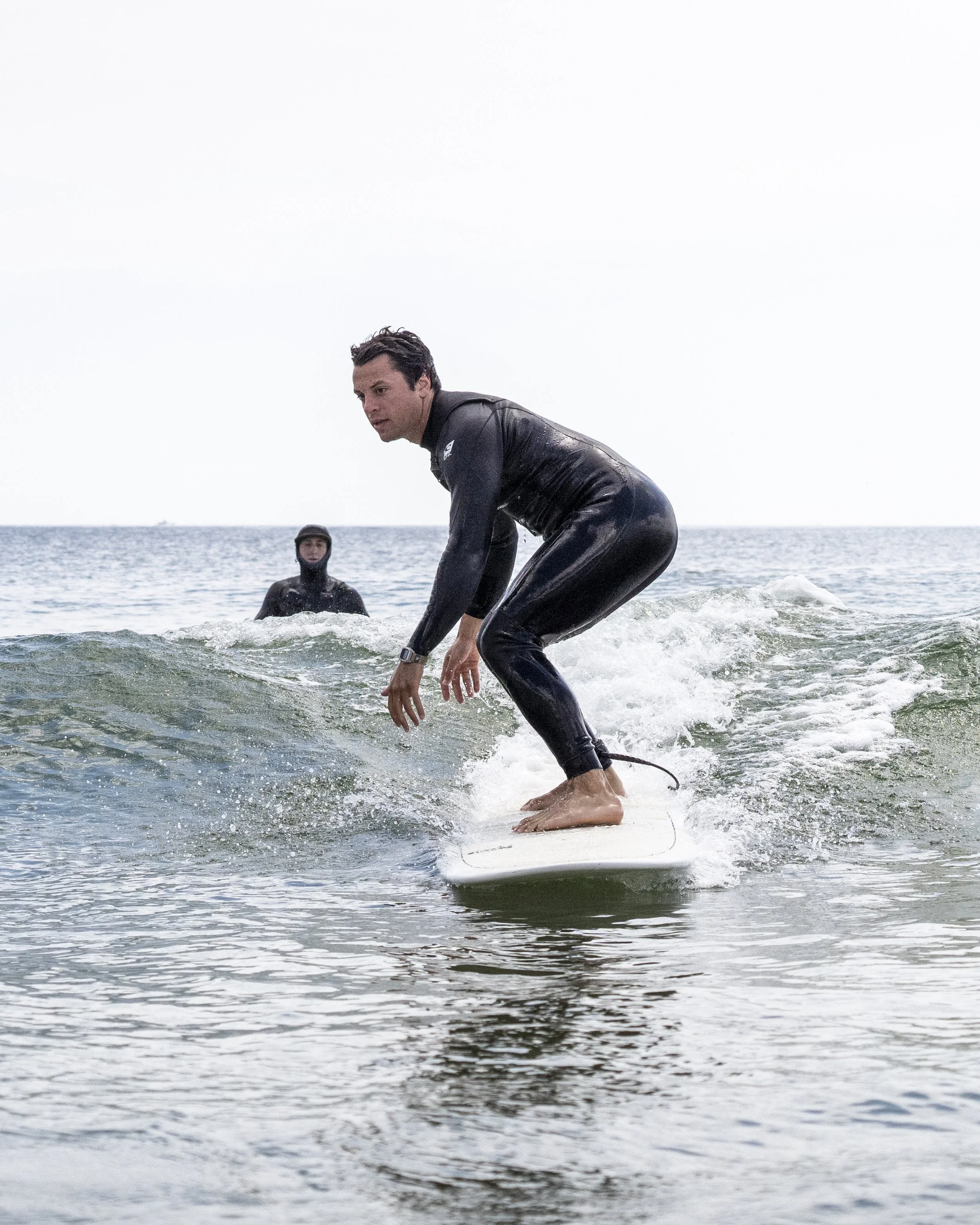
The primary advantage of a weekend intensive is muscle memory compounding. When you surf once every three weeks, your body spends the first forty-five minutes of every session trying to remember how to paddle straight and balance on the stringer. In a structured weekend camp, you surf multiple times across three consecutive days. The mechanical adjustments you make during a Saturday morning session carry directly into Saturday afternoon and Sunday morning, letting you lock down your pop-up mechanics before old habits creep back in.
The subscription model
For professionals with unpredictable on-call shifts, quarterly travel, or volatile project cycles, even committing to a specific weekend three months in advance can prove tricky. That reality led to the development of flexible membership structures.
The Boston Surf Adventures Progression Sessions model allows surfers to purchase recurring blocks, such as two structured sessions every four weeks, booked through an active scheduling calendar. Surfers get three hours of targeted coaching per block—including twenty minutes of in-water video capture, forty minutes of on-beach technical review, and two hours of live water work—without losing their spot if work travel forces them to reschedule to another open weekend.
How to spot real coaching versus supervised drowning in adult surf camps
Most surf schools operate on an assembly-line model. You pay eighty dollars, put on an ill-fitting wetsuit that smells like mildew, listen to a twenty-minute speech on the sand, and get pushed into three whitewater rollers by a teenager on summer break. You leave tired, salty, and completely incapable of catching an unbroken wave by yourself.
Real adult surf instruction is active coaching, not babysitting. Boston Surf Adventures was founded in 2021 by Grant Gary, who spent eleven years as a professional school teacher before applying evidence-based educational theory to the ocean. Instead of chaotic trial and error, instruction follows a proprietary ten-level coaching curriculum designed to give you specific, diagnostic fixes on every single wave.
When vetting any adult surf camp from Rhode Island to Maine, look for three baseline indicators of instructional quality:
- A maximum student-to-instructor ratio of 3:1 in the water so you receive immediate, per-wave coaching rather than waiting in an unmonitored line.
- International Surfing Association (ISA) certification among the coaching staff, which establishes global benchmarks for safety, surf mechanics, and curriculum delivery.
- Active in-water lifeguarding credentials for every instructor, rather than basic CPR alone.
Group size dictates how many waves you catch and how quickly your errors get corrected. Many regional options, such as the adult camps at Northeast Surfing, run a 5:1 student-to-instructor ratio. In a two-hour session with five adults to one instructor, you spend the vast majority of your time floating unattended.
Boston Surf Adventures operates with a strict 3:1 ratio during its adult camps and semi-private lessons, and holds the distinction of being the only ISA Certified surf school in New England. Furthermore, every coach in the water is a certified lifeguard, and land staff maintains active Red Cross CPR qualifications. That level of supervision allows coaches to position you deeper in the takeoff zone, call your entry timing, and pull you out of dead water before fatigue ruins your paddle technique.
The true cost of entry: gear and logistics for Boston surfers
One of the quickest ways adult learners waste capital is buying a full quiver of gear before understanding what their local break requires. Between carbon-fiber fins, performance rubber, and designer shapes, surf retail can burn two thousand dollars before you ever catch an unbroken green wave.
A credible adult surf school handles the gear equation for you while you build competency. At Boston Surf Adventures, all wetsuits and board rentals are provided directly with lessons and adult camps, eliminating the pressure to purchase gear prematurely. You show up, suit up in properly maintained neoprene, and ride high-volume boards suited to that day's wave period.
When you do decide to invest in your own kit, local geography dictates your choices. New England wave energy is heavily driven by seasonal weather systems. For Northern New England surfers, Cinnamon Rainbows in Hampton, New Hampshire, carries the largest selection of boards in the region.
Expect to spend around $500 for a quality, new epoxy longboard. If your initial equipment budget sits below $500, finding the right board requires careful scouring of the used market for watertight nine-footers rather than impulsive purchases on marketplace apps.
Location logistics also dictate whether you will actually surf on a consistent basis. Nahant Beach is approximately 30 minutes from downtown Boston, making it the most accessible real surf break in the metropolitan area. Rather than spending two hours sitting in bridge traffic heading to Cape Cod, Boston surfers can exit the city, hit the water at beach entrance #9 on Nahant Long Beach, and return home within an afternoon window. For a detailed breakdown of parking meters, drop-off spots, and arrival times, check out our guide on where to park and meet for Nahant beach surf lessons.
Local weekend intensives vs. winter retreats at Boston Surf Adventures
Once you understand the basic mechanics of trimming a wave, you face a strategic choice: continue grinding through the Northeast seasonal shifts, or use focused travel to compress months of progress into a single week.
| Option | Best For | Typical Format | Key Tradeoff |
|---|---|---|---|
| Adult Surf Camp (Nahant, MA) | First-timers & re-starters | 2.5-day weekend intensive | Limited to summer/fall swell windows |
| Monthly Progression Sessions | Local intermediates | 2 sessions every 4 weeks | Requires steady calendar availability |
| Puerto Rico Progression Retreat | Rapid technique compounding | 7-day winter intensive | Requires travel time and higher budget |
Mastering the local break in Nahant, MA
Learning to surf on your home coast builds real resilience. The sandbar at Nahant offers a sheltered, predictable setup that absorbs swell while protecting beginners from heavy shorebreak.
Working through local weekend sessions teaches you how to read cold Atlantic tides, identify rip currents, and position yourself on shiftier sandbar peaks. If you can catch, pop up, and ride waves at Nahant on a breezy autumn afternoon, you can surf almost anywhere on the East Coast.
Accelerating progress in Puerto Rico
New England winters bring great swells, but freezing water temps, thick 5/4mm neoprene, and heavy booties tax your physical endurance. To bypass that winter stall, Boston Surf Adventures hosts week-long surf retreats in Rincón, Puerto Rico during January, February, and March.
The team bases its winter operations directly in front of two world-class breaks: Maria's and Dogman's. The retreat uses an ultra-tight coaching ratio of four coaches to just nine surfers, pairing daily morning surf sessions with five filmed sessions and technical video review.
The tropical water and consistent reef setups eliminate the physical drag of heavy rubber, allowing you to catch dozens of waves per session. For a deeper look at planning winter travel, read our comparison on Boston Surf Adventures vs Rincon Surf School: choosing your Puerto Rico surf trip.

What most adult surfers get wrong about learning in New England
Adult brains learn differently than children. Kids learn through fearless kinetic mimicry; adults learn through spatial understanding, mechanical reasoning, and risk management. Unfortunately, bad assumptions often derail progress before muscle memory has a chance to take root.
Thinking one session is enough to learn
One session in the ocean gives you an introduction; it does not make you a surfer. Surfing demands complex motor multitasking: paddling against backwash, matching wave speed, timing your pop-up during a split-second transition, and angling your board down the open face.
Treating surf instruction as a one-and-done bucket list activity is why thousands of adults try surfing once, drink half a gallon of seawater, and never touch a board again. Expecting legitimate independence requires committing to multiple coached sessions where errors are diagnosed and corrected in real time. If you wonder how your current cardio and strength translate to the lineup, review how fit you actually need to be to learn to surf.
Buying a shortboard before you are ready
The shortboard trap claims more adult beginners than anything else. You see people duck diving six-foot blades on social media and assume that buying a shorter, narrower board is the natural second step after your first lesson.
In New England, buying a shortboard early will completely halt your progression. Our region relies heavily on small, lower-energy wave faces between major hurricane and winter swell cycles. First off, always have a longboard in New England, otherwise you will not be able to surf most days. High-volume longboards give you the paddle speed needed to catch waves early, giving your feet and hips time to set clean rails.
Assuming Northeast surf is inaccessible
Many Boston residents assume that surfing requires a flight to San Diego or Oahu. They look at the harbor and write off the local coast entirely.
Within 45 minutes of downtown Boston, there are over 20 distinct surf breaks that feature manageable waves and low crowds. The geography of Massachusetts Bay and the North Shore captures diverse swell angles, meaning clean, rideable waves break within a short drive of the Financial District far more often than non-surfers realize.
Stop guessing your way through beach breaks or trying to decipher ocean swell models alone. Visit the Boston Surf Adventures website to take our 30-second quiz and find the exact adult camp, membership session, or retreat built for your schedule and skill level.
Filed under