The offshore wind safety audit: verifying a surf school's drift limits and retrieval protocols

Boston Surf Adventures

When strong offshore winds blow across a coastal break, novice surfers face an immediate drift hazard that can pull them away from the beach in minutes. Evaluating a surf school requires auditing their specific wind velocity cutoffs and verified extraction protocols rather than assuming proximity to the sand guarantees personal safety. At Boston Surf Adventures, instruction adheres to international safety standards as the only ISA certification accredited school in New England, operating under strict environmental caps at Nahant Beach. Before committing to any surf lesson or youth camp, students and parents must verify that an operator enforces non-negotiable drift boundaries, maintains low student-to-coach ratios, and uses active rescue plans.
Ocean safety demands institutional discipline rather than reliance on casual athletic ability. Strong personal swimming skills do not qualify an instructor to manage open-water crises when environmental conditions turn unfavorable. Boston Surf Adventures founder Grant Gary built the school's operational framework on more than 15 years of professional teaching experience, establishing systematic safety guidelines that govern all sessions. Through BSA's Surf Camps in Boston and New England, all coaches hold active lifeguard certifications and complete custom rescue training explicitly designed for local coastal conditions.
Establishing hard wind speed and directional limits in surf instruction
Wind direction and velocity determine the physical boundaries of a safe surf lesson. Professional schools categorize conditions across three distinct directional profiles:
- Offshore winds: Air moves from the land toward the sea, smoothing wave faces but actively pushing floating surfboards toward deep water.
- Onshore winds: Air blows directly from open water toward the beach, creating choppy surface conditions while pushing students back toward the sand.
- Cross-shore winds: Air travels parallel to the coastline, generating lateral sweep that drags students down the beach away from the designated coaching zone.

Wind direction safety variables
Offshore breezes produce the manicured, peeling waves featured in surf photography, which tempts irresponsible surf operators into taking novices into hazardous conditions. A 9-foot foam beginner surfboard carries massive surface area and buoyancy, turning the board and rider into a sail. A beginner who tires or slips off their board can lose ground against an offshore draft faster than they can paddle back against it.
Data from Weather Conditions and Kitesurfing Safety Precautions confirms that offshore winds present the most severe operational hazard for surface water sports, requiring active retrieval plans when wind moves watercraft away from immediate shore access. If an operator cannot explain how they control offshore drift, they are relying on luck rather than risk mitigation.
Establishing knot-speed cutoffs
A credible surf school establishes absolute velocity limits and cancels lessons when conditions cross those thresholds. In beginner instruction, breezes between 8 and 15 knots provide workable surfaces without compromising physical control. Once sustained winds or gusts surpass 20 to 25 knots, the open ocean becomes volatile, drastically increasing paddle fatigue and drift velocity.
When offshore breezes reach 15 knots, professional surf coaches restrict beginner instruction to waist-deep water inside the sandbar break. This depth threshold keeps students grounded on the seafloor so they can walk against the wind rather than drifting out to sea on buoyant equipment. If gusts exceed 20 knots, responsible directors call off beginner sessions completely.
Analyzing the risk assessment and emergency response plan
Unregulated surf camps often operate without written emergency action plans, reacting to water distress only after a student has drifted beyond shouting distance. Professional academies treat coastal operations with the same rigor found in commercial maritime safety protocols. Formal guidelines like the UK Maritime and Coastguard Agency's Methodology for Assessing the Marine Navigational Safety & Emergency Response Risks emphasize that emergency response protocols must define clear operational limits, search parameters, and documented extraction pathways before personnel enter the water.
| Protocol element | Why it matters | Warning signs of a weak plan |
|---|---|---|
| Defined drift limits | Establishes physical boundaries where instruction must stop | Coaches allow students to scatter across 200 yards of beach |
| Visual landmark alignment | Gives coaches and students immediate shore-based drift markers | No shore orientation briefed to students before paddling out |
| Signal communications | Enables instant distress alerts over breaking wave noise | Coaches rely purely on shouting across open water |
| Dedicated rescue equipment | Provides immediate flotation and tow capacity for extraction | No rescue tubes, fins, or designated chase boards on the sand |
Systematic research published in a guide on How to Create a Comprehensive Kitesurfing Risk Assessment Plan reveals that structured emergency response systems reduce the severity of water-sports incidents by up to 60%. When instructors know the exact sequence of an extraction, panic vanishes from the equation.
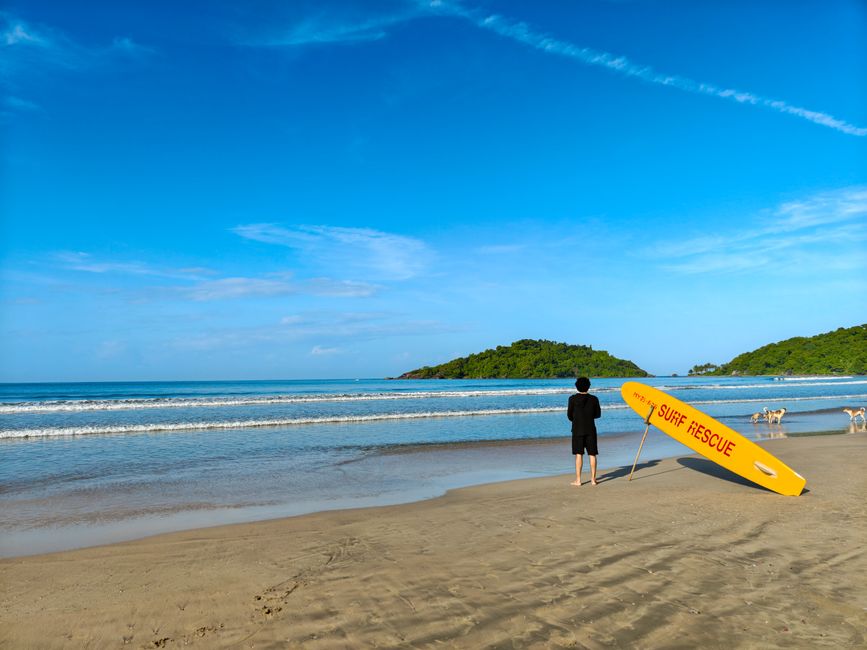
A practical drift limit is not an abstract concept; it is an enforced geographic perimeter. At Nahant Beach, coaches benchmark safety lines against specific physical land markers, jetties, or beach bathhouses. If a student drifts down-current past a designated landmark, the coach immediately calls them in or paddles out to reposition them.
When a student cannot break through an offshore pull or lateral current, coaches activate a systematic beach retrieval strategy. Reviewing how to audit a surf school's emergency beach extraction plan shows how high-level programs transition an exhausted swimmer from deep water to dry sand using board-tow techniques and designated shore-support staff.
Verifying instructor certifications and rescue training
Being a skilled, stylish surfer has virtually nothing to do with ocean rescue capabilities. An instructor can execute high-performance maneuvers yet lack the training needed to extract a panicking adult through breaking whitewater during an offshore squall.
Professional operations require comprehensive credentials that cover both in-water life support and land-based medical care.
Credential Hierarchy for High-Standard Surf Instruction:
├── Regional / Global Accreditation: International Surfing Association (ISA)
├── Water Rescue: Open Water Lifeguard Certification (active)
├── Medical Emergency: Cardiopulmonary Resuscitation (CPR) & AED Certification
└── Location Training: Custom site-specific rescue and extraction drills
In-water supervision ratios
Visual control breaks down when a single coach attempts to supervise too many students in active swell. International governing bodies define absolute maximums for beginner safety, but high-tier surf schools set their internal standards much tighter.
For youth programs, Boston Surf Adventures caps summer camp coaching ratios at five or fewer students per instructor. In adult weekend camps, groups are strictly capped at six total participants.
Maintaining this density allows coaches to keep every student within immediate swimming reach. When an offshore gust pushes one student outside the sandbar, an instructor running a low ratio can secure that student without abandoning the rest of the group. For deeper insights on evaluating these numbers, read how to audit a surf school's in-water supervision ratios.
Lifeguard and CPR requirements
Many commercial surf operations operate on bare minimum municipal standards, employing seasonal workers who lack formal water-rescue credentials. Parents and adult learners must confirm that every in-water instructor holds an active open-water lifeguard certification, not just a pool-based credential. Ocean lifeguarding demands proficiency in rip current dynamics, heavy-surf entries, board rescues, and spinal injury management.
BSA requires all coaches to hold verified lifeguard certifications, while every on-land staff member maintains active CPR and first-aid credentials. Furthermore, founder Grant Gary trains coaches in custom extraction maneuvers adapted directly to the coastal breaks of Massachusetts. This site-specific preparation guarantees that if an equipment failure occurs during offshore conditions, instructors execute a planned, coordinated rescue immediately.
What most people get wrong about surf zone drift
Novices and parents booking lessons frequently fall victim to two dangerous assumptions regarding coastal dynamics:
The municipal lifeguard misconception
The most common error is assuming municipal beach lifeguards protect private surf lessons. Public lifeguards monitor hundreds of casual swimmers across large stretches of open sand; they are not private safety lookouts for commercial surf clinics.
If a student in a surf class drifts 150 yards offshore into a rip neck during a gusty offshore wind, municipal tower guards may take critical minutes to spot the situation amid crowded surf. The surf school itself bears full legal and operational responsibility for immediate, close-quarters intervention. A professional surf school acts as its own self-contained water rescue unit.
Confusing offshore wind with onshore wind safety
Beginner surfers routinely confuse onshore and offshore wind directions, misjudging which environment poses a real physical threat:
Wind Profile Risk Comparison:

Onshore Wind (Blowing from Sea toward Land):
- Surface: Choppy, messy, unorganized wave faces
- Physical Risk: Low drift danger; wind and waves naturally push surfers to shore
- Coaching Action: Good for beginner stability training in whitewater

Offshore Wind (Blowing from Land toward Sea):
- Surface: Clean, smooth, glassy wave faces (visually appealing)
- Physical Risk: Severe drift danger; wind blows equipment out to open ocean
- Coaching Action: Requires strict waist-deep depth caps and constant positioning audits
A clean, flat ocean surface with light offshore spray can be significantly more dangerous for an inexperienced paddler than a stormy, onshore wave field that continuously washes equipment back onto the sand.
How to execute a pre-booking safety audit
Do not book surf lessons based on marketing imagery or generic claims of being "safe and fun." Protect yourself and your children by putting prospective surf schools through an objective safety review:
- Request documentation of external governing body accreditations, such as the International Surfing Association standard maintained by Boston Surf Adventures.
- Ask the director for their exact knot-speed operational ceiling and whether they implement waist-deep water restrictions during offshore breezes.
- Verify that every assigned in-water instructor holds an open-water lifeguard certification rather than basic first aid alone.
- Confirm student-to-coach ratios in writing, ensuring camps maintain no more than five students per coach in the water.
- Inquire about the school's emergency response plan and their physical boundary markers on the beach.
A qualified surf operation will answer these technical safety questions immediately and transparently. Visit Boston Surf Adventures to review verified coaching credentials, safety frameworks, and curriculum standards before booking your next session in the surf.

