A 1-to-8 surf instructor ratio might be legal on paper, but a sudden 15-knot cross-shore wind can instantly turn a routine lesson into an emergency. To help students make informed decisions, Boston Surf Adventures has developed a framework for auditing a surf school's student-to-coach ratios based on real-time marine forecasts rather than static paperwork. The recommended baseline for safe, progression-focused adult lessons is 3:1, while youth camps require a hard maximum of 5:1 in calm conditions, scaling down even further when wave heights exceed three feet. By auditing these numbers against real-time wind and drift conditions, surfers can ensure their coaching team is equipped to maintain visual contact and physical control at all times.
Baseline standards for safe instruction
The ocean does not read paperwork. While municipal permits and business licenses are necessary, they rarely dictate the safety margins required when managing a group of beginner surfers in open water. Many commercial surf schools operate at the absolute limit of local regulations, treating the legal maximum ratio as their daily operational standard. This practice prioritizes volume over safety and instruction quality.
To understand what constitutes a safe baseline, you must look at the standards established by major international governing bodies and regional authorities. The International Surfing Association (ISA), which serves as the worldwide governing body for the sport, sets a maximum ratio of 1:8 under optimum conditions. However, "optimum" refers to small, clean waves with minimal wind and no lateral current. When conditions degrade, this ratio must scale down immediately.
The table below outlines how different regulatory bodies and organizations structure their student-to-instructor ratios based on age and regional safety laws:
| Governing body / Region | Standard adult ratio | Kids ratio (under 12) | Key safety tradeoff |
|---|---|---|---|
| Surfing England | 1:8 maximum | 1:4 (adjusted) | Higher adult ratio requires calmer conditions |
| BCASI (Canada) | 1:6 maximum | 1:5 (under 12), 1:4 (under 8) | Strict age brackets reduce group sizes |
| Hawaii (Kahaluu Bay law) | 1:4 maximum | 1:4 maximum | Mandated by state law for all ages |
| Boston Surf Adventures | 1:3 (semi-private) | 1:5 maximum | Lower ratios mean faster progression |
These numbers represent the formal starting points, but they are not interchangeable. For instance, the strict 1:4 ratio mandated by state law under Haw. Code R. § 13-256-152 for Kahaluu Bay was established specifically to manage the extreme crowd density and shallow reef hazards of that specific zone. In contrast, the Canadian standards set by the British Columbia Association of Surf Instructors (BCASI) require smaller group sizes for younger children to mitigate the rapid onset of hypothermia in colder Pacific waters.
At Boston Surf Adventures, we operate as the only ISA Certified Surf School in New England. Our founder, Grant Gary, is a former school teacher with over 15 years of professional teaching experience. This background in formal education is why we do not use the maximum allowable industry ratios. For adult learners looking to build real self-sufficiency, we offer semi-private coaching with a strict 3:1 ratio at Nahant Beach. You can view our structured lesson options and book directly through the Boston Surf Adventures surf lessons page. Keeping the group small ensures that your instructor can watch every wave you catch, providing immediate feedback rather than managing a chaotic crowd.
Adjusting ratios for wind and drift
Static ratios fail the moment the wind begins to blow. When auditing a surf school along the Massachusetts North Shore, you must ask how the school adjusts its staffing based on the daily marine forecast. Wind does not just create waves; it generates lateral drift and surface chop, both of which increase the physical demands on the surfer and the safety margins required of the coach.
Managing cross-shore winds
A strong cross-shore wind pushes water along the beach, creating a lateral current known as a sweep or drift. In these conditions, a group of beginner surfers will constantly drift down the beach, away from their entry point. If a single instructor is managing eight students, those students will drift at different speeds based on their body weight and board size. Within ten minutes, the group can become scattered across a 100-yard stretch of beach.
According to the official Surfing England Guidance, managing a strong side drift requires a multi-instructor strategy. Instead of a single coach trying to watch students drifting in multiple directions, two instructors work together to bookend the group. One instructor is positioned upwind to assist students launching into the surf, while the second instructor is positioned downwind to mark the safe boundary of the surfing zone. Any student who drifts past the downwind coach is immediately recalled to the beach to walk back up. If a school attempts to run a lesson in a strong cross-shore wind with only one instructor and a large group, students will inevitably drift into dangerous zones, including rip currents or rocky outcroppings.
Adjusting for swell size
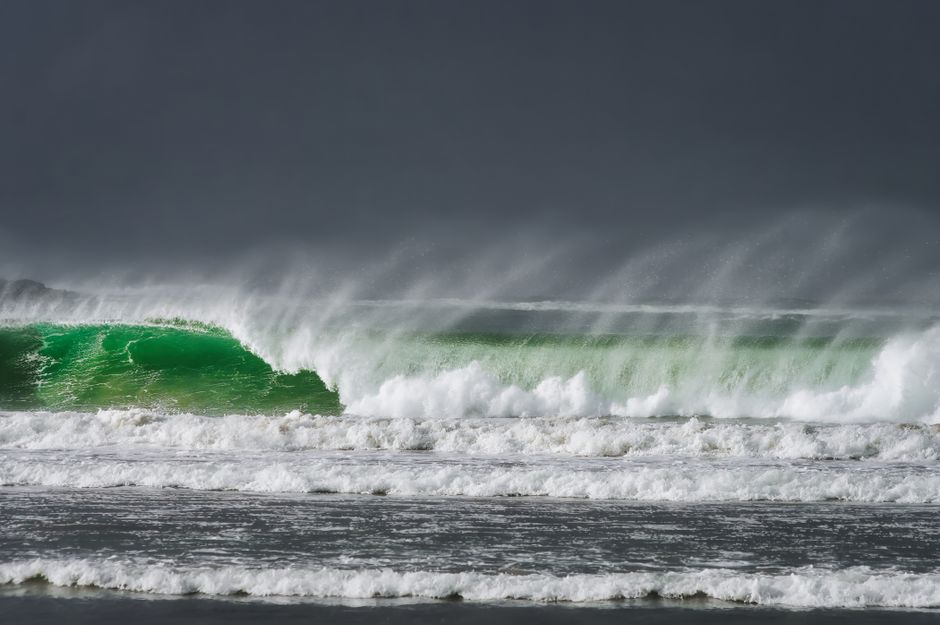
Swell size and wave period also dictate how many coaches are needed in the water. When waves are under three feet, a single coach can easily maintain visual contact with multiple students. However, once the waves exceed three feet, the physical terrain of the ocean changes. Large waves create troughs and whitewater barriers that block the instructor's line of sight.
When wave heights increase, the time it takes for an instructor to reach a struggling student increases. If a student loses their board behind a large set of waves, the coach must swim through the whitewater to reach them. If that coach is responsible for seven other students scattered across the surf zone, those remaining students are left unsupervised. For a deeper understanding of how line-of-sight failures lead to emergency delays, read our detailed analysis on vetting surf school emergency protocols. When wave heights climb, a responsible surf school must lower its operational ratios, sometimes pairing students one-on-one or recalling the session entirely.
The math behind age and mixed-ability groups
Mixing different demographics within a single surf lesson is a common way for low-cost schools to fill their schedules. However, this practice presents a major safety risk. The physical, cognitive, and thermal limits of an eight-year-old child are vastly different from those of a thirty-five-year-old adult. When these groups are combined under a single instructor, the safety ratio is functionally broken.
The higher duty of care for minors
Minors are owed a higher duty of care under the legal concept of loco parentis. As outlined in the Surfing England Guidance, an instructor working with children under eighteen must act as a reasonable parent or carer would. This responsibility cannot be split. Children have less developed risk perception, are more susceptible to cold, and have a shorter physical height, meaning they will be in deep water much faster than an adult in the exact same surf zone.
When an instructor is forced to split their attention between a struggling adult and a child, they cannot fulfill this duty of care. If an adult beginner panics after losing their board, the instructor must assist them. During those minutes of rescue and reassurance, the children in the group are left without direct supervision. To examine why these mixed-age classes fail safety audits, read our comprehensive guide on why separating kids and adults matters.
Why age separation is mandatory
A professional surf camp must maintain strict age separation to ensure that the coaching style, physical limits, and safety ratios match the students' developmental stage. Children fatigue much faster than adults in cold water. To manage this fatigue, our summer program at Nahant Beach uses a game-based, on-land skill introduction before entering the water. This structured approach keeps kids engaged and prevents them from becoming exhausted in the surf zone.
Our summer camps are designed with a hard limit of five or fewer students per coach. This 5:1 ratio is strictly maintained for all youth groups to ensure that every coach can keep all five children within arm's reach at all times. All of our summer camp coaches are certified lifeguards, and our on-land staff is CPR certified. By separating children into peer groups of similar ages, we can tailor the safety protocols to their specific physical limits.
Common misconceptions in surf school safety audits
Many consumers look for the wrong indicators when evaluating the safety of a surf school. They rely on the presence of a permit or the general friendliness of the staff rather than auditing the operational details of the lessons.
Treating the legal maximum as the daily standard
The most common mistake is assuming that a legal ratio of 1:8 is appropriate for every session. In reality, that ratio is a ceiling designed for perfect conditions. If a school runs a 1:8 session on a day with heavy shorebreak, strong currents, or poor visibility, they are prioritizing profit over safety. A responsible operator will proactively reduce group sizes or add extra coaches to the rotation when conditions deteriorate, without charging the customer extra.
Counting assistants as lead instructors
Parents often see multiple staff members standing on the beach and assume the student-to-coach ratio is highly favorable. However, you must verify the qualifications of each staff member in the water. Under standard coaching guidelines, assistant instructors or counselors who do not hold active ISA coaching qualifications and lifeguard certifications cannot be counted toward the safety ratio.
An assistant is there to help manage gear and assist with land-based games. In the water, they must be actively supervised by a lead coach. If a school is running a group of fifteen children with one certified lead instructor and two uncertified teenagers, the true safety ratio is 15:1. If an emergency occurs, only one person is qualified to perform a deep-water rescue or administer advanced first aid.
Vetting your next lesson
Before you enter the water with any surf school, ask the coordinator three specific questions about how they manage their ratios:
- What is the maximum student-to-coach ratio for today's specific wind and wave forecast?
- Are all staff members in the water certified surf instructors and active lifeguards?
- How does the school separate adults and young children during the session?
If the school cannot provide immediate, clear answers to these questions, they are likely operating on a default business model that ignores changing ocean conditions.
At Boston Surf Adventures, we believe that safety and progression are deeply linked. When you are not fighting for your instructor's attention in an oversized group, you learn to read the waves, time your pop-up, and build real confidence in the water. Whether you are looking for a weekend camp for yourself or a structured summer program for your child, our small group sizes ensure that the safety of the group is never left to chance. To see how we maintain these standards across our youth programs, check out the details of the Boston Surf Adventures Kids Camp and secure a spot for the upcoming season.