Boston Surf Adventures solves the whitewater plateau by replacing guesswork with objective video analysis at Nahant Beach and our international retreats. Many beginners spend years riding foam because they cannot see their own biomechanical errors, leading to a state of unconscious incompetence. By isolating the root cause of stalled progress and prescribing exactly two specific technical adjustments per session, the coaching team helps students transition from reactive foam riding to intentional green wave surfing, often increasing successful wave counts from five to over fifty in a single weekend. This structured approach, led by former educator Grant Gary, ensures that surfers in the Greater Boston area bypass the common multi year learning rut through evidence based instruction.
The reality of the whitewater plateau at Nahant Beach
You know how to pop up in the wash and ride straight to the sand, but every time you paddle for an unbroken, green wave, you either nosedive, miss it entirely, or lose your balance on the drop. This specific frustration is the hallmark of the whitewater plateau. It is a phase where the initial excitement of standing up on a board gives way to the realization that you are not actually surfing the wave face. Instead, you are a passenger on a wall of broken energy. At Boston Surf Adventures, we frequently see local surfers who have visited Nahant Beach for two or three seasons yet remain unable to turn their board or ride down the line.
Two years of surfing does not make you an intermediate surfer if you spend those twenty-four months repeating the exact same beginner mistakes. In a recent analysis of surf progression, it was noted that time in the water is often a liar. Progress is not a byproduct of duration; it is a result of intentionality. When you are self taught, you rely on luck and the occasional "lucky reform" that carries you toward the sand. This reactive style of surfing is physically exhausting. You paddle out repeatedly, fighting the shorebreak, only to catch one or two waves that offer zero opportunity for real skill development.
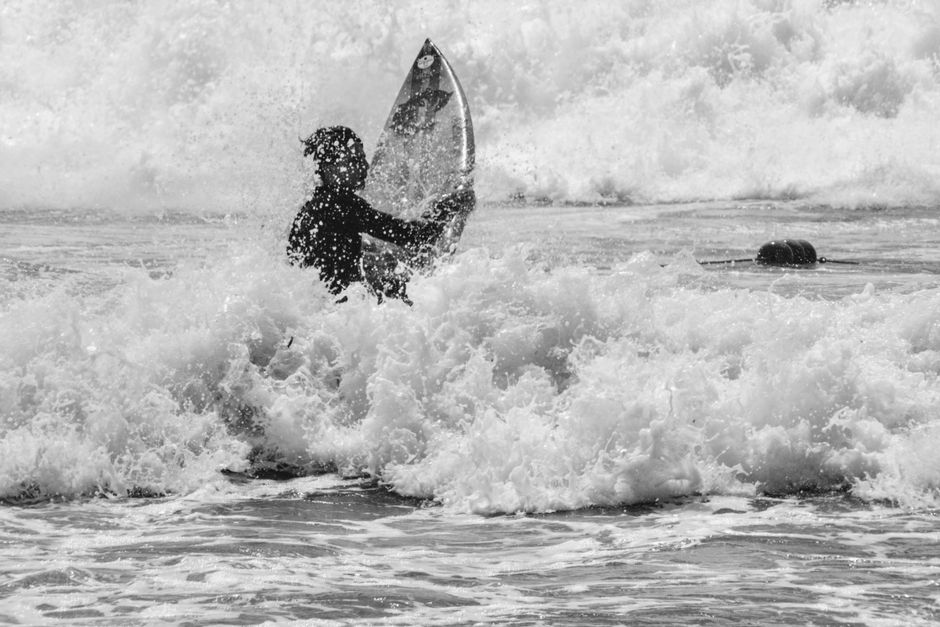
Most self taught surfers get stuck here because the ocean never gives you the same repetition twice. Unlike a tennis player who can hit a thousand identical backhands against a wall, a surfer faces a moving, changing playing field. Without a coach to provide a baseline, you are simply guessing. This lack of structure is why many enthusiasts in the North Shore area eventually burn out or plateau, feeling like they have hit a ceiling they cannot break through.
Why the plateau happens to Greater Boston surfers
The primary reason surfers stall is a lack of objective feedback. When you are in the water, your brain is occupied with survival and balance. You cannot see your foot placement, your shoulder rotation, or your eye line. You rely entirely on what a movement feels like, but in the chaotic environment of the Atlantic, feelings are notoriously inaccurate. This creates a massive perception gap where what you think you are doing differs dramatically from reality.
The unconscious incompetence trap
This phenomenon is best described through the lens of the learning curve. Silas Beaver, an expert instructor, identifies the first stage of learning as unconscious incompetence. This is a state where you do not know what you do not know. As noted in his framework on the learning curve and the case for instruction, your gaps are invisible. You might be nosediving because your weight is too far forward, or you might be missing waves because your hands are too high on the rails during your paddle. If you cannot see the error, you cannot fix it. You are simply repeating a flawed process and hoping for a different result.
Reinforcing bad habits early
At our surf school, we find that many adult learners have accidentally hardwired bad habits into their muscle memory. The "just figure it out" approach leads to staggering pop ups, looking down at the board instead of the beach, and inefficient paddling. Once these movements become automatic, they are significantly harder to unlearn. This is why how a professional education framework is so effective; it short circuits these bad habits by ensuring your early technique is sound. If you learn the wrong way, you are building a house on a shaky foundation. Eventually, that foundation will prevent you from ever surfing waves over three feet.
The video analysis solution for surf progression
To break the plateau, you have to move from guessing to watching. Video analysis is the most powerful tool in the Boston Surf Adventures toolkit because it provides undeniable evidence. You cannot argue with footage. When you see yourself on screen, the "feel" of the wave is replaced by the "fact" of the wave.
| Learning Component | DIY Learning (No Feedback) | BSA Video Analysis Framework |
|---|---|---|
| Wave Count | ~5 waves per weekend | 50–70 waves per weekend |
| Feedback Type | Vague feeling / Guesswork | Objective frame-by-frame review |
| Technical Focus | Trying everything at once | Two high-impact changes only |
| Success Rate | Months to years for progress | Breakthroughs in a single session |
| Tooling | None | BSA Progression Journal |
Record targeted and consistent clips
Instruction is not complete without visual review. Even a 30 second clip of a single wave can yield thirty minutes of technical insight. As whitewater coach Anna Levesque explains in her guide on how video review transforms paddling, a head cam or tripod setup allows you to pause, rewind, and slow down your movements to see what is actually going on. At our retreats, we film every single wave caught during the morning session. This level of documentation allows us to spot the split second where a pop up stalls or where a surfer loses their rail.

Restrict feedback to two simple changes
One of the biggest mistakes in coaching is overwhelming the student with too much information. If a coach gives you ten corrections, you will remember zero. The BSA Progression Pyramid is built on the principle of simplicity. We cut through the noise and identify the two highest impact changes you need to make. This might be as simple as "keep your chin up" and "move your back foot three inches." By focusing on only two variables, the student can actually implement the change without overthinking in the water.
Immediate in-water application
Video feedback is only useful if it is applied immediately. This is why our Puerto Rico Retreat in Rincon is structured with video analysis sessions held directly between the morning and afternoon surfs. You watch your waves at lunch, identify your two corrections with Grant Gary, and then get back in the water while the visual memory is still fresh. This direct link converts visual feedback into physical muscle memory faster than any other method. We use a BSA Progression Journal to document these goals, ensuring that each session has a clear, measurable purpose.
When DIY progression is no longer enough
If you find yourself identifying with the following symptoms, you have likely hit a plateau that requires professional intervention. Many surfers in the Greater Boston area wait too long to seek coaching, assuming that another few months of "putting in the time" will solve the issue. However, if your metrics haven't changed in six months, they aren't going to change without a new strategy.
- You nosedive (pearl) on more than 50% of the unbroken waves you attempt to catch.
- You paddle with maximum effort but the wave consistently rolls completely under you.
- You feel physically exhausted after a session but have only successfully ridden 2 or 3 waves.
- You have been surfing for over a year but still feel uncomfortable in anything over two feet of foam.
Professional coaching at an ISA Certified school like ours focuses on the mechanics of the wave face. While you might catch 5 waves on your own over a weekend, a coached session can facilitate catching 50 to 70 waves. This volume of repetition, combined with technical correction, is what creates the 10x progression leap. Our programs target comfort in waves 3 feet and under, building the essential foundation required for intermediate and advanced maneuvers.
How to keep the progression moving
Once you break through the whitewater plateau and start riding green waves, the journey does not end. The goal is to move from reactive surfing to intentional surfing. An intentional surfer has a plan before their hands even touch the water. They identify whether a wave is a left or a right, they angle their take off, and they choose their line down the face.

To maintain this momentum, we recommend the following habits:
- Maintain a Progression Journal: Track the specific technical cues you are working on each week. Do not just "go for a surf"; go with a goal.
- Seek External Observation: Whether through a formal Progression Session or a session with a skilled friend, you need someone on the beach or in the water to call out your form.
- Surge with Community: Our core rule is that "no one eats alone." Surfing with a community like the one at Nahant provides social accountability and shared knowledge that accelerates everyone's growth.
By combining expert coaching, video analysis, and a supportive community, you can bypass years of frustration. Whether you are a child in our Boston Summer Surf Camps or an adult looking to finally master the green wave, the framework remains the same: stop guessing, start watching, and commit to the process.
If you are ready to fix your foundation and stop riding the foam, check out our upcoming Surf Camps in Boston and New England held at Nahant Beach. For those looking for ongoing, advanced coaching, you can join the waitlist for our Progression Sessions launching in August 2025. Visit the Boston Surf Adventures website to book your next adventure.