Booking a surf lesson out of an unmarked van parked on a remote beach might feel authentically local, but without a commercial permit or physical facility, you trade essential safety infrastructure for aesthetics. Boston Surf Adventures designed this guide to help new surfers navigate the critical structural differences between mobile surf vans and permitted beach operations. Our analysis shows that while mobile vans offer wave-chasing flexibility, a permitted beachfront school utilizing an International Surfing Association (ISA) certified framework at Nahant Beach provides the non-negotiable safety equipment, municipal accountability, and lesson consistency required for true skill progression.
Evaluating the commercial permit and beachfront beach access
To operate legally in Massachusetts, a surf school must satisfy three distinct regulatory hurdles before ever placing a surfboard on the sand. The first is a municipal beach permit, which is a commercial access agreement issued by the local recreation department or town select board. The second is compliance with Massachusetts Board of Health regulations under 105 CMR 430.000, which strictly governs recreational camps for youth. Finally, state law mandates CORI and SORI criminal background screenings for all staff working with minors.
Commercial entities cannot simply show up on a public beach and start charging for lessons. Towns like Sandwich or Nahant require official educational permit applications that mandate proof of open-ocean liability insurance, explicit operating hours, and participant capacity caps. For example, Boston Surf Adventures operates under a dedicated municipal permit at Nahant Beach that restricts group sizes to protect both the public and the students.
If a surf school cannot name the specific municipal permit they operate under, they are likely operating illegally. Unpermitted schools risk being shut down mid-lesson by environmental police or local beach rangers, leaving you stranded on the sand. Unpermitted operations also bypass local parking, safety, and bathroom infrastructure requirements that coastal towns put in place to manage beach capacity. You can read more about these requirements in our guide on verifying surf school permits and liability insurance in New England.

Mobile van operations vs. beachfront facilities: a side-by-side comparison
Choosing between a mobile surf truck and a permitted beach operation depends on your priorities regarding comfort, safety, and reliability. Mobile operations move along the coastline daily, whereas permitted facilities maintain a dedicated physical footprint on a single beach.
The table below outlines how these two models compare across five core operational metrics.
| Evaluation Criteria | Mobile Van Operations | Permitted Beachfront Facilities |
|---|---|---|
| Adaptability to conditions | High; can drive to different beaches to find clean sandbanks | Medium; locked into a single beach, requiring precise tide scheduling |
| Physical comfort & amenities | Low; students change in parking lots or the back of a truck | High; features staging areas, dry gear storage, and shade structures |
| Safety & medical response | Variable; limited storage space for heavy trauma gear and rescue boards | High; dedicated safety stations with standardized emergency protocols |
| Gear capacity & storage | Limited; vans must pack tightly, reducing board and wetsuit size options | High; large inventory of boards and wetsuits matching various body types |
| Municipal accountability | Low; itinerant setups often bypass local regulations and land use permits | High; audited regularly by local health boards and environmental police |
The advantage of chasing sandbanks
Mobile surf schools, such as those profiled by Ki Surf School, carry their gear in a truck and meet students directly in beach parking lots. The primary benefit of this model is geographical flexibility. Because sandbanks shift with winter storms, the ideal beginner wave can migrate several miles up or down a coastline over a season.
A mobile operator has the freedom to drive to the beach with the cleanest wave shape on any given day. This approach is highly effective in regions with sprawling, unregulated coastlines. However, in populated metropolitan areas like Greater Boston, this flexibility is heavily limited by local parking restrictions and strict commercial beach bans.
The tradeoff in comfort and amenities
The lack of physical beachfront infrastructure introduces significant comfort challenges for students. In a mobile van setup, there are no changing rooms, showers, or restrooms. Students must change into wet neoprene in public parking lots while balancing on small plastic mats or towels.
Furthermore, storing dry clothes and personal valuables during your lesson becomes a security risk. In contrast, a permitted beachfront setup allows a school to establish structured staging areas. These spaces include dry storage for personal items and dedicated gear storage. If you plan to surf regularly, look into options like the board storage in Boston area — Boston Surf Adventures program to avoid hauling wet gear in your own vehicle.
Analyzing emergency infrastructure and baseline safety equipment
The safety standards of a surf school are heavily dictated by the physical gear present on the sand. A professional surf school treats ocean safety as a system of redundant protocols rather than relying on the instincts of individual instructors.
Mandatory safety equipment on site
A certified surf school must maintain specific safety equipment on the wet sand during every lesson. Under the official OBLIGATIONS OF A REGISTERED SURFSCHOOL set by the ISA, registered schools are required to provide a clear set of physical safety items on the beach.
To meet these global safety baselines, an operator must have the following items readily available:
- A dedicated, high-buoyancy rescue board that is never used for student instruction.
- A comprehensive first aid kit packed in a waterproof dry bag.
- Uniformly colored, high-visibility rash vests for all participants.
- Clear area indicator flags or beach markers to define the safe zone.
- A communication device, such as a water-resistant mobile phone or VHF marine radio.
- Waterproof whistles for every in-water instructor to signal across the surf zone.
If an operator lacks this basic gear on the sand, they are operating outside international safety protocols. You can find more detail on these requirements in our guide on how to vet a New England surf school's cold-water safety standards.
Shade, hydration, and environmental protection
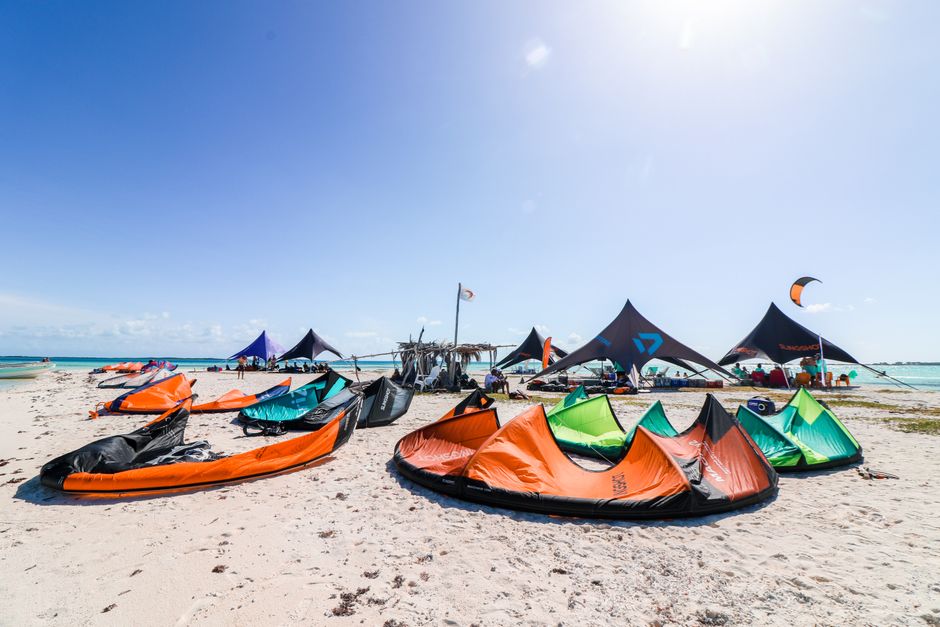
A major hazard of a four-hour surf lesson is not the water, but the sun and wind. Beachfront facilities manage environmental exposure by setting up physical rest areas on the sand. Shaded canopies are essential for multi-hour summer surf camps, providing a space where students can rest out of the sun and rehydrate.
Mobile vans rarely have the space to transport heavy pop-up tents, weighted sandbags, and large water coolers alongside fifteen surfboards. Without a shaded base camp, students must spend their entire rest breaks fully exposed to the sun and wind. This lack of shelter accelerates fatigue and increases the risk of dehydration or heat exhaustion, especially during youth programs.
Demystifying common misconceptions about surf school locations
Many beginners select a surf school based on branding or proximity without analyzing how the physical setup impacts their learning. Understanding these common myths can prevent you from booking an unsafe or unproductive session.
Equating a physical storefront with surf quality
A common error is assuming that a surf shop located on a coastal main street is the same as a beachfront facility. A retail shop two miles from the beach does not provide safety infrastructure on the sand.
When you book with a main-street shop, the instructors still function as a mobile van operation once they reach the water. They must pack gear into a truck, find parking, and set up on the beach without a permitted, physical footprint on the sand. Look for operations that hold direct municipal permits for the specific beach where you will be getting in the water.
Assuming vans carry sufficient first aid
People often assume that because an instructor has a van, they have a complete medical setup inside. In reality, space constraints in a mobile van are tight.
When a truck is packed to the ceiling with soft boards, wetsuits, and leashes, medical gear is frequently buried or left behind. A permitted beachfront setup allows a school to maintain a visible, dedicated first aid station on the dry sand. This station remains instantly accessible to coaches in the water without requiring them to search through a packed vehicle.
Making your decision: infrastructure questions to ask before booking
Before entering your credit card information, call the surf school or check their website to verify their physical setup. This quick audit will help you identify professional educational academies and avoid unpermitted, amateur operations.
- Ask if the school holds a current municipal commercial permit for the specific beach they use.
- Ask if the coaches are certified by the International Surfing Association and if they keep a dedicated rescue board on the sand.
- Ask where students can safely change, store their dry clothes, and access fresh drinking water.
- Ask if the school provides shaded rest areas on the sand during warm summer days.
- Ask if the program is registered with the state board of health as a recreational camp if you are booking for children.
By prioritizing physical infrastructure and safety permitting, you ensure your time in the water is focused on progression rather than dealing with avoidable logistics. To book a lesson with an ISA-certified surf school that maintains a permitted beach footprint at Nahant Beach, visit Boston Surf Adventures and register for an upcoming session.