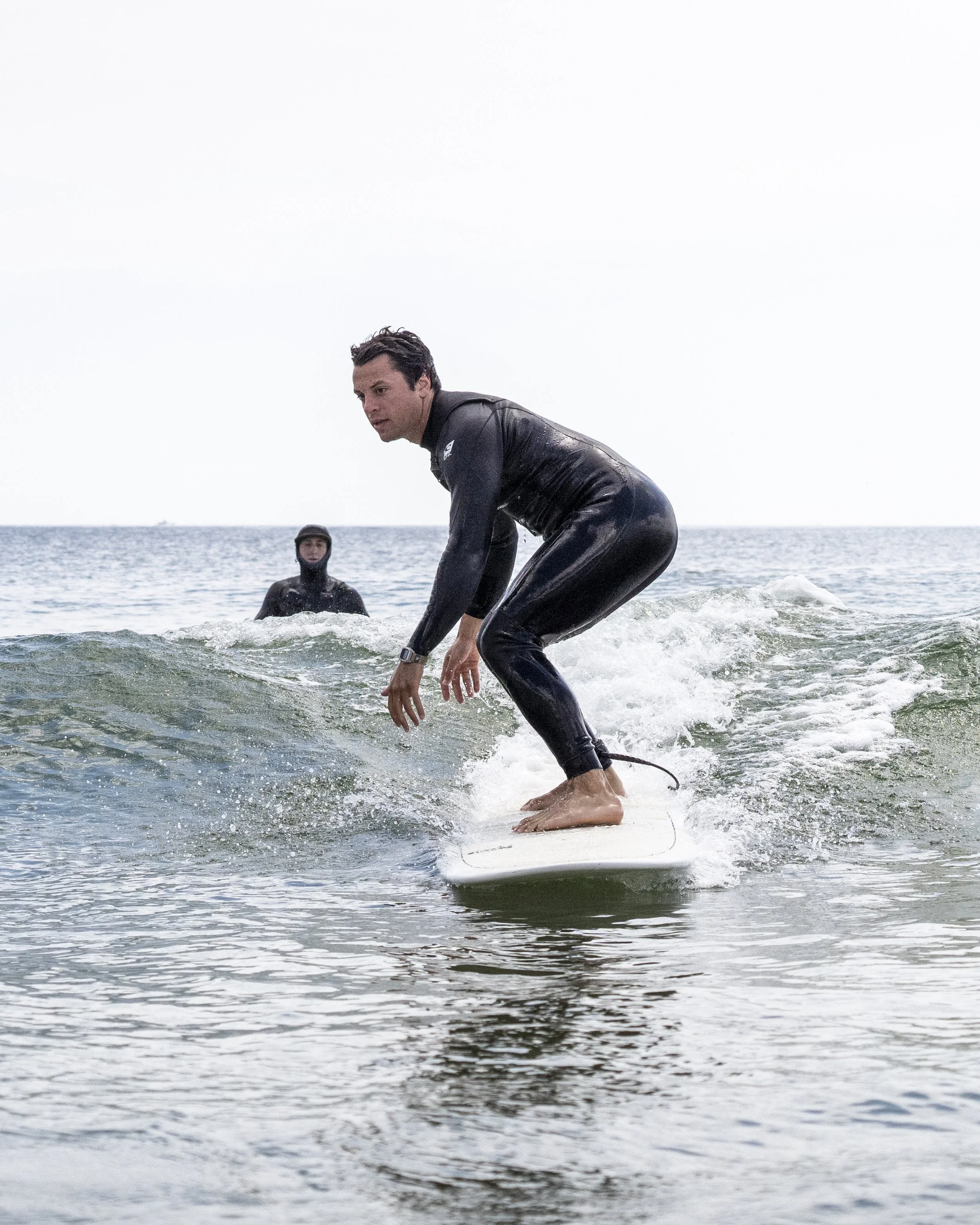
What happened when a Boston startup swapped trust falls for surf lessons
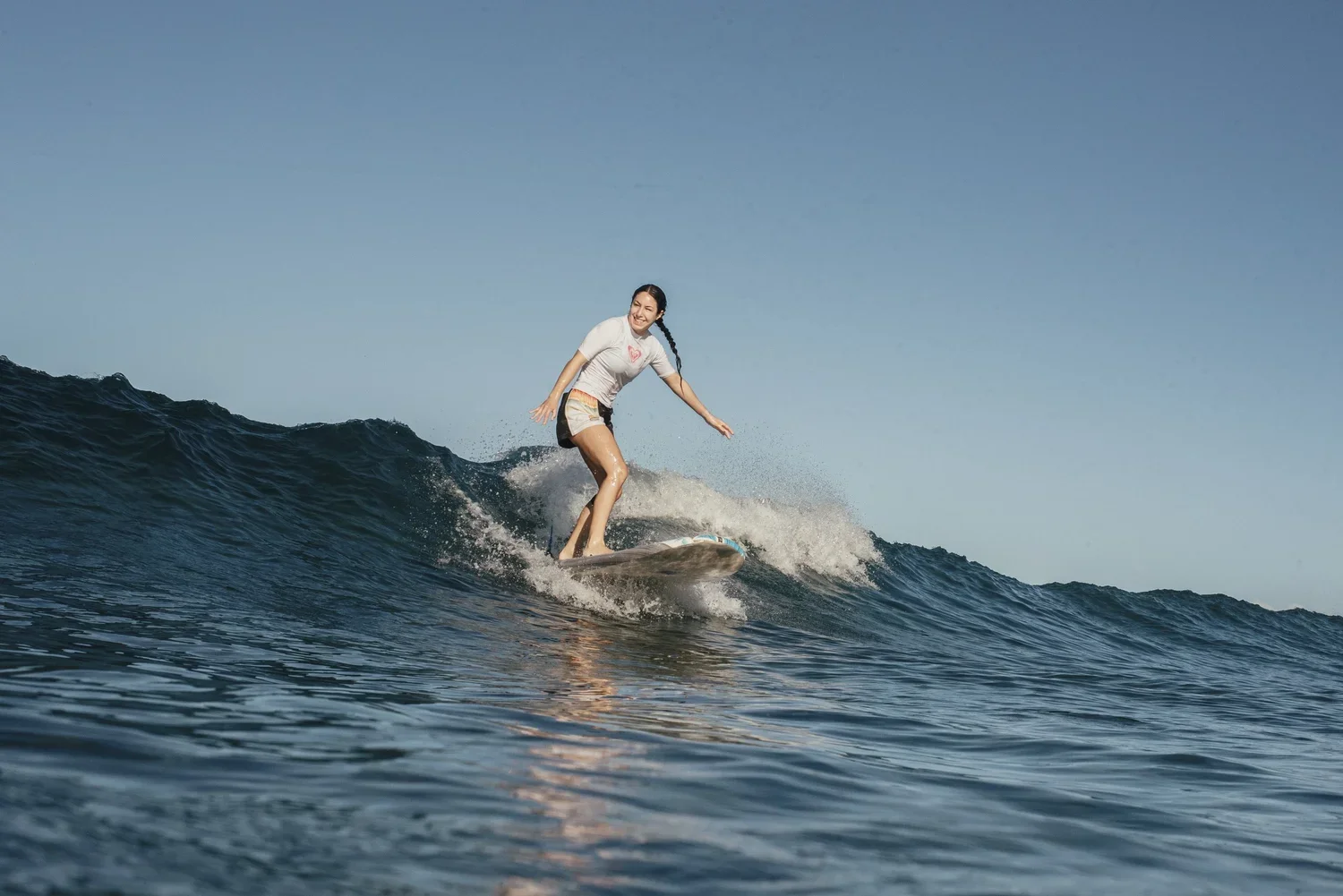
When a growing technology leadership team in Massachusetts realized their standard quarterly offsites were doing nothing to resolve cross-department communication bottlenecks, they brought their staff to Boston Surf Adventures at Nahant Beach. Instead of enduring another weekend of whiteboard sessions and simulated problem-solving exercises, the group stepped into the North Shore surf zone using a structured 3:1 semi-private coaching ratio. The ocean stripped away executive hierarchy within thirty minutes: by placing senior executives and junior contributors into identical whitewater conditions as complete beginners, the session rebuilt workplace communication around immediate presence, mutual accountability, and shared physical challenge.
The situation in 90 seconds
The company was running into a wall that tech startups encounter as they scale past fifty employees: teams stopped talking directly to one another. Department heads had retreated behind project management tickets, engineering and product were sparring over delivery timelines, and recent hires felt detached from the executive team. The standard playbook for this dilemma is well-worn across Greater Boston. Most organizations book a hotel conference room in the Seaport, hire an external facilitator to administer personality profiles, and cap off the afternoon with an awkward open bar.
That approach was rejected in favor of something with actual physical stakes. The leadership team wanted an environment where no one could coast on verbal rhetoric or rely on organizational authority.
When a group of corporate professionals arrives at Nahant Beach, the atmosphere is typically quiet apprehension. People who are accustomed to controlling slide decks and quarterly roadmaps suddenly find themselves pulling on neoprene wetsuits in a brisk salt breeze. The dynamic shifts before anyone even dips a toe in the water. For an executive team accustomed to polish and composure, standing barefoot on the sand with a ten-foot foam longboard creates an immediate leveling effect that no conference room breakout group can reproduce.
The problem with standard corporate retreats
Traditional team offsites fail because they operate in low-risk, synthetic environments. Asking employees to fall backward into a colleague's arms or assemble a structure out of dry spaghetti and marshmallows does not evaluate how humans actually react under pressure. Everyone in the room knows the exercise is staged, which allows participants to maintain their everyday workplace personas. The gregarious manager remains performative, the reserved engineer stays quiet in the corner, and the underlying silos remain untouched.
The cost of this failure is substantial. According to workplace research compiled by Surf Team-Building on the Oregon Coast, disengaged employees create an enormous drag on company performance, while structured team-building initiatives with real experiential components correlate with 30% lower employee turnover and a 50% improvement in communication. When team activities fail to bridge interpersonal distance, businesses pay for it through stalled projects, unspoken resentment, and quiet attrition.
Offsite activities must challenge participants in ways that make polite corporate masking impossible.
| Retreat Format | Physical Stakes | Hierarchy Status | Communication Trigger | Long-Term Retention |
|---|---|---|---|---|
| Hotel Conference Room | Zero | Reinforced by seating and titles | Scripted discussion prompts | Low (forgotten in two weeks) |
| Indoor Escape Room | Minimal | Often dominated by loudest voice | Artificial puzzle solving | Moderate (treated as a game) |
| Corporate Happy Hour | None | Cliques reform along existing lines | Casual unstructured chat | Low (socially performative) |
| Ocean Surf Coaching | High, managed | Completely erased by wave conditions | Immediate, real-time safety and support | High (shared emotional anchor) |
The ocean does not read an organizational chart. A shoulder-high set wave treats a chief revenue officer with the exact same indifference as an associate developer. When organizations remove the safety net of manufactured office politics, employees have to rely on straightforward, direct interaction.
Trading the boardroom for Nahant Beach
Taking a corporate group into the Atlantic requires a deliberate pedagogical framework, not an undisciplined free-for-all. Boston Surf Adventures operates as the only International Surfing Association (ISA) certified surf school in New England. That accreditation shapes how lessons are sequenced, managed, and coached in the surf zone.
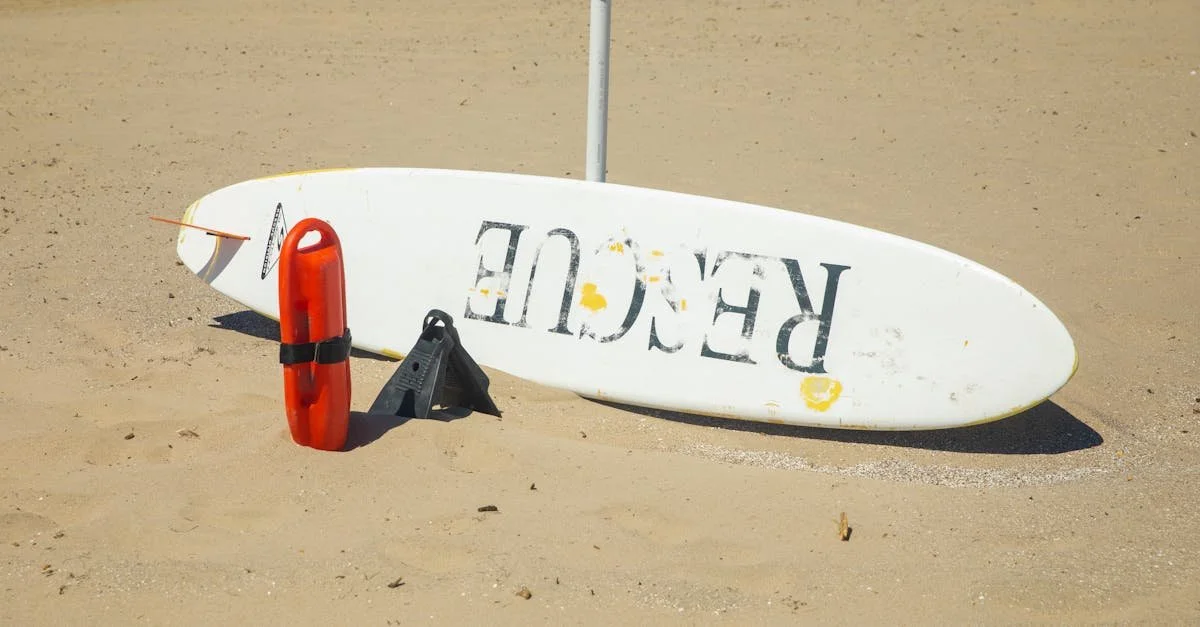
Every water coach on staff is a certified lifeguard, and on-land support staff holds CPR certification. Instructors undergo technical training in specialized water rescue protocols before working with any group. For corporate teams that might have varying swimming proficiencies and fitness baselines, this safety infrastructure removes the fear of genuine hazard while preserving the feeling of raw challenge.
The 3:1 coaching advantage
Most commercial surf operations herd corporate groups into large crowds, assigning eight or ten beginners to a single instructor who simply pushes people into waves. Boston Surf Adventures restricts its local instruction to a strict 3:1 semi-private coaching ratio.
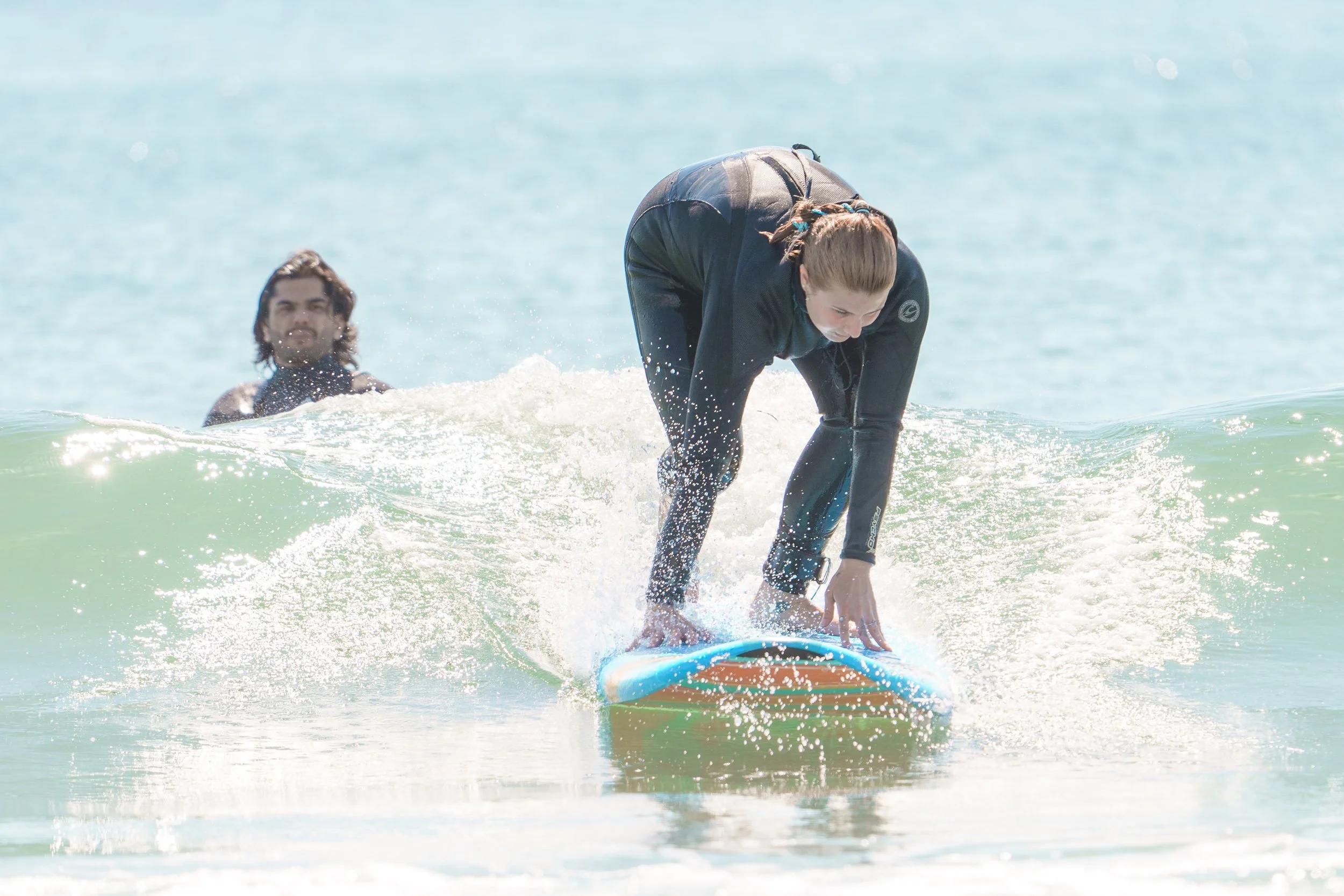
This ratio alters the learning curve. In a 3:1 group, coaches observe every paddle stroke, board trim adjustment, and pop-up attempt in real time. Rather than floating passively in the swell waiting for a turn, each team member receives constant technical feedback.
- Every participant receives continuous attention on wave selection, board positioning, and entry timing.
- Equipment logistics are managed completely, with fitted wetsuits and high-volume learner boards provided on site.
- Instructors teach the mechanics of reading incoming sets, teaching students how to scan the horizon collectively.
- Small coaching pods keep participants within voice range, prompting rapid peer encouragement during tough sets.
This tight instruction format mirrors what happens in private adult surf lessons in Boston. Adults do not learn motor skills through abstract lectures; they need small-group diagnostics, rapid correction, and high-frequency repetitions.
Facing things head-on in the water
The instruction methodology stems from founder Grant Gary, who spent eleven years as a public school teacher before starting Boston Surf Adventures in 2021. Gary discovered surfing during a grueling period in his personal life, using the sport as a direct way to confront difficulty rather than avoid it. His coaching model translates that classroom background into a structured ten-level skill progression, stripping the sport of intimidation and focusing on how people learn when their nervous systems are activated.
As explored in studies on surfing as a catalyst for team building, stepping completely outside your regular physical comfort zone forces an intense state of mental presence. You cannot check a smartphone while ducking beneath whitewater. You cannot ruminate on a delayed software release while timing a paddle stroke on a breaking wave.
Nahant Beach sits roughly 30 minutes from downtown Boston, making it the most accessible coastal wave venue for Greater Boston companies. The beach features gentle, sloping sandbars that create forgiving beginner waves, but paddling against even small Atlantic rollers requires real cardiovascular output and mental focus. Participants must make peace with getting knocked down, getting salt in their nose, and immediately turning their board around to paddle back out.
The actual impact on team dynamics
The transformation that occurs during a two-hour session at Nahant is visibly distinct from standard office team-building days. When groups start in the sand, participants tend to stand next to their usual functional peers. Designers stand with designers; senior managers talk quietly with other leaders.
Once the team wades waist-deep into the water, those office boundaries disappear.
Stripping away the corporate hierarchy
Surfing is an unapologetic equalizer. The moment a wave approaches, title and seniority carry zero weight. Everyone is wrapped in identical black rubber, fighting the same current, trying to balance on a wet surface.
During coached sessions, junior employees watch their department directors misjudge waves, lose their footing, and tumble headfirst into the foam. More importantly, they see them surface coughing, wipe the water from their eyes, and laugh.
That single dynamic alters the social contract back at work. When a team sees a company founder struggle through ten failed attempts before finally standing up on an unbroken wave, the myth of effortless executive perfection breaks down. Psychological safety in an organization is rarely built through corporate memos; it forms when people share moments of awkward vulnerability, struggle publicly, and witness each other recover with humility.
Measurable shifts in office communication
In the surf lineup, clear communication is an immediate physical necessity. If you see a cleanup set rolling in behind a teammate who is looking toward shore, you do not write a diplomatic memo. You shout clear, actionable direction: "Turn around! Paddle outside now!"
Teams that have shared a lineup learn to speak with crisp clarity. They also develop a common set of shared experiences:
- A baseline tolerance for public failure, making team members more willing to pitch unpolished ideas in planning sessions.
- An organic communication rhythm that relies on direct, supportive cues rather than political posturing.
- Stronger mutual respect between disparate departments that previously only interacted over contentious Slack threads.
- Shared memories of collective accomplishment, replacing the cynicism that typically trails mandatory corporate social events.
Instead of polite small talk over catered appetizers, colleagues leave the beach having witnessed each other manage real fatigue, fear, and triumph. That connection persists long after their wetsuits have dried.

What this means for your team
Transforming team dynamics does not require an expensive cross-country expedition or an awkward trust seminar. Greater Boston companies have access to world-class coastal resources right in their backyard, provided they approach the ocean with qualified coaches and a clear curriculum.
Whether an organization needs an intensive afternoon reset for twenty people or a week-long strategic immersion for an executive group, matching the venue to the objective is the first decision.
For local Boston teams
For organizations based in Boston, Cambridge, or the surrounding Route 128 corridor, local sessions at Nahant Beach offer an efficient, high-leverage outing. Because the beach is roughly 30 minutes from downtown Boston, teams can leave their desks at midday, complete a full orientation and water session, and be back in the city for dinner.
Boston Surf Adventures provides all necessary gear, including custom-selected wetsuits matched to seasonal water temperatures and stable beginner longboards. Sessions are run in tight 3:1 coaching pods, guaranteeing that every person on the roster gets individualized attention rather than being left to struggle on their own. For leadership groups looking for broader foundational skill-building, adult surf camp programs provide a deep immersion in ocean etiquette, wave reading, and board control.
For executive retreats in Puerto Rico
When executive teams need an extended offsite to reset long-term strategy while breaking down internal friction, BSA runs dedicated travel retreats in Rincón, Puerto Rico.
Operating directly on the beachfront at Maria's and Dogman's, these intensive progression weeks use an uncompromising coaching format: four professional coaches dedicated strictly to nine surfers.
- Teams receive ten fully coached surf sessions over the week, keeping instructional intensity exceptionally high.
- Five sessions include dedicated water and beach filming, with comprehensive video analysis to dissect mechanics.
- Groups are divided into specific skill pods, allowing true beginners and experienced surfers on the same leadership team to progress safely at their own level.
- Access to a comprehensive quiver of boards allows team members to swap equipment as conditions change throughout the day.
To evaluate this format for senior leadership groups, review the program structure for the Puerto Rico Progression Retreats. Combining high-focus physical training in tropical breaks with uninterrupted strategy discussions produces an offsite experience that no standard resort conference room can touch.
Teams that face real ocean conditions together return to the office with an established baseline of mutual trust. If you are ready to retire tired corporate retreat formulas and get your group into the water, contact Boston Surf Adventures or visit bostonsurfadventures.com to schedule a custom semi-private progression session.
Filed under