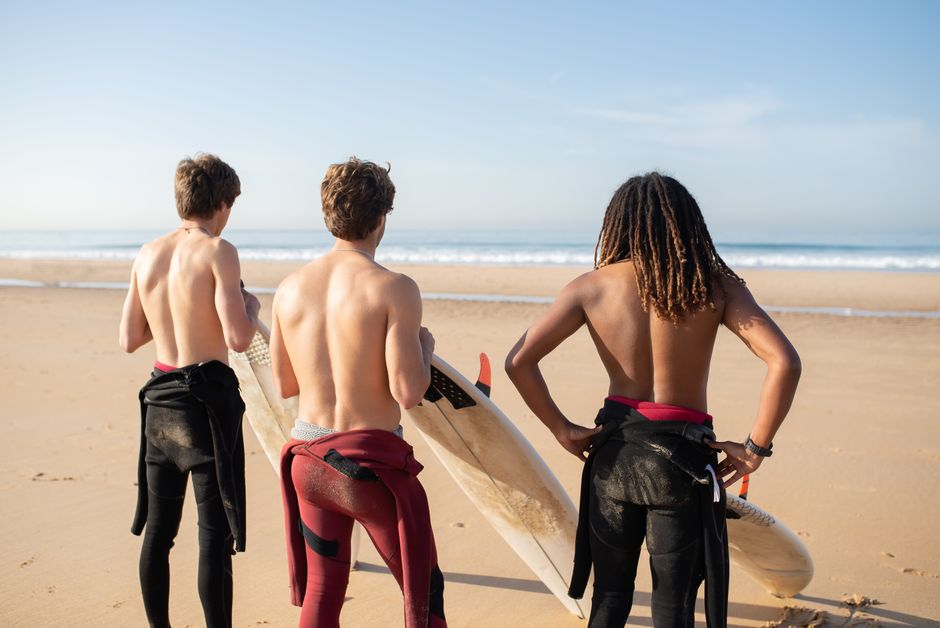
Many aspiring surfers find themselves trapped in the "whitewater plateau" because traditional, one-off surf lessons prioritize a quick thrill over foundational biomechanics. At Boston Surf Adventures, we solve this common stagnation by dismantling the bad habits formed when instructors push students into waves instead of teaching independent wave riding. By replacing standard shore-break pushing with structured coaching, proper hand placement, eye-line correction, and massive wave-count repetition at Nahant Beach, students learn to catch and ride unbroken green waves safely. This technical approach, developed by former educator Grant Gary, shifts the focus back to proper muscle memory and oceanography to build independent surfers in 2026.
The problem: the whitewater illusion
Most beginners spend their first surf lesson getting pushed into whitewater by an instructor, standing up once, and walking away thinking they know how to surf—until they try to catch a real wave on their own. The rush of standing up on broken white foam is highly addictive, but it is physically different from riding an unbroken green wave. Whitewater is a chaotic wall of turbulent water moving forward at a constant speed, which makes staying on top of the board artificially easy.
When you transition to an open face, you must match the speed of a wave that is constantly changing shape. This transition requires subtle shifts in weight and timing that whitewater simply does not teach. Self-taught surfers or graduates of generic surf programs often spend months paddling for unbroken swells, only to nosedive or watch the wave pass right beneath them.
This persistent struggle is what we call the whitewater plateau. It is a phase where hours in the sea do not translate to skill development. In our coaching sessions at Boston Surf Adventures, we meet many local surfers who have spent years surfing around Boston without ever learning how to angle a takeoff or ride down the line. To progress past this point, you must stop treating surfing as a passive experience where the ocean or an instructor does the work for you.
As noted in our analysis of how traditional surf schools teach backwards, starting with pop-up drills on the sand is a flawed sequence. It forces you to draw all your attention inward toward your feet and hands. Meanwhile, the wave is doing something complex beneath you that you remain completely unaware of. True progression requires you to read the ocean first and let standing up happen as a natural byproduct of correct positioning.
Why it happens: instruction versus coaching
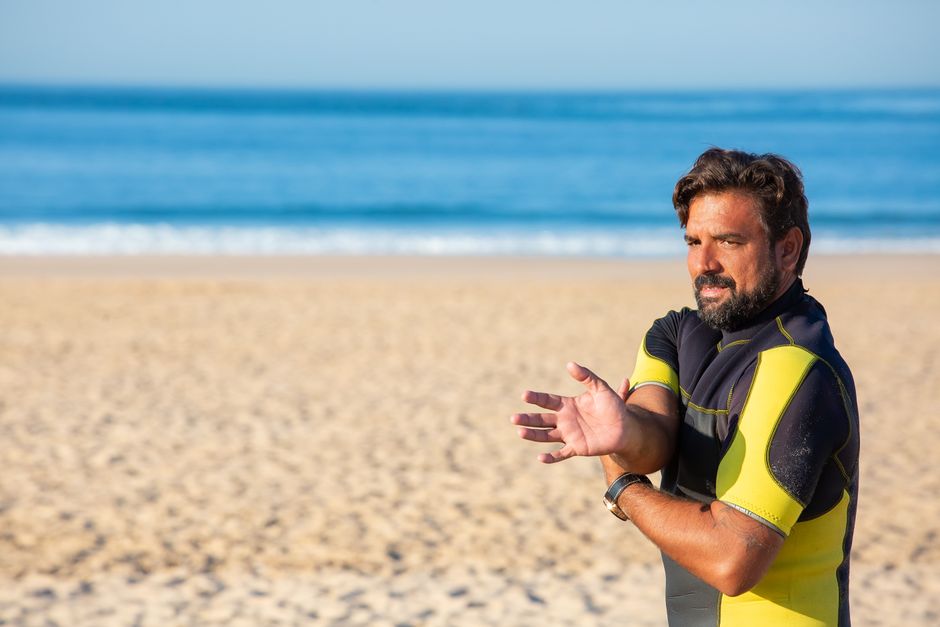
The root of the problem lies in the structural difference between transactional surf instruction and long-term surf coaching. A standard surf lesson is designed as a bucket-list activity where the main goal is to get a photo of you standing on a board for a split second. To achieve this, instructors handle every variable: they read the tide, select the wave, position your board, and give you a physical push at the perfect moment.
While this approach is fun for a afternoon, it leaves you completely dependent on external help. Once you paddle out on your own, you realize you have no wave judgment, poor paddling form, and a collection of bad physical habits. Real progression requires a school that coaches you to become independent, teaching you how to analyze conditions and catch waves on your own.
To illustrate the difference between these two pathways, look at how skills are built in a typical commercial lesson versus a structured, coached environment:
| Skill Element | Traditional Surf Lessons | Boston Surf Adventures Coaching |
|---|---|---|
| Wave Selection | Instructor chooses and pushes you in | You learn to read swell direction and interval |
| Paddling Mechanics | Minimal effort required due to physical push | Focused training on high-efficiency paddle form |
| Pop-Up Training | Rushed beach drills focusing on speed | Biomechanical breakdown of joint angles and balance |
| Wave Count | 5 to 10 waves per session on average | 50 to 70 waves caught over a single weekend |
| Feedback Loops | Generic encouragement ("Good job!") | Video analysis identifying exact technical faults |
The knee pop-up trap
One of the most destructive habits formed in low-level lessons is the knee pop-up. When a surfer lacks the core strength or correct training, they instinctively drag their knees onto the wax before bringing their feet forward. This two-step motion feels safer on land, but on water, it is a recipe for instability.
Placing your knees on the deck slows down your takeoff and shifts your weight backward, which causes the nose of the board to lift and lose speed. According to a detailed study on common beginner surf mistakes and how to fix them, the kneeling position is highly unstable and incredibly difficult to unlearn once your muscle memory hardens. A correct pop-up must be a single, explosive motion that goes directly from a flat chest-down position to a standing stance.
Looking at your feet
When you are anxious or uncertain, your natural instinct is to look down at your feet to verify your stance. This is a major technical failure because your body goes where your eyes look. Staring down at your surfboard causes your head to drop, your shoulders to collapse, and your hips to bend outward, which immediately throws off your center of gravity.
Analysis from surf coaches who analyze first-time surfers daily proves that looking down at the board is the primary reason beginners fall during the first second of a ride. To stay balanced, you must keep your eyes focused on the beach or down the wave line. This simple change opens your chest, stabilizes your shoulders, and allows your feet to find the center stringer naturally without visual confirmation.
Riding the wrong board
Many beginners buy a short, narrow board because they want to look like experienced surfers. This is a mistake that can stall your progress for years because low-volume boards do not float your body weight well enough to allow for efficient paddling. You will spend all your energy paddling without ever catching a wave.
Early progression requires an 8-to-9-foot soft-top foam board because of its stability and paddle power. This volume is especially critical when surfing in New England, where you must fight against the extra weight and stiffness of thick winter wetsuits. Matching your board volume to your gear and body weight, as outlined in our surf school board-volume audit, is a non-negotiable step to catching waves consistently.
The solution: rebuilding your biomechanics
To break out of the whitewater rut, you must rebuild your physical technique from the sand up. At our Nahant Beach surf school, Boston Surf Adventures uses a specific biomechanical progression developed by former teacher Grant Gary. This framework treats surfing as a sequence of physical movements that can be broken down, practiced, and mastered.
Rather than just telling you to stand up, our coaches analyze the specific angles of your joints and the distribution of your weight. We focus on teaching you the "why" behind every movement, giving you the tools to self-correct when you are out in the water alone.
Correcting hand placement
The foundation of a clean pop-up starts with where you place your hands on the deck. Most beginners place their hands far forward near their shoulders, resembling a standard floor push-up. This position is highly inefficient because it forces your chest up but leaves zero room for your legs to swing underneath your torso.
To fix this, your hands must be positioned much lower, at the level of your lower ribs or chest, and slightly wider than shoulder width. As detailed in biomechanical pop-up guides, this lower placement acts as a primary pivot point. It creates a larger pocket of space between your hips and the board, allowing you to swing your feet through in one fluid movement without your knees scraping the wax.
The explosive pop-up
Once your hands are positioned correctly, the pop-up must be executed as a single, coordinated movement. As you push your chest up, you must simultaneously drive your hips upward and swing your feet forward. Your feet should land perpendicular to the center line of the board, known as the stringer.
When you land, your knees should be bent to absorb the movement of the wave, and your hands should remain raised for balance. Practicing this motion on dry land fifty times before entering the water helps build the neural pathways needed to make this movement automatic under pressure.
Repetition and wave count
You cannot build muscle memory by catching only three or four waves per session. This is why solo beginners struggle; they spend two hours paddling, catch very few waves, and never get enough repetition to lock in proper habits.
With structured coaching, you can easily catch 50 to 70 waves over a single weekend. This massive increase in wave count is what allows our students to progress ten times faster than those trying to figure it out on their own. By catching wave after wave under the direct supervision of a coach, your body quickly learns to automate the correct movements.
When it's more serious
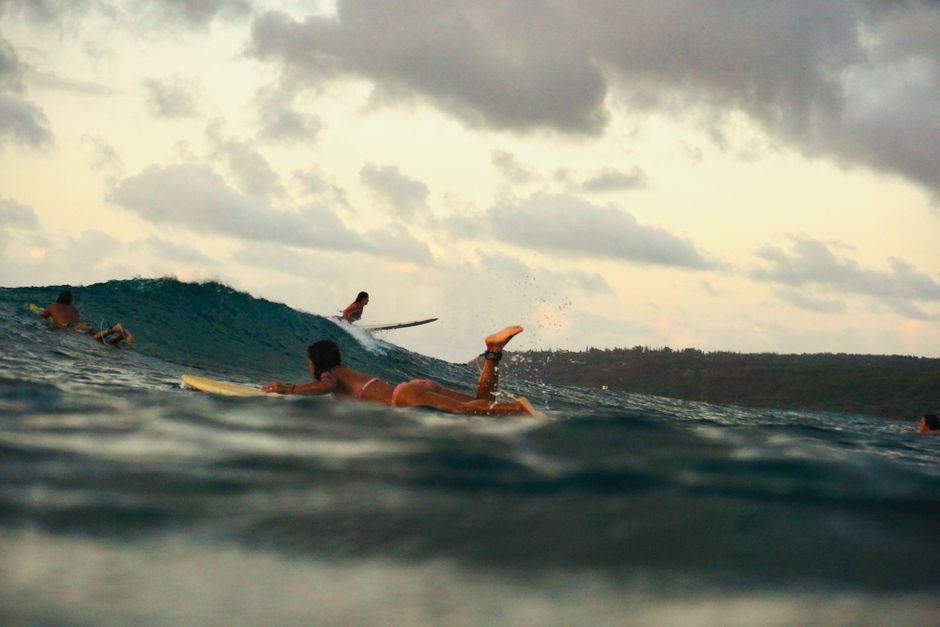
Staying stuck in the whitewater is not just a blow to your progress; it can also become a safety concern. When you rely on an instructor to push you, you never develop the wave judgment required to navigate a crowded lineup. This lack of awareness can lead to dangerous situations, such as dropping in on other surfers, nosediving in heavy shorebreak, or losing control of a large board.
Surfing in New England presents unique environmental conditions, from shifting tidal currents to sudden winds. If you do not understand ocean safety, you put yourself and others at risk. This is why choosing a certified, highly trained surf school is essential for your development.
Boston Surf Adventures is the only ISA Certified Surf School in New England, meaning our entire curriculum meets the safety and educational standards of the International Surfing Association. All of our coaches are certified lifeguards, and our on-land staff is CPR certified. We train our team in custom ocean rescue techniques to ensure that you can focus on building your skills in a completely safe, controlled environment. Our protocols are thoroughly reviewed to ensure student safety, as highlighted in our surf school standards index.
Prevention: cementing the right muscle memory
The best way to prevent bad habits from taking hold is to establish structured feedback loops early in your surfing journey. Without objective feedback, you will continue to make the same errors without realizing why you are falling.
To solve this, our programs combine in-water coaching with specialized technical tools designed to accelerate your development. Whether you are taking lessons at Nahant Beach or joining one of our winter retreats, we make sure you have a clear roadmap for your progression.
Daily video analysis
Video analysis is one of the most powerful tools for correcting technical errors. When you are riding a wave, your brain is overwhelmed by sensory inputs, making it impossible to feel exactly what your body is doing. Watching high-definition footage of your waves allows you to see the exact moment your form breaks down.
During our winter retreats in Rincon, Puerto Rico, we film every single wave caught during the morning session. Between sessions, founder Grant Gary reviews the footage with you, identifying exactly two specific technical adjustments to focus on during your next paddle-out. This targeted feedback prevents cognitive overload and allows you to make rapid, visible changes to your stance. You can learn more about how we integrate these feedback loops during our Puerto Rico retreats.
The 10x wave count rule
Building a lasting foundation requires consistent, high-volume practice. Our New England surf camps are designed around this principle, giving you the coaching and wave count needed to make proper technique your default physical response.
We are so confident in our structured coaching method that we offer a full stand-up guarantee. If you do not stand up and ride a wave during your first lesson, we will issue a full refund, no questions asked. This guarantee reflects our belief that anyone can learn to surf when they are given the right biomechanical tools, expert coaching, and a supportive community.