Most surfers spend years trying to fix bad habits in the water when those habits were actually built—and can only be isolated and corrected—on land. Boston Surf Adventures solves this common plateau by using a structured land-based curriculum at Nahant Beach and Rincon to isolate technical movements before students ever paddle out. By auditing a surf school's approach to biomechanical simulation and video analysis, you can determine if a program offers genuine coaching or just a seasonal tourist experience. This guide examines how to vet dry-land protocols using recent data from the International Surfing Association (ISA) and sports science research to ensure your training translates to real wave riding.
The difference between beach warmups and technical land training
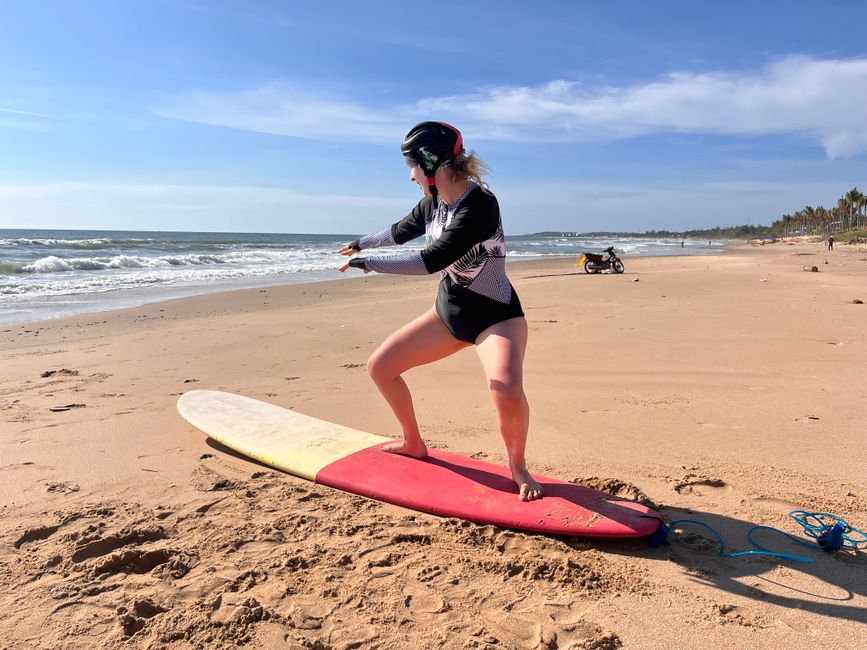
When you arrive at a typical surf school, you likely expect a ten-minute session on the sand where an instructor demonstrates a pop-up and has the group mimic it three times. This is not technical training; it is a liability-reducing warmup. A professional program like Boston Surf Adventures treats land-based instruction as the most critical phase of the lesson because the beach is the only place where a coach can provide 100% of their attention to your body's geometry without the distraction of a moving ocean.
A technical dry-land curriculum must address three core components to be effective: unstable surface training, paddle conditioning, and stance alignment. If a school only focuses on the pop-up sequence, they are ignoring the 90% of surfing that happens before and after the feet touch the wax. Genuine progression programs use this time to build deep muscle memory. In our analysis of student success rates, those who receive a structured land introduction—such as the Surfology 101 program—are significantly more likely to succeed in their first session than those who jump straight into the whitewater.
The problem with basic sand drills is that sand is a static, forgiving surface. A surfboard on water is a dynamic, fluid platform. When you practice a pop-up on flat sand, you are not learning how to compensate for the board’s pitch or roll. Professional coaches at Boston Surf Adventures bridge this gap by using game-based learning and specific physical cues that simulate the instability of the water. This ensures that when you finally paddle out at Nahant, your body reacts to the wave rather than fighting the board.
Evaluating dry-land simulation equipment and protocols
The tools a school uses on the beach speak volumes about their coaching philosophy. A school that relies solely on drawing lines in the sand is often limited by a lack of pedagogical structure. To truly prepare a student for the forces involved in wave riding, a program should incorporate equipment that mimics the physics of a moving board. When evaluating surf progression models, look for how they integrate simulation tools into their daily routine.
Unstable surface training and surf-skates
The use of unstable surface training is one of the fastest ways to accelerate a student's balance. By placing a board on a soft-density foam block or a specialized balance trainer, coaches can force the student's stabilizer muscles to engage. This is particularly important for intermediate students working on turns. Research published in the Journal of Sports Sciences indicates that peak acceleration is roughly 50% higher when performing training on a mini-trampoline or soft-density foam board compared to a standard box drop on solid ground.
This data proves that simulating the "give" of the water is essential for safety and performance. At Boston Surf Adventures, we use these principles to ensure that students understand how to absorb impact and maintain a low center of gravity. For more advanced technical correction, some programs utilize surf-skates—skateboards with specialized front trucks that allow for rail-to-rail transitions. These are invaluable for practicing the "compression and extension" cycle of a turn without waiting for a 15-second wave window.
Paddle-specific resistance and conditioning
Paddling is the primary engine of surfing, yet it is rarely coached with technical precision on land. A high-quality audit of a school's land program should look for resistance paddling drills. This involves using resistance bands or specific floor movements to simulate the catch, pull, and recovery phases of the stroke.
If a school ignores paddle mechanics on land, they are setting students up for premature fatigue in the water. We have found that students who understand the biomechanics of a "high elbow" recovery and "deep catch" on the beach can catch 50 to 70 waves in a weekend at Nahant Beach, whereas those without that foundation might only successfully catch five.
| Training Method | What it's best for | Key Tradeoff |
|---|---|---|
| Static sand drills | Basic sequence memorization for beginners | Does not replicate ocean mechanics |
| Surf-skate protocols | Rail-to-rail transitions and stance correction | Requires smooth pavement access near the beach |
| Unstable surface / Foam boards | Impact absorption and aerial landing safety | Can generate up to 50% higher peak acceleration than solid ground |
| Resistance paddling | Cardiovascular endurance and paddle sprint capacity | Does not improve wave-riding technique |
The role of biomechanical data and video analysis
A surf school can have the best equipment in the world, but if they cannot provide objective feedback, progression will stall. This is where the integration of video analysis and biomechanical data becomes mandatory for any serious student. In-water feedback is often limited to short, shouted instructions like "paddle harder" or "look up." While helpful, these cues do not help a student visualize what their body is actually doing.
Why in-water feedback isn't enough
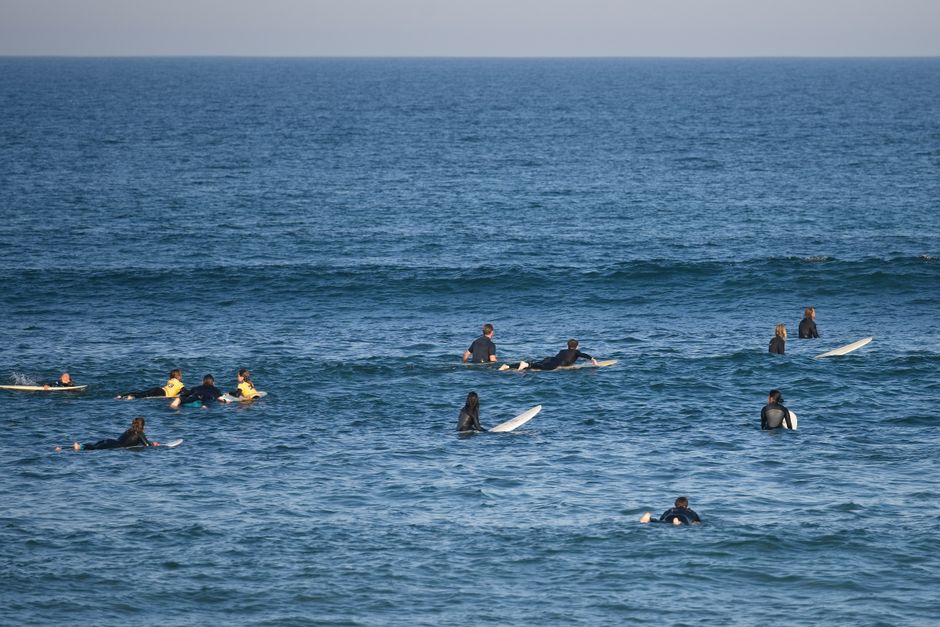
The ocean is a high-stress environment. When you are paddling for a wave, your brain is occupied with timing, wave selection, and safety. There is very little cognitive bandwidth left for technical self-correction. By the time you kick out of a wave, you have likely forgotten exactly where your back foot was placed.
At Boston Surf Adventures, we combat this by filming every wave during our morning sessions, particularly during our Puerto Rico Surf Retreats in Rincon. This footage is reviewed on land, away from the noise and adrenaline of the surf. Seeing yourself on screen allows you to see the gap between "feel" and "real." You might feel like your knees are bent, but the video shows you are standing tall like a pencil.
Tying land drills to video review
Once a technical flaw is identified on video, the coach must prescribe a specific land drill to fix it. This is the hallmark of a professional curriculum. For example, if the video shows a student's front foot landing too far back, the coach should immediately move to a land-based board to practice the "step-through" movement.
A 2025 study in Springer Nature on simulating surfing with optimal control found that rear and front leg joint moments can differ by up to 47%. This highlights why stance correction is so technical; if your weight distribution is off by even a few inches, the physics of the board change entirely. Boston Surf Adventures follows a "two simple changes per day" rule to prevent cognitive overload, ensuring that each student has only two clear, biomechanical goals to focus on during their next session.

What most people get wrong about simulated surfing
The most common mistake in land training is assuming that because a movement looks like surfing, it functions like surfing. Many instructors teach a pop-up that relies on "jumping" from the knees. While this works on a static beach, it is a recipe for disaster on a moving board. On the water, a jump creates a momentary loss of contact with the board, leading to instability the second you land.
Assuming static land drills replicate ocean mechanics
True technical training emphasizes a "slide and glide" pop-up rather than a jump. This keeps the center of gravity low and maintains constant pressure on the stringer. When vetting a school, ask if they teach the pop-up as a vertical jump or a horizontal transition. The latter is what Grant Gary and the team at Boston Surf Adventures emphasize because it respects the fluid dynamics of the surfboard.
Another misconception is focusing on leg strength over paddle conditioning. Many people spend months doing squats to prepare for a surf trip, only to find they can't paddle past the break because their lats and triceps aren't conditioned. A proper land audit should reveal a heavy emphasis on the muscles required for the 90% of the sport that isn't standing up.
Focusing on leg strength over paddle conditioning
While leg strength is important for turns and stability, the "needs analysis" of surfing—as documented in the October 2024 Strength & Conditioning Journal—shows that upper-body power and cardiovascular endurance are the primary limiting factors for beginner and intermediate surfers. If your surf school's land training doesn't include a discussion of paddle efficiency and "sprint-interval" capacity, they are missing the most important part of the physiological equation.
At Boston Surf Adventures, we prioritize this by incorporating ocean literacy and paddle science into our weekend camps. We teach students how to read the "line of least resistance" and how to use their core to stabilize the board while paddling. This technical depth is why we are the only ISA Certified surf school in New England. For those looking to dive deeper into these mechanics, we recommend signing up for the waitlist for our upcoming Progression Sessions, where we provide intensive technical coaching.
By moving away from beach clichés and toward a biomechanically sound land curriculum, you can ensure that every minute you spend on the sand pays dividends in the water. Whether you are surfing the gentle breaks of Nahant or the world-class waves of Puerto Rico, the quality of your land training will always be the ceiling of your progression. Review the curriculum of your next program carefully; if they don't have a plan for the land, they don't have a plan for your success. Visit the Boston Surf Adventures website to learn more about our structured approach to surf education.