Boston Surf Adventures developed this technical audit to help students distinguish between professional surf coaching and recreational board rentals, which often leave surfers without the skills to catch waves independently. To ensure rapid progression and safety, students should prioritize schools that maintain a maximum 5:1 student-to-coach ratio and hold current ISA Level 1 certifications. By focusing on high wave counts and structured video analysis at locations like Nahant Beach, this vetting standard ensures that surfers move beyond the whitewash into self-sufficient open-face riding.
Baseline safety and instructor certifications in the Boston area
Most beginner surf lessons in New England operate in a regulatory grey area where the only requirement is a beach permit and a stack of foam boards. For the discerning student, this is insufficient. A professional surf school, such as Boston Surf Adventures, must be evaluated based on the documented credentials of its staff. The industry standard for coaching excellence is the ISA Level 1 Surf Instructor certification, issued by the International Surfing Association. This is the only globally recognized qualification that requires instructors to pass rigorous assessments in teaching methodology, risk management, and oceanography.
When vetting a local surf school near Boston or the North Shore, do not settle for "experienced surfers" as instructors. Experience in the water does not equate to the ability to communicate biomechanical cues to a beginner. The ISA Level 1 Surf Instructor program requires candidates to demonstrate they can structure a lesson progressively, ensuring that safety is the primary pillar of the session. As the only ISA Certified Surf School in New England, we maintain that this certification is the non-negotiable baseline for anyone charging for instruction.
Beyond surf-specific coaching, the physical safety of students requires a secondary layer of medical and rescue qualifications. A qualified surf coach must also hold an in-date beach lifeguard qualification, such as the NVBLQ or an equivalent open-water rescue certificate. This ensures the coach is trained in identifying rip currents, managing spinal injuries in the surf zone, and performing deep-water rescues. At our Nahant operations, every coach is a certified lifeguard, and all on-land staff is CPR certified to ensure a closed loop of safety from the sand to the break.
Wave count economics and operating ratios at Nahant Beach
The primary failure of high-volume surf schools is the dilution of the student-to-coach ratio. In many large-scale summer programs, it is common to see ten or twelve students assigned to a single instructor. This is not a coaching environment; it is a supervised drift. For a student to actually learn to time a pop-up and select a wave, they need immediate, per-wave feedback. Boston Surf Adventures operates on a strict ratio of five or fewer students per coach for kids' programs, and even tighter pods of three students per coach for adult weekend camps.
The impact of these ratios is most clearly seen in wave count economics. If you attempt to surf alone at Nahant Beach over a two-day period, you might successfully paddle into and stand up on five waves. The rest of your time is spent mispositioning yourself or missing the "peak" of the wave. With a professional coach dictating your positioning and providing the necessary momentum, that count jumps to 50 or 70 waves in a single weekend. This repetition is the only way to build the muscle memory required for self-sufficiency.
| Metric | DIY/High-Ratio Lesson | BSA Technical Coaching |
|---|---|---|
| Student-to-Coach Ratio | 10:1 or 12:1 | 3:1 (Adult) / 5:1 (Kids) |
| Weekend Wave Count | 5 - 10 waves | 50 - 70 waves |
| Feedback Frequency | General group tips | Per-wave biomechanical cues |
| Primary Goal | Standing for a photo | Self-sufficient wave selection |
Safety also dictates these ratios. In the unpredictable environment of the North Shore, a coach cannot effectively monitor the safety and positioning of more than five individuals simultaneously. Small groups allow the instructor to maintain a tight "impact zone" where they can intervene if a student loses their board or enters a dangerous section of the break. When schools prioritize volume over these ratios, they are compromising both your progression and your physical safety.
Pedagogical rigor and progression mapping in New England
True surf coaching is a discipline of education, not just a lifestyle experience. This is why Boston Surf Adventures was founded by Grant Gary, a former professional educator with over 15 years of teaching experience. A school's curriculum should be judged by its ability to translate complex ocean movements into repeatable land-based drills. If a school does not have a structured on-land session before hitting the water, they are likely just "pushing" you into waves rather than teaching you how to surf.
On-land to in-water translation
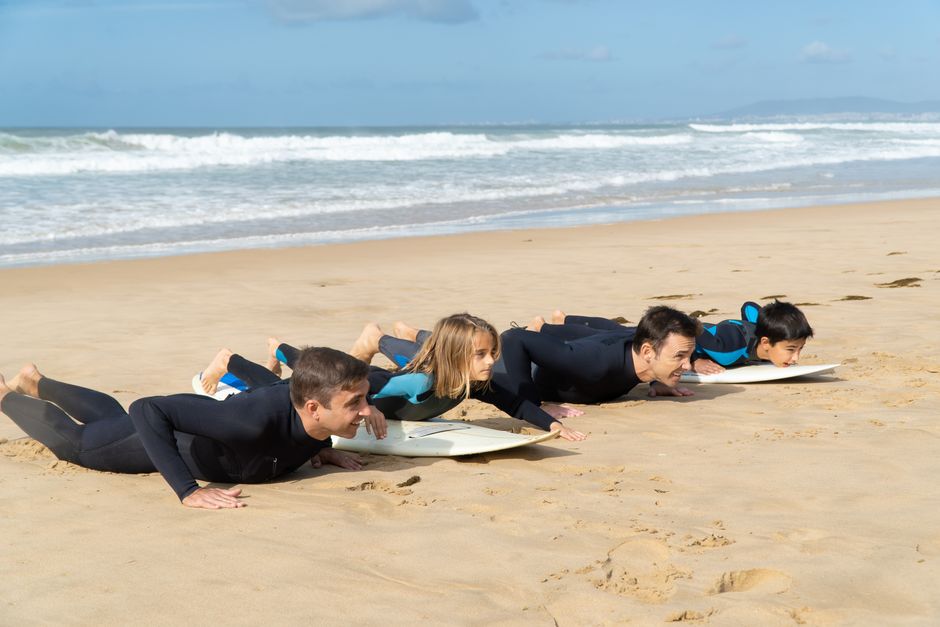
Our Surfology 101 program is an example of how classroom-style pedagogy applies to the beach. Before a student even touches the water at Nahant, they must understand the physics of the "pop-up" and the importance of hand placement on the rails. We use game-based, on-land skill introduction to isolate these movements. By the time the student enters the water, the mechanical sequence is already engrained, allowing the in-water session to focus on timing and wave selection. You can read more about this in our guide on how to vet a surf school curriculum: biomechanics vs. beach clichés.
Video analysis integration
The most significant advancement in modern surf coaching is the use of video analysis. For intermediate surfers or adults looking for rapid improvement, external visual feedback is indispensable. In our advanced programs and international retreats, we film every single wave caught in the morning session. Between sessions, founder Grant Gary reviews the footage with students, identifying the specific "two changes" that will yield the most significant improvement. This objective feedback removes the guesswork from progression, allowing students to see exactly where their weight distribution or eye-line is failing them.

What most people get wrong about surf instruction
There is a common misconception that standing up on a board once or twice means the lesson was a success. In reality, a successful lesson is one that moves you closer to the self-sufficiency test. If you cannot identify which wave is going to "close out" and which one will offer an open face, you haven't actually learned to surf; you've simply been a passenger on a board. Professional coaching must include "ocean literacy"—the ability to read tides, wind, and swell direction independently.
Confusing cheerleading with technical coaching
Many seasonal workers at local beach schools rely on "cheerleading"—telling you "great job" or "just paddle harder"—rather than providing technical cues. A real coach identifies that your back foot is landing too far forward or that your shoulders are too square to the beach. This level of detail is what separates a professional surf school from a summer hobby. We provide a stand-up guarantee because our biomechanical framework is so consistent that standing up becomes a mathematical certainty, not a lucky accident.
Ignoring the "pull off" and wave selection
Beginners often focus entirely on the ride, but the marks of a competent surfer are how they handle the end of the wave and how they return to the lineup. A comprehensive curriculum must teach students how to pull off a wave safely before it hits shallow water or other surfers. It must also cover "surf etiquette"—the unwritten laws of the lineup that prevent collisions and conflict. Without these skills, a student is a liability to themselves and others. For a deeper dive into these technical milestones, refer to our surf progression audit.

Accountability and the professional standard
The final metric of a high-quality surf school is accountability. This is evidenced by the school's willingness to stand behind its results and its commitment to the local community. For example, our "No one eats alone" rule reflects the community-focused nature of the Boston Surf Adventures experience. We believe that the transformative power of surfing is best realized when it is shared, which is why our weekend camps include "Apres Surf" sessions at local restaurants or breweries near Nahant.
When choosing a program, look for clear documentation of what is included. A professional package should not have hidden costs for gear or safety equipment. Our weekend camps, for instance, include a full breakdown of value—from the Swim to Surf fitness program to the board and wetsuit rentals. This transparency allows the student to see that they are investing in a comprehensive educational experience, not just a few hours of rental time.
In New England, the surf season is short but incredibly rewarding. Don't waste your sessions with uncertified instructors or overcrowded groups. Demand the ISA standard, insist on low ratios, and choose a program that views surfing as the professional discipline it is. Whether you are a parent looking for a safe, structured environment for your child or an adult looking to finally master the pop-up, the vetting standard remains the same: certifications, ratios, and results.
Review the actual coaching methodology behind our programs. Explore our Progression Sessions to see how video analysis and low ratios turn beginners into self-sufficient surfers. Learn more about our full range of offerings at the Boston Surf Adventures homepage.