Specialized surf coaching in Costa Rica and Hawaii: what you actually get
Dropping $4,000 on a week-long surf trip does not guarantee you will catch better waves, and it certainly does not guarantee you will fix your pop-up. For surfers looking to build real technical skill, Boston Surf Adventures evaluates coaching programs by their measurable coaching mechanics: in-water ratios below 3:1 and daily, structured video review. In 2026, premier Pacific operations like Surf Simply and Barefoot Surf Travel set the standard for biomechanical deconstruction in Costa Rica, while operations in Hawaii offer essential localized wave entry. For East Coast surfers, balancing these coaching frameworks against travel days determines whether an international trip delivers genuine skill acquisition or just expensive fatigue.
The difference between a surf camp and a surf coaching retreat
A standard surf camp sells an experience centered on beach living and physical activity, whereas a technical coaching retreat operates like an athletic training facility. Most entry-level surf camps hand you an eight-foot foam board, walk a dozen people into waist-deep whitewater, and push you into broken waves for two hours. You stand up, feel the rush of moving across the water, and leave with the impression that you learned how to surf.
Once you try to paddle into unbroken green waves on your own, that illusion dissolves. You miss waves because of poor trim positioning, get caught inside because nobody taught you how to read interval sets, or find yourself stuck in a crouched, off-balance stance. Adult learners often spend years caught in this exact phase, wondering why additional sessions do not yield better rides. As we see in our own What's Next? — Boston Surf Adventures progression programs, breaking past that wall requires diagnostics rather than just more paddle time.
Technical coaching retreats tackle surfing as a complex motor skill. Instead of generic encouragement, these programs isolate the exact kinetic breakdowns in your mechanics:
- Hip rotation speed and foot placement during the pop-up transition
- Chest elevation and board trim angle during entry paddling
- Eye tracking down the wave face versus staring down at the nose of the board
- Upper-body rotational wind-up before executing a bottom turn
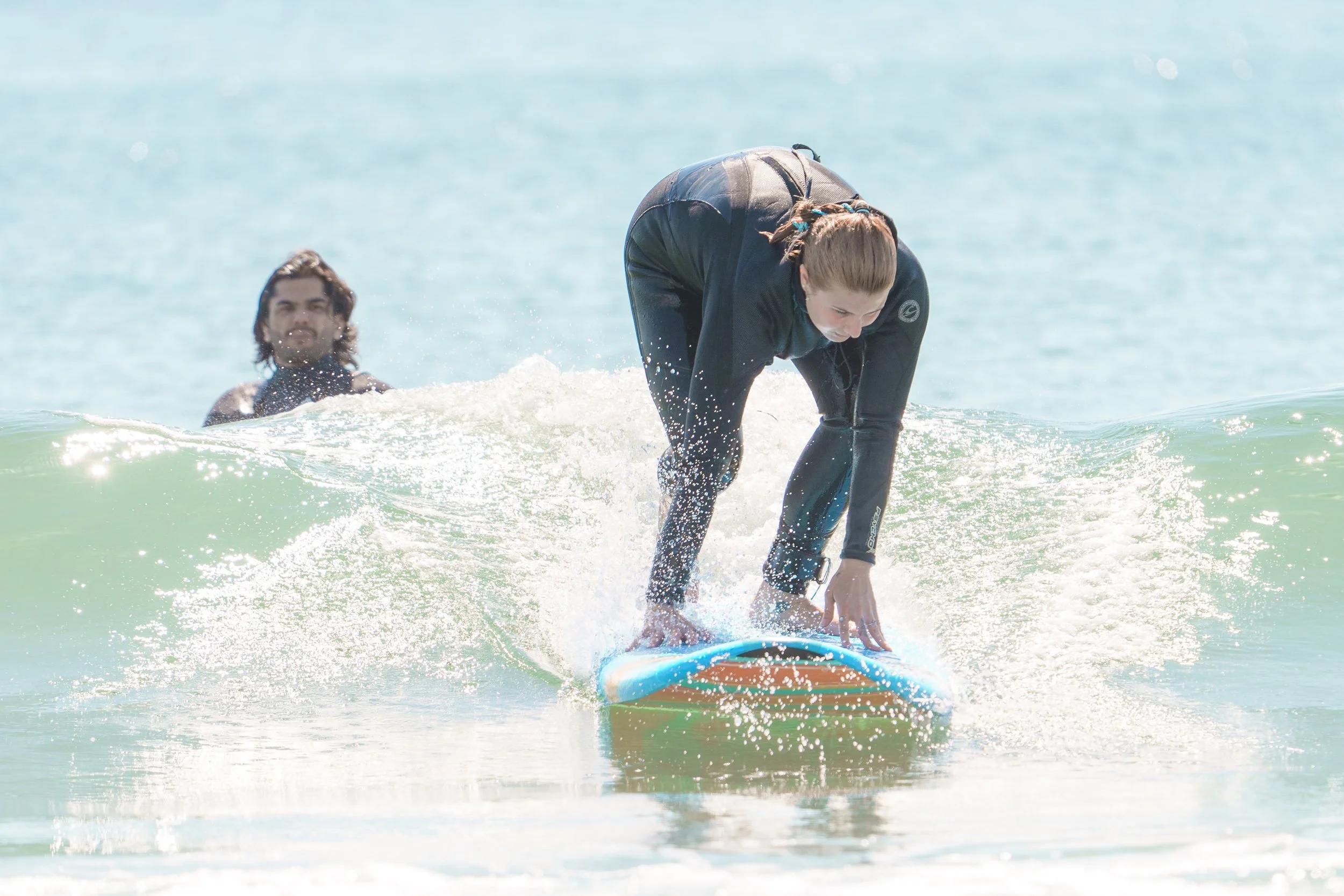
A legitimate coaching retreat uses a defined curriculum to systematically fix these errors. Rather than leaving you to guess what went wrong on a blown wave, a dedicated coach observes your setup from the water or beach, reviews recorded footage, and gives you specific adjustments to test on your next set.
Costa Rica's technical surf coaching options
Costa Rica has emerged as the global epicenter for systematic surf education. The combination of warm water, consistent Pacific swells, and accessible sand and cobblestone breaks has allowed operators in regions like Nosara and the Central Pacific to build permanent campuses focused entirely on adult skill acquisition.
| Operator | Location | Guest-to-Coach Ratio | Video Analysis Protocol | Primary Coaching Focus |
|---|---|---|---|---|
| Surf Simply | Nosara, Guanacaste | ~1.5:1 (14 guests, 9 coaches) | Daily filmed sessions, classroom theory | Biomechanical theory, video deconstruction |
| Barefoot Surf Travel | Nosara, Guanacaste | 2:1 (Max 12 guests, 6 coaches) | Daily video review, personal surfer profiles | Technical feedback, paddle mechanics |
| Surf Synergy | Jaco, Central Pacific | Up to 1:1 private coaching | Video review, surfskate, mobility sessions | Holistic performance, breathwork, movement |
Systematized coaching at Surf Simply
Located in Playa Guiones near Nosara, Surf Simply built the modern benchmark for data-informed surf instruction. The facility runs week-long programs capped at 14 guests, supported by a team of nine certified coaches. This staffing density gives them roughly a 1.5:1 ratio, among the lowest in the commercial surf industry.
Instead of relying on surf jargon, their syllabus uses a proprietary framework called the "Tree of Knowledge," which separates surf technique into distinct, observable physics concepts. Guests spend almost as much time in air-conditioned classroom sessions studying video footage as they do in the water. Coaches break down board design, wave energy physics, and joint mobility to explain why a rail catches or why a cutback loses speed. For analytical surfers, this engineering-style breakdown provides a clear mental model of the ocean.
Small ratios at Barefoot Surf
Barefoot Surf Travel operates technical coaching retreats in Nosara with a strict cap of 12 surfers managed by six dedicated coaches. This guarantees an exact 2:1 student-to-coach ratio in the ocean. The program strips away excess resort fluff to concentrate on progressive technical milestones for beginner and intermediate riders.
Barefoot Surf relies heavily on their structured digital curriculum, which categorizes surfers into precise tiers based on their wave-riding capacity. In the water, coaches position themselves right next to you on the peak, calling positioning adjustments, wave angles, and entry timing. Back on land, daily video review connects what you felt on the board to what your body actually did, pinpointing the mechanical flaws that stall your progress.
Wellness integration at Surf Synergy
Situated on Costa Rica's Central Pacific coast, Surf Synergy pairs direct coaching with athletic recovery and nervous system control. They offer up to 1-on-1 coaching packages, taking guests to local beach and point breaks around Jaco and Hermosa based on daily swell direction and individual skill level.
What separates their approach is the deliberate use of land-based movement training. Coaches integrate surfskate training on flat ground to engrain rail-to-rail motor patterns before paddling out. They also combine technical wave debriefs with targeted breathwork, mobility drills, and yoga. For surfers who struggle with ocean anxiety, paddling fatigue, or physical stiffness, addressing these physiological barriers alongside surf technique helps smooth out the learning curve.
Hawaii's specialized local operators
While Costa Rica is built around resort-style academies, Hawaii presents an entirely different learning environment. The Hawaiian Islands generate raw, powerful Pacific swells that break over shallow volcanic reefs and steep sandbars. Wave energy moves with far more velocity here than on standard continental shelves, and lineups carry strict social hierarchies. Because of this, technical coaching in Hawaii centers heavily on ocean literacy, lineup management, and local wave entry.
Former pros at Siren Surf Adventures
On Oahu, Siren Surf Adventures provides guided surf trips led by former competitive surfers like Cat Slatinsky. Slatinsky spent two decades living and surfing on Oahu, competed internationally, and participated in the inaugural US collegiate Surf Science program back in 1997.
That level of historical knowledge changes how intermediate surfers approach heavy water. Hawaii lineups can intimidate visiting surfers, often leading to hesitation on the take-off or poor wave selection. Siren Surf focuses on positioning returning and intermediate surfers in suitable setups across the South and North shores, matching swell angles and tides to the group's comfort level. The instruction here leans heavily on live lineup guidance, wave reading, and building the confidence to commit to steeper takeoffs without getting caught inside.
Curated networks via Thermal
Surfers seeking private coaching across Hawaii often look to platforms like Thermal, which operates as an upscale booking engine partnering with verified local guides. Instead of maintaining a fixed brick-and-mortar camp, they pair traveling surfers with high-level regional watermen and ISA-credentialed coaches across Oahu, Maui, and Kauai.
Through these private setups, intermediate surfers get customized sessions featuring video review, dedicated water safety escorts, and spot-specific coaching. Having an experienced local guide is mandatory if you want to surf genuine Hawaiian reef breaks safely. Your guide knows the entry channels, identifies the shallow boil zones on the reef, and understands the lineup etiquette needed to catch waves without causing friction in crowded breaks.

The exact mechanics of high-level surf progression
Whether you travel to Central America, the Pacific, or join our retreats at Boston Surf Adventures, actual progression is not a mystery. It relies on two strict training conditions: an in-water ratio that never exceeds 3:1, and a rigorous routine of filmed video feedback. If a surf school cannot confirm both details in writing before you book, you are paying for a guided vacation, not a coaching clinic.
The 2:1 ratio ceiling
In the ocean, a coach cannot effectively supervise four or five intermediate surfers at the same time. Sets arrive in pulses, waves break across wide shifting zones, and each ride scatters students across the lineup. When an instructor manages a large group, they spend the entire session rounding up stray surfers and doing basic crowd control.
A 2:1 ratio—or at maximum, a 3:1 ratio—completely changes the water dynamic. With two surfers per coach, your instructor watches every single paddle attempt, takeoff, and bottom turn. They can call you into the correct takeoff peak, point out the shifting sweep, and deliver actionable advice the moment you paddle back to the lineup:
- "You paddled three extra strokes after the wave had you, which dropped your nose."
- "Your back foot landed four inches left of the stringer, which is why your bottom turn bogged."
- "You looked down at your feet during the pop-up instead of angling your eyes down the line."
This real-time feedback loop allows you to test adjustments immediately on the very next wave, cementing the motor pattern while the sensation is fresh.
Video analysis vs. simple filming
Many surf operators claim to offer video analysis, but there is a massive gap between casual filming and structured biomechanical analysis. Simply receiving a raw folder of high-definition clips at the end of the week does not help your surfing. You need a trained coach to break down those frames alongside you, pinpointing your blind spots.
What you feel on a surfboard rarely matches what you are actually doing. A surfer might swear their knees were deeply bent, only to watch the replay and discover their legs were nearly straight while their waist was bent at ninety degrees. Detailed video analysis removes this subjective feeling.
At Boston Surf Adventures, we build our coaching retreats around daily video deconstruction sessions, using our proprietary Progression Pyramid to identify specific "warp zone" skills. In our Puerto Rico Retreat — Boston Surf Adventures, every morning session is filmed from the beach for two hours. We then sit down for a focused review session, delivering just two actionable adjustments per surfer to apply that afternoon. Capping the feedback prevents cognitive overload, allowing you to focus on one mechanical fix at a time. To understand why this process works so well, read our breakdown on the mechanics of surf video analysis: why feeling the wave isn't enough.
The travel tax for East Coast surfers
When evaluating specialized surf coaching retreats, time spent in transit is often the most overlooked cost. For surfers based in New England, New York, or the Mid-Atlantic, traveling to the Pacific Ocean requires a significant physical toll that directly impacts your stamina in the water.
A trip from Boston Logan (BOS) to Nosara, Costa Rica, typically involves a five-to-six-hour flight to San Jose (SJO) or Liberia (LIR), followed by a rough three-to-five-hour overland shuttle across unpaved roads. Traveling to Honolulu (HNL) requires eleven to thirteen hours in transit, crossing five time zones, and dealing with intense jet lag.
When you lose two full days to travel on either end of a seven-day trip, your five days of surfing are compromised:
- Travel fatigue drains your core paddling stamina on day one.
- Circadian disruption interrupts deep sleep, slowing muscular recovery between two-a-day paddle sessions.
- Return travel leaves you exhausted, wiping out the physical gains you worked to build.
East Coast Flight Time Comparison
Boston to San Juan (SJU):   ~4 hours non-stop (0 time zones crossed)
Boston to Liberia (LIR):    ~7-9 hours with layovers + 3 hr drive
Boston to Honolulu (HNL):   ~11-14 hours with layover (5 time zones crossed)
This logistical friction is why we structured our PR Progression retreats in Rincon, Puerto Rico. For East Coast surfers, Rincon offers world-class winter point and reef breaks, like Maria's and Dogman's, with a direct four-hour flight from Boston or New York. There is zero time change, no passport requirements for US citizens, and no multi-day travel hangover.
Our winter retreat houses nine surfers with four coaches, maintaining an intensive 2:1 coaching ratio alongside five filmed analysis sessions. Guests walk out the back door of our beachfront villa directly into warm, firing waves, maximizing water time without the Pacific travel tax. If you want to review the exact gear required for this climate, check our Puerto Rico surf trip packing list: what to bring and skip.
If you are an East Coast professional ready to invest in technical surf coaching without burning half your vacation days in airport terminals, visit the Boston Surf Adventures home base to explore our upcoming winter Puerto Rico progression weeks and summer local clinics. Invest in real coaching metrics, demand daily video analysis, and choose a destination that maximizes your time in the lineup.
Filed under